The Complete Magnesium Guide: Forms, Doses, and Nutrient Synergies
1. Why Magnesium Matters
Magnesium is a cofactor in hundreds of enzymatic reactions — commonly cited as over 300, with more recent estimates ranging higher. It is required for ATP to be biologically active, for DNA and protein synthesis, for normal nerve conduction and muscle contraction, and for the regulation of blood glucose and blood pressure[1]. About 60% of the body's magnesium is in bone.
Dietary surveys in several countries show that a substantial proportion of adults consume less than the recommended amount, largely because refined grains lose most of their magnesium in processing and vegetable intake is often low. The frequently repeated claim that modern farming has drastically depleted soil magnesium is more contested than it is usually presented — dietary pattern appears to be the larger factor. Heavy alcohol use, chronic diarrhoea, poorly controlled diabetes, and certain medications also increase losses.
Requirements and the Number That Matters Most
| Group | RDA (total, food + supplements) |
|---|---|
| Men 19–30 / 31+ | 400 mg / 420 mg |
| Women 19–30 / 31+ | 310 mg / 320 mg |
| Pregnancy | Around 350–400 mg |
| Upper limit from supplements only | 350 mg per day |
Who Is More Likely to Be Low
- People taking proton pump inhibitors long term — an association well documented enough that regulators have issued warnings about low magnesium with prolonged use
- People on loop or thiazide diuretics
- People with type 2 diabetes, particularly if poorly controlled
- People with chronic alcohol use, celiac disease, Crohn's disease, or chronic diarrhoea
- Older adults, due to reduced absorption and increased urinary loss
Note that a standard blood test is a poor indicator: less than 1% of body magnesium is in serum, and levels are tightly regulated, so a normal result does not rule out low total body stores.
2. A Deep Dive Into Magnesium's Studied Effects
Muscle Function and Cramps
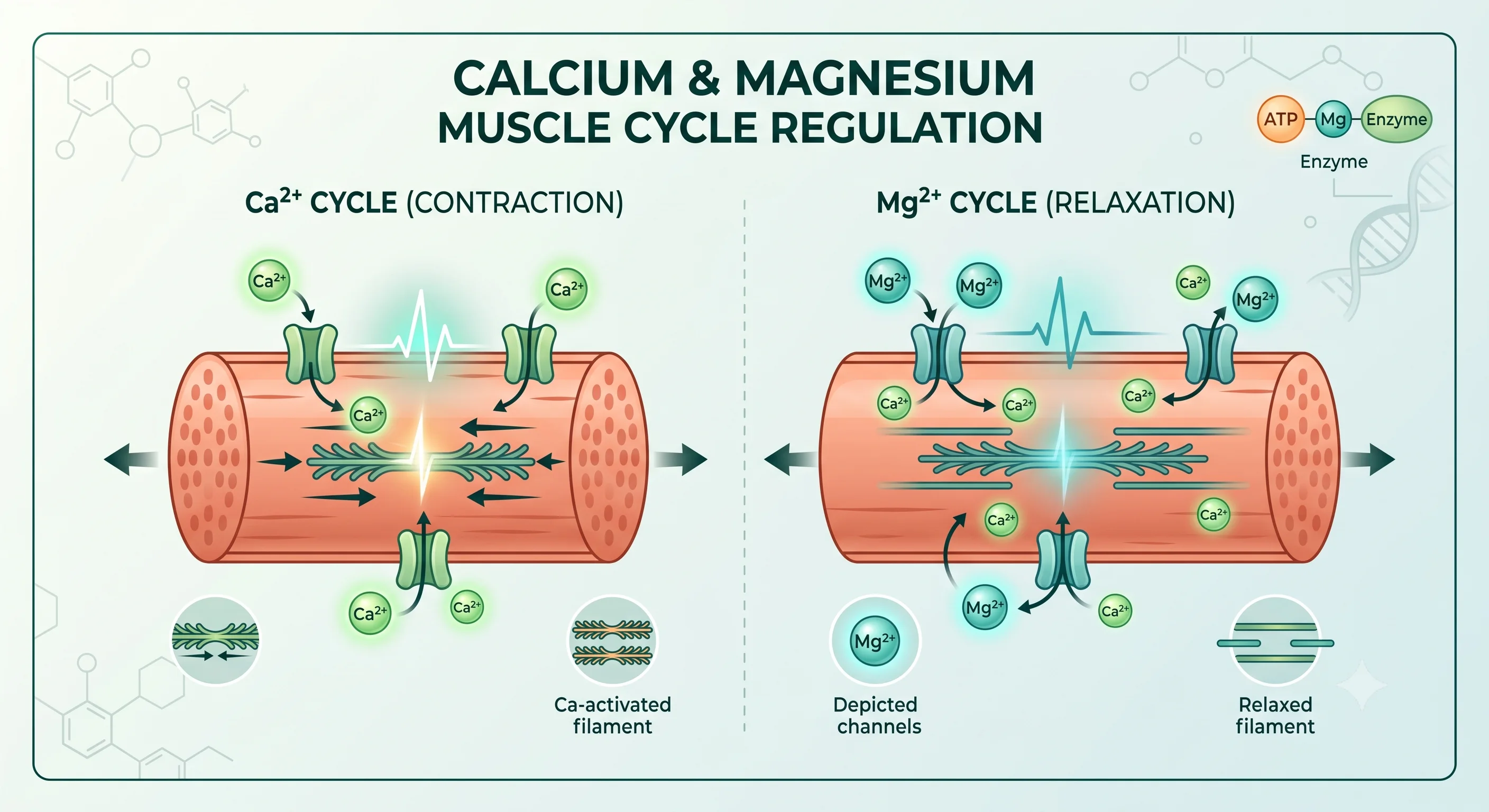
Calcium drives muscle contraction and magnesium counteracts it by regulating calcium entry into cells, which is the basis of magnesium's "relaxation mineral" reputation. The mechanism is sound. Where honesty is needed is the application: systematic reviews of magnesium for nocturnal leg cramps in older adults have concluded it is unlikely to provide meaningful benefit. Results have been somewhat more encouraging for cramps in pregnancy and in some athletes. So magnesium is worth trying for cramps if your intake is low, but it is not the reliable cramp cure it is marketed as.
Sleep and Nervous System
Magnesium modulates NMDA receptor activity and interacts with GABA signalling, the main inhibitory system in the brain — a plausible route to a calming effect. The clinical evidence is thinner than the marketing suggests: trials are small, often in older adults with insomnia, and results are mixed, with reviews generally describing the evidence as low quality. Many people report a subjective benefit, particularly if their intake was inadequate, and the risk is low — but it should be presented as a reasonable thing to try rather than an established sleep aid.
Constipation — the Most Reliable Effect
Magnesium's osmotic effect in the bowel is well established, which is why magnesium oxide, citrate, and hydroxide are used as laxatives. This is the one effect you can count on, and also the reason higher doses cause diarrhoea.
Migraine
Magnesium has moderate supporting evidence for migraine prevention, and it appears in several headache society guidance documents as an option with possible benefit, typically at higher doses than general supplementation and over a period of months. This should be discussed with a physician rather than self-managed at high doses.
Blood Pressure and Metabolic Measures
Meta-analyses report small average reductions in blood pressure with supplementation, more pronounced in people with hypertension or low baseline intake. Observational research consistently associates higher magnesium intake with lower rates of type 2 diabetes and cardiovascular disease, though supplementation trials have shown more modest effects on glucose measures.
Bone Health
Magnesium is a structural component of bone and is involved in vitamin D metabolism and parathyroid hormone regulation. Adequate intake supports bone health as part of the broader picture alongside calcium, vitamin D, protein, and weight-bearing exercise.
What the Evidence Does and Doesn't Show
| Use | Strength of evidence | Notes |
|---|---|---|
| Constipation | Well established | Osmotic effect; dose-dependent |
| Correcting low magnesium status | Well established | Especially with PPIs, diuretics, alcohol use |
| Migraine prevention | Moderate | Higher doses, over months, with medical input |
| Blood pressure | Small average effect | Greater in hypertension / low intake |
| Sleep quality | Limited / low-quality evidence | Plausible, widely reported, not established |
| Nocturnal leg cramps in older adults | Unlikely to help | Reviews largely negative |
3. Shop Smart: How to Choose the Right Magnesium
Step 1: Match the Form to Your Purpose
| Form | Best suited to | Notes |
|---|---|---|
| Glycinate (bisglycinate) | General use, evening, sensitive stomachs | Well absorbed, minimal laxative effect; glycine itself is calming |
| Citrate | General use, mild constipation | Well absorbed; mild laxative effect at higher doses |
| Oxide | Constipation | Cheap, high elemental content, poorly absorbed — useful as a laxative, weak for repletion |
| Malate | General use, daytime | Well tolerated; claims about fatigue are not well established |
| L-threonate | Marketed for cognition | Crosses into brain tissue in animal studies; human evidence preliminary and it is expensive |
| Chloride / lactate | General use | Reasonable absorption |
| Sulfate (Epsom salts) | Baths | Absorption through skin is not well demonstrated; pleasant, not a reliable supplement route |
Step 2: Read the Elemental Amount
Labels sometimes state the weight of the magnesium compound rather than the magnesium itself. Look for elemental magnesium per serving. A practical target is roughly 100–200 mg of elemental magnesium from a supplement alongside a reasonable diet — comfortably within the 350 mg supplemental limit and enough to close a typical dietary gap.
Step 3: Third-Party Testing and Serving Size
Check the serving size, since many products require two or three capsules for the stated amount. Look for USP or NSF verification, and be wary of blends that combine several magnesium forms without disclosing the elemental content of each.
4. Everyday Habits: Getting Magnesium From Food
- Pumpkin seeds and chia: Among the densest sources — a small handful of pumpkin seeds supplies a substantial share of the daily requirement.
- Dark leafy greens: Spinach, chard, and kale. Magnesium sits at the centre of the chlorophyll molecule, which is why green vegetables are reliable sources.
- Nuts and legumes: Almonds, cashews, black beans, and edamame.
- Whole grains: Brown rice, oats, quinoa, and whole-wheat products. Refining strips most of the magnesium, which is a major reason intakes have fallen.
- Dark chocolate: A genuinely good source at 70% cocoa or above — the common craving for chocolate is sometimes attributed to magnesium, though that link is folklore rather than established.
- Mineral water: Some brands contribute meaningfully; check the label if you drink it regularly.
- Reduce what depletes it: Heavy alcohol intake increases urinary magnesium loss substantially, and very high caffeine intake has a mild effect.
5. The Perfect Match: Synergies and Incompatibilities
Nutrients rarely work in isolation, and magnesium both interacts with other minerals and affects the absorption of several common medications.
✅ Combinations That Work Well Together
- Vitamin D: Magnesium is required by the enzymes that convert vitamin D into its active form, so adequate magnesium status supports vitamin D metabolism. A genuine and often overlooked pairing.
- Calcium: The two work as a functional pair in muscle and nerve signalling and both contribute to bone. Note that the frequently quoted "2:1 calcium to magnesium ratio" is a rule of thumb rather than an established requirement — meeting each nutrient's own recommendation matters more than the ratio. Take large doses of each at separate times, since they compete for absorption.
- Vitamin B6: Involved in magnesium transport into cells, and the two are commonly combined in formulas aimed at stress and PMS. Keep B6 well below its 100 mg upper limit.
- Vitamin K2: Frequently combined with magnesium, calcium, and D3 in bone formulas.
❌ Separate These
- Antibiotics — tetracyclines and fluoroquinolones: Magnesium binds them and substantially reduces absorption. Separate by at least 2 hours before or 4–6 hours after, as your pharmacist advises.
- Bisphosphonates (osteoporosis medication): Take at least 2 hours apart.
- Levothyroxine: Magnesium can reduce absorption; separate by at least 4 hours.
- Gabapentin and some other medications: Absorption may be reduced; check with a pharmacist.
- High-dose zinc and iron: Compete for absorption pathways; space them by a couple of hours.
- Diuretics and PPIs: Not a reason to avoid magnesium — rather the opposite, since both increase the likelihood of low magnesium. Worth raising with your prescriber.
6. Dosage, Timing, and Safety
Practical Approach
- Typical supplemental dose: 100–200 mg elemental magnesium daily is sufficient for most people alongside a reasonable diet; stay at or below 350 mg from supplements.
- Timing: With food, to reduce digestive upset. Evening suits those using it for relaxation; there is no strong evidence that timing changes absorption.
- Splitting doses improves absorption and reduces the laxative effect — absorption efficiency falls as the single dose rises.
- Start low and increase if needed, since tolerance to the bowel effect varies widely.
Common Side Effects
Loose stools, diarrhoea, and abdominal cramping are the usual dose-limiting effects, most pronounced with oxide, citrate, and sulfate forms. Switching to glycinate or reducing the dose typically resolves them. Nausea can occur if taken on an empty stomach.
Also check with a healthcare professional before supplementing if you have heart block or a significant arrhythmia, myasthenia gravis, or a bowel obstruction; if you take antibiotics, thyroid medication, bisphosphonates, or diuretics (for timing and monitoring); or if you are considering high-dose magnesium for migraine. Magnesium-containing laxatives and antacids should not be used regularly without medical advice, as this is a common route to unintentionally excessive intake. Seek prompt medical attention for symptoms of excess magnesium: marked drowsiness, confusion, muscle weakness, very low blood pressure, or slow or irregular heartbeat.
7. Frequently Asked Questions
Q. Which form should I buy?
A. Glycinate is the sensible default for general use — well absorbed and gentle on the stomach. Citrate is a good all-rounder, particularly if you also want mild help with regularity. Oxide is best thought of as a laxative rather than a repletion supplement.
Q. Will it help me sleep?
A. It might, particularly if your intake was low, and the risk of trying is minimal. But the clinical evidence is weaker than the marketing implies, so set expectations modestly.
Q. Can I check my level with a blood test?
A. Standard serum magnesium is a poor indicator of total body stores, since less than 1% circulates in blood. Doctors interpret it in clinical context rather than as a screening test for mild deficiency.
Q. Why does it give me diarrhoea?
A. Unabsorbed magnesium draws water into the bowel. Reduce the dose, split it across the day, take it with food, or switch to glycinate.
Q. Do Epsom salt baths count?
A. Absorption of magnesium through intact skin has not been well demonstrated. Baths may be relaxing, but they are not a reliable way to raise magnesium status.
Q. Is magnesium threonate worth the price for brain health?
A. The animal data on brain magnesium are interesting, but human evidence is preliminary and the cost is considerably higher. For most people, a standard well-absorbed form at an adequate dose is the more sensible choice.
8. Conclusion and Precautions
Magnesium is an essential mineral with wide-ranging and well-characterised biochemical roles, and shortfalls are genuinely common because refined diets supply little of it. Correcting an inadequate intake is worthwhile and low-risk, and the evidence is strongest for constipation, for repletion in people on PPIs or diuretics, and reasonably supportive for migraine prevention and blood pressure. Claims around sleep and leg cramps are more popular than proven — worth trying, worth not overselling. Choose a well-absorbed form, keep supplemental intake at or below 350 mg elemental, take it with food, and get food sources into the picture too.
⚠️ Precautions: The FDA has not evaluated magnesium supplements for the treatment of any medical condition, and this article is not medical advice. People with reduced kidney function or kidney disease should not take magnesium supplements without strict medical supervision, as impaired clearance can cause dangerously high blood levels. Do not exceed 350 mg of supplemental elemental magnesium daily without medical direction. Magnesium reduces the absorption of several antibiotics, thyroid medication, and bisphosphonates — separate them. Consult a healthcare professional before use if you have a heart rhythm condition, myasthenia gravis, or take prescription medication.
9. Sources and References
- National Institutes of Health (NIH), ODS — Magnesium Fact Sheet for Health Professionals
https://ods.od.nih.gov/factsheets/Magnesium-HealthProfessional/ - Linus Pauling Institute, Oregon State University — Micronutrient Information Center: Magnesium
https://lpi.oregonstate.edu - Harvard T.H. Chan School of Public Health, The Nutrition Source — Magnesium
https://www.hsph.harvard.edu - Mayo Clinic — Magnesium supplements: Uses and risks
https://www.mayoclinic.org - Cleveland Clinic — Magnesium: Benefits and sources
https://my.clevelandclinic.org - Sleep Foundation — Magnesium and Sleep
https://www.sleepfoundation.org
© 2026 Healing-Finder. All rights reserved.