The Complete Vitamin K Guide: Coagulation, Bone-Artery Regulation, and Synergies
1. What Vitamin K Does and Why There Are Two Kinds
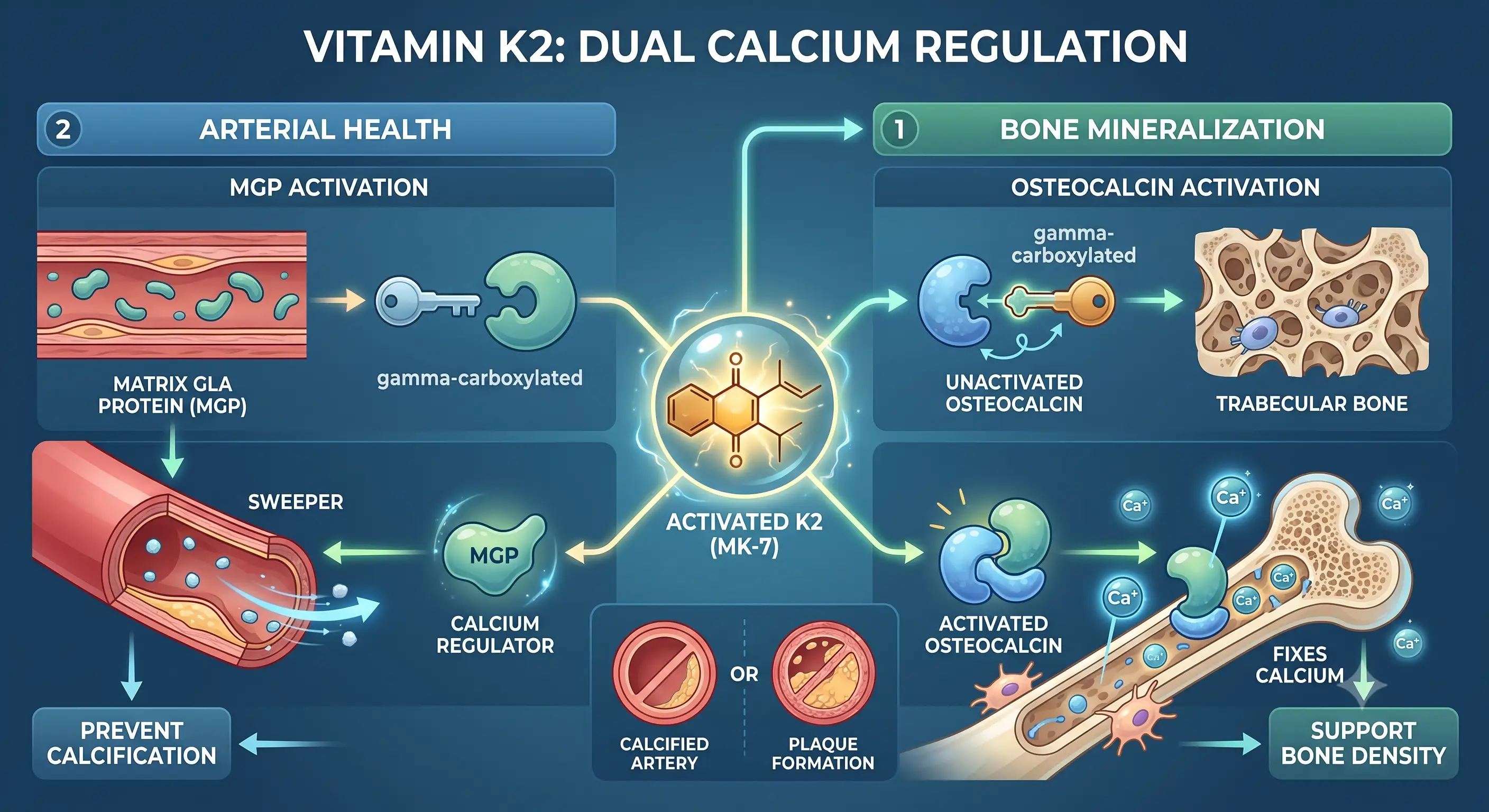
Vitamin K is a group of fat-soluble compounds whose shared function is to activate a family of proteins known as Gla proteins, through a chemical modification called gamma-carboxylation. Without vitamin K, these proteins are produced but remain inactive and cannot bind calcium[1].
The best-known Gla proteins are the clotting factors — hence vitamin K's name, from the German Koagulation. But the same mechanism activates osteocalcin in bone and matrix Gla protein (MGP) in blood vessel walls, which is the basis of the more recent research interest.
The Two Families
- Vitamin K1 (phylloquinone): From leafy greens and vegetable oils; the dominant dietary form, making up most of typical intake. Taken up preferentially by the liver, where clotting factors are made.
- Vitamin K2 (menaquinones, MK-4 to MK-13): From fermented foods, some animal products, and gut bacteria. Distributed more widely to bone and vascular tissue, with a longer circulating half-life for the longer-chain forms such as MK-7.
Intake Reference Values
| Group | Adequate Intake | Upper limit |
|---|---|---|
| Adult men | 120 mcg/day | None established |
| Adult women | 90 mcg/day | None established |
| Children | Lower by age | None established |
2. A Deep Dive Into Vitamin K's Studied Effects
Blood Coagulation — the Established Role
Vitamin K activates clotting factors II, VII, IX, and X. This function is not in dispute and is the basis of both its name and its most important clinical interaction. Deficiency causes impaired clotting and easy bleeding, and it is why warfarin — which blocks vitamin K recycling — works as an anticoagulant at all.
Bone Mineralisation
Vitamin K activates osteocalcin, which binds calcium into the bone matrix. Undercarboxylated osteocalcin — the inactive form that accumulates when vitamin K is insufficient — has been associated with lower bone density and higher fracture risk in observational studies. In Japan, high-dose MK-4 is approved as a pharmaceutical treatment for osteoporosis, based largely on Japanese trial data.
Being accurate about the wider picture: trials of vitamin K supplementation for fracture prevention in Western populations have produced mixed and largely unconvincing results, and it is not part of standard osteoporosis guidance outside Japan. The mechanism is sound; the outcome evidence is not settled.
Arterial Calcification
Matrix Gla protein, when activated by vitamin K, inhibits calcium deposition in blood vessel walls — a well-described mechanism, and the origin of the popular "traffic cop" description. Observational research has associated higher K2 intake with less arterial calcification. However, several randomized trials specifically testing vitamin K supplementation to slow arterial or aortic valve calcification, including in kidney disease populations, have not shown the benefit that the mechanism predicted. This remains an active research question rather than an established use, and the "directs calcium into bones and away from arteries" framing overstates what has been demonstrated in people.
Deficiency and Who Is at Risk
Clinically significant deficiency is uncommon in healthy adults eating a normal diet. Risk rises with fat malabsorption (celiac disease, Crohn's, cystic fibrosis, cholestatic liver disease), prolonged broad-spectrum antibiotic use, bariatric surgery, and certain medications. Newborns are a special case, covered in Section 6.
What the Evidence Does and Doesn't Show
| Use | Strength of evidence | Notes |
|---|---|---|
| Blood clotting | Definitive | Core function |
| Newborn VKDB prevention (medical prophylaxis) | Definitive | Given by injection at birth |
| Osteocalcin activation | Well established | Biochemical marker |
| Fracture prevention | Mixed / unconvincing outside Japan | MK-4 is a drug there, not a supplement |
| Slowing arterial calcification | Mechanism sound; trials largely negative | Active research question |
3. Shop Smart: How to Choose the Right Form
Step 1: K1, MK-4, or MK-7
- Vitamin K1 (phylloquinone): Abundant in food; supplements are rarely necessary if you eat leafy greens.
- MK-4: Short half-life of only a few hours, so the pharmaceutical Japanese protocols use very high doses several times daily. Low-dose MK-4 supplements do not replicate that.
- MK-7: Half-life of around three days, so once-daily dosing maintains steadier blood levels. This is the form most supplement research has used and the more practical choice. Typical supplemental doses are 90–180 mcg.
Step 2: Trans vs. Cis Isomer
Only the all-trans form of MK-7 is biologically active. Some cheaper synthetic material contains a significant proportion of the inactive cis isomer. Quality products state "all-trans MK-7" or specify a minimum trans content — worth checking, as it is one of the few genuinely meaningful label details in this category.
Step 3: The D3 + K2 Question
Combined D3/K2 products are popular and the rationale is coherent: vitamin D increases calcium absorption, vitamin K activates the proteins that handle it. It is a reasonable, well-tolerated combination. It should be described as biologically sensible rather than as an established requirement, since outcome trials have not confirmed the added benefit. And if you take warfarin, a combination product is a hidden vitamin K source — read labels carefully.
4. Everyday Habits: Dietary Sources
- Natto: Japanese fermented soybeans are by far the richest known source of MK-7, containing far more than any other common food. Populations with high natto consumption are the basis for much of the observational K2 research.
- Dark leafy greens (K1): Kale, spinach, collard greens, Swiss chard, and broccoli. A single serving can exceed the daily adequate intake several times over.
- Fermented and animal foods (K2): Hard and aged cheeses, egg yolk, butter from pasture-raised animals, liver, and fermented vegetables provide MK-4 and shorter-chain menaquinones.
- Take with fat: Vitamin K is fat-soluble — dressing on your salad genuinely improves absorption, and vitamin K from vegetables is absorbed relatively poorly without it.
- Gut bacteria contribute some menaquinones, though how much reaches circulation is uncertain — which is one reason prolonged broad-spectrum antibiotics can affect vitamin K status.
5. The Perfect Match: Synergies and Incompatibilities
Nutrients rarely work in isolation, and vitamin K sits within the fat-soluble vitamin and bone mineral group.
✅ Combinations That Work Well Together
- Vitamin D3: D increases calcium absorption; K activates the proteins that direct its handling. Mechanistically complementary and commonly combined.
- Calcium and Magnesium: The other components of bone mineral metabolism. Adequacy of each matters more than any specific ratio.
- Dietary fat: Required for absorption of all forms.
- Adequate protein and weight-bearing exercise: Not supplements, but the elements of bone health with the strongest evidence — worth stating alongside any bone-focused nutrient.
❌ Requiring Care
- Warfarin and other vitamin K antagonists: The critical interaction — see the warning below.
- Broad-spectrum antibiotics: Prolonged courses reduce gut bacterial menaquinone production and can lower vitamin K status.
- Orlistat, bile acid sequestrants, and mineral oil: Reduce absorption of fat-soluble vitamins.
- High-dose vitamin E: Can interfere with vitamin K-dependent clotting factor activity, compounding bleeding risk.
- Before surgery: Inform your surgical team of all supplements, including any D3/K2 combination.
6. Dosage and Safety
Typical Doses
- Adequate Intake: 120 mcg (men) / 90 mcg (women) daily, readily met by a serving of leafy greens.
- MK-7 supplements: Commonly 90–180 mcg daily, taken with a fat-containing meal.
- No upper limit has been established, and toxicity from K1 and K2 has not been documented in people not on anticoagulants.
The correct approach is a steady, consistent daily vitamin K intake, so that your warfarin dose can be calibrated to it. Do not start, stop, or change the dose of a vitamin K supplement — including any D3/K2 combination product — without telling the clinician who manages your anticoagulation, and expect INR monitoring around any change. This applies to warfarin and similar vitamin K antagonists; the newer direct oral anticoagulants (apixaban, rivaroxaban, and others) do not work through vitamin K and are not affected in the same way, though you should still inform your physician.
Other Cautions
- Pregnancy and breastfeeding: Dietary amounts are fine; discuss supplements with your provider.
- Kidney disease and dialysis: Vitamin K status is often altered; supplementation should be medically supervised.
- Liver disease and fat malabsorption: Deficiency is more likely and warrants medical assessment rather than self-treatment.
- Menadione (vitamin K3): A synthetic form no longer used in human supplements because of toxicity concerns. Avoid any product containing it.
7. Frequently Asked Questions
Q. I take warfarin. Should I avoid leafy greens?
A. No — this is the most common and most harmful misunderstanding. Aim for a consistent intake day to day so your dose can be matched to it, and discuss any change with your anticoagulation clinic.
Q. Do I need a K2 supplement with my vitamin D?
A. The rationale is sound and the combination is well tolerated, but trials have not confirmed the added benefit. It is a reasonable option rather than a requirement — and not appropriate without medical advice if you take warfarin.
Q. MK-4 or MK-7?
A. MK-7 for supplements, because its long half-life supports once-daily dosing. The Japanese MK-4 osteoporosis protocols use pharmaceutical doses many times higher than supplement products and are not comparable.
Q. Can I get enough from food?
A. For K1, easily — one serving of kale or spinach covers it. For K2, natto is by far the richest source; otherwise aged cheese, egg yolk, and fermented foods contribute modestly.
Q. Is there a risk of taking too much?
A. No upper limit has been established and toxicity has not been documented in people not on anticoagulants. The risk in this category is entirely about the warfarin interaction, not about the nutrient itself.
8. Conclusion and Precautions
Vitamin K's role in activating calcium-binding proteins is well established, and its function in blood clotting is beyond question. The bone and arterial applications rest on an elegant and genuinely well-described mechanism — but the trials designed to confirm the clinical payoff have so far been mixed for bone and largely negative for arterial calcification, so the popular "directs calcium into bones, away from arteries" claim runs ahead of the human evidence. Vitamin K is safe, easy to obtain from leafy greens and fermented foods, and a reasonable supplement in MK-7 form for those who want it. The one thing that genuinely demands care is anticoagulant therapy.
⚠️ Precautions: The FDA has not evaluated vitamin K supplements for the treatment of any medical condition, and this article is not medical advice. If you take warfarin or another vitamin K antagonist, do not start, stop, or change a vitamin K supplement without consulting the clinician managing your anticoagulation — and do not avoid vitamin K foods, but keep your intake consistent. Check combination D3/K2 products, which are an easily overlooked source. Newborn vitamin K prophylaxis is a medical matter for your paediatric team. Consult a healthcare professional before supplementing if you have kidney or liver disease or a fat malabsorption condition.
9. Sources and References
- National Institutes of Health (NIH), ODS — Vitamin K Fact Sheet for Health Professionals
https://ods.od.nih.gov/factsheets/VitaminK-HealthProfessional/ - Mayo Clinic — Vitamin K: Benefits, sources, and interactions
https://www.mayoclinic.org - Harvard T.H. Chan School of Public Health, The Nutrition Source — Vitamin K
https://www.hsph.harvard.edu - Cleveland Clinic — Vitamin K and Vitamin K2
https://my.clevelandclinic.org - Linus Pauling Institute, Oregon State University — Micronutrient Information Center: Vitamin K
https://lpi.oregonstate.edu - Centers for Disease Control and Prevention (CDC) — Vitamin K deficiency bleeding in newborns
https://www.cdc.gov
© 2026 Healing-Finder. All rights reserved.