The Complete Vitamin D Guide: Bone Health, Blood Levels, and Synergies
1. Why Vitamin D Is Unusual Among Vitamins
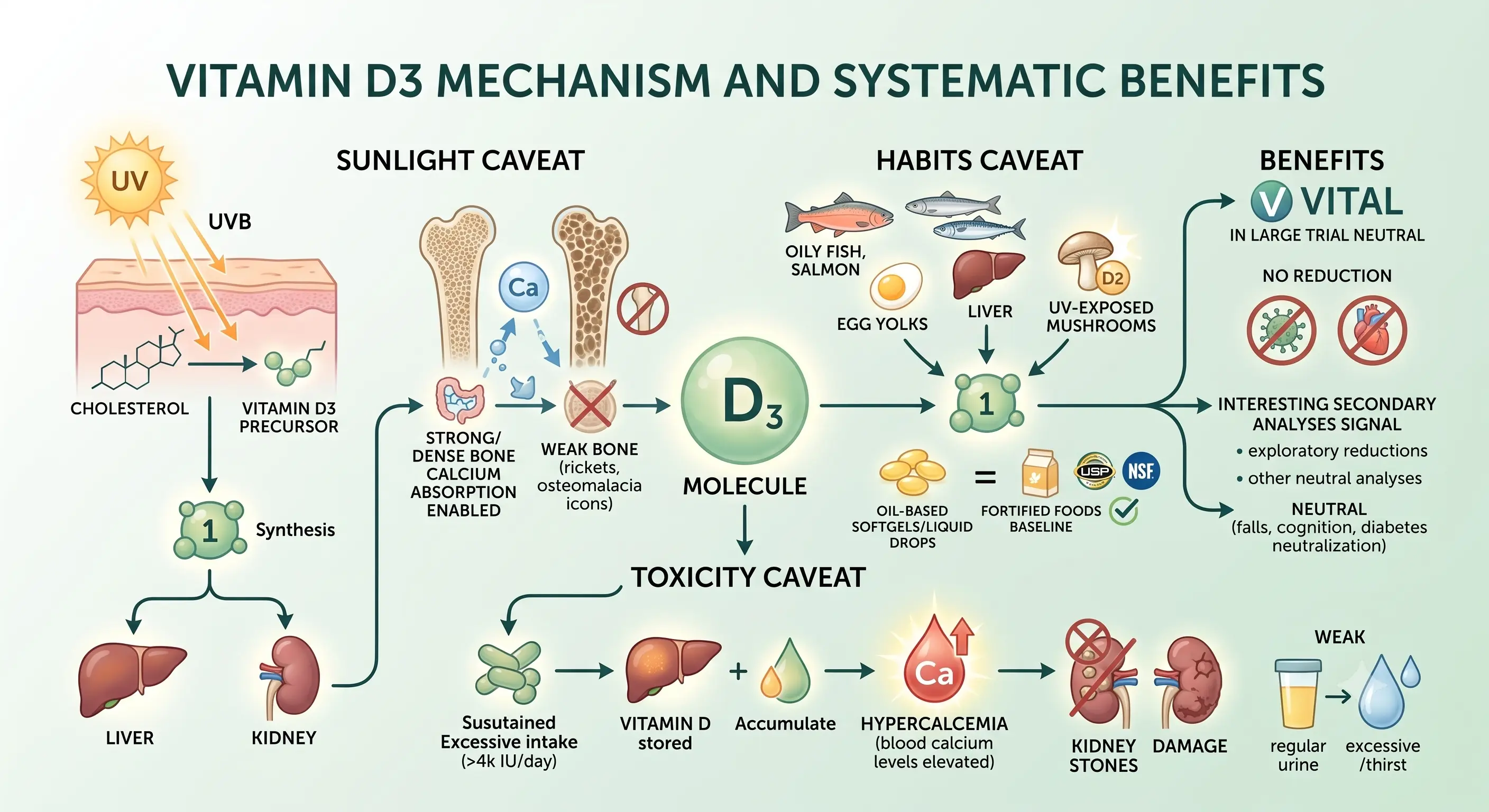
Vitamin D behaves more like a hormone than a vitamin. The skin synthesises it from cholesterol on exposure to UVB radiation, the liver converts it to 25-hydroxyvitamin D — the form measured in blood tests — and the kidneys activate it to calcitriol, which binds receptors found in tissues throughout the body[1].
Because synthesis depends on sunlight, status varies enormously by latitude, season, skin pigmentation, age, clothing, and how much time you spend indoors. Above roughly 35 degrees latitude, skin synthesis is negligible through the winter months. Low levels are common in office-based populations and in older adults, whose skin produces less efficiently — though "common" is not the same as the universal crisis the term "epidemic" implies, and how low is too low is genuinely debated.
Requirements and Blood Levels
| Group / measure | Value |
|---|---|
| RDA, adults 19–70 | 600 IU (15 mcg)/day |
| RDA, adults 71+ | 800 IU (20 mcg)/day |
| Upper limit, adults | 4,000 IU (100 mcg)/day |
| Blood level considered adequate for most | 20 ng/mL (50 nmol/L) or above |
| Deficiency | Below 12 ng/mL (30 nmol/L) |
| Potentially harmful | Above roughly 50 ng/mL (125 nmol/L) |
This does not mean vitamin D stopped mattering. It reflects that large trials testing supplementation in already-replete people mostly came back neutral, and that routine testing in healthy adults changes management less often than assumed. If you have a clinical reason — malabsorption, osteoporosis, limited sun exposure, dark skin at high latitude, or a relevant medication — testing and supplementation still make sense, guided by your physician.
2. A Deep Dive Into Vitamin D's Studied Effects
Bone Health and Calcium Absorption — the Established Role
This is where the evidence is strongest and least contested. Vitamin D enables intestinal calcium absorption; without it, only a small fraction of dietary calcium is taken up regardless of how much you consume. Severe deficiency causes rickets in children and osteomalacia in adults — diseases that vitamin D definitively prevents and treats.
For fracture prevention in older adults, vitamin D combined with calcium has shown modest benefit, particularly in institutionalised or deficient populations. Vitamin D alone, in people who are already replete, has generally not reduced fractures in large trials — an honest distinction that explains much of the apparent inconsistency in headlines.
Immune Function
Vitamin D receptors are present on immune cells, and it influences both innate and adaptive immune responses. Observational studies consistently associate low levels with more frequent respiratory infections. Supplementation trials have produced mixed results, with some meta-analyses suggesting a small protective effect against acute respiratory infection that is largest in people who were deficient to begin with — again, correcting a deficit rather than enhancing a normal state.
What the Large Trials Found
It is worth reporting this plainly. The VITAL trial randomised over 25,000 adults to 2,000 IU of vitamin D daily and found no reduction in cancer incidence or major cardiovascular events over about five years. Secondary and follow-up analyses have suggested possible reductions in cancer mortality and in the incidence of autoimmune disease, which are interesting but exploratory. Similar large trials on falls, cognition, and diabetes prevention have been largely neutral in replete populations, with a signal for progression from prediabetes to diabetes in some analyses.
Mood
Low vitamin D levels have been correlated with seasonal mood changes and depressive symptoms in observational research. Supplementation trials for mood have been inconsistent, and it remains unclear whether low levels are a cause or simply a marker of less time outdoors. Vitamin D is not a treatment for depression, and persistent low mood warrants professional assessment.
What the Evidence Does and Doesn't Show
| Use | Strength of evidence | Notes |
|---|---|---|
| Preventing/treating rickets and osteomalacia | Definitive | — |
| Calcium absorption | Definitive | Core physiological role |
| Fracture reduction (with calcium, in deficient/older adults) | Modest | Alone in replete people: not shown |
| Respiratory infection | Small, mainly in the deficient | Mixed trial results |
| Cancer or cardiovascular prevention | Not supported | VITAL primary endpoints neutral |
| Depression treatment | Not established | Correlation, not demonstrated effect |
3. Shop Smart: How to Choose the Right Vitamin D
Step 1: D3 Over D2
- Vitamin D2 (ergocalciferol): Plant- or fungus-derived. Raises blood 25(OH)D less effectively and with a shorter duration of effect.
- Vitamin D3 (cholecalciferol): The form the skin produces, typically from lanolin or fish oil. More effective at raising and maintaining blood levels, and the sensible default. Vegan D3 derived from lichen is available for those who need it.
Step 2: Oil-Based Softgels and Taking It With Fat
Vitamin D is fat-soluble, and absorption improves substantially when taken with a meal containing fat. Oil-based softgels or liquid drops generally outperform dry tablets, and taking your dose with the largest meal of the day is a simple, evidence-supported habit.
Step 3: Sensible Strength and Verification
Products range from 400 IU to 50,000 IU. High-strength weekly or monthly products exist for medically supervised repletion and are not appropriate for casual daily use. For general supplementation, 1,000–2,000 IU daily covers most people. Look for USP or NSF verification — independent testing has found meaningful discrepancies between labelled and actual vitamin D content, in both directions.
4. Everyday Habits: Sunlight and Food
- Sun exposure — with an honest caveat: Short midday exposure of arms and legs, on the order of 10–20 minutes for lighter skin and considerably longer for darker skin, can generate meaningful vitamin D in summer months. However, dermatology organisations do not recommend UV exposure as a vitamin D strategy, because UV radiation is a known carcinogen and there is no exposure level that raises vitamin D without also raising skin cancer risk. Diet and supplements achieve the same result without that trade-off. Tanning beds are not an acceptable route under any framing.
- Oily fish: Salmon, mackerel, sardines, and herring are the richest natural food sources.
- Egg yolks, liver, and UV-exposed mushrooms: Modest contributors; mushrooms exposed to UV light provide D2.
- Fortified foods: Milk, plant milks, and cereals are fortified in many countries and contribute a meaningful baseline.
- Realistic expectation: Very few diets supply 600–800 IU daily from food alone without oily fish several times a week — which is why supplementation is a reasonable option in low-sunlight seasons.
5. The Perfect Match: Synergies and Incompatibilities
Nutrients rarely work in isolation, and vitamin D sits at the centre of a genuinely interdependent group.
✅ Combinations That Work Well Together
- Magnesium: Required by the enzymes that convert vitamin D to its active form, so magnesium status genuinely affects vitamin D metabolism. An often-overlooked and well-founded pairing.
- Calcium: The pairing with the best fracture-prevention evidence in older adults. Neither works well for bone without the other.
- Vitamin K2: K2 activates proteins that bind calcium into bone and inhibit soft-tissue calcification, which is the biochemical rationale for combined D3/K2 products. The mechanism is well described; clinical outcome evidence for the combination is still limited, so treat it as a sensible option rather than a requirement — and note K2 interacts with warfarin.
- Dietary fat: The simplest and most reliable way to improve absorption.
❌ Requiring Caution
- Thiazide diuretics: Reduce urinary calcium excretion; combined with vitamin D and calcium, this raises the risk of hypercalcemia. Monitoring is advisable.
- Digoxin: Hypercalcemia from excess vitamin D increases the risk of digoxin toxicity.
- Orlistat, bile acid sequestrants, and mineral oil: Reduce absorption of fat-soluble vitamins; separate dosing.
- Corticosteroids, some anticonvulsants, and certain HIV medications: Alter vitamin D metabolism; discuss dosing with your physician.
- Statins: Interaction has been suggested in both directions; mention your supplement use.
6. Dosage, Testing, and Safety
Practical Approach
- General supplementation: 1,000–2,000 IU daily covers most adults comfortably and sits well within the upper limit.
- Do not exceed 4,000 IU/day from all sources without medical direction. Higher doses belong to supervised repletion protocols with monitoring.
- Timing: With the largest fat-containing meal. Daily dosing is generally preferred to large intermittent doses — some trials of very high monthly or annual doses reported increased falls and fractures.
- Testing: Not routinely recommended for generally healthy adults, but appropriate if you have osteoporosis, malabsorption, chronic kidney or liver disease, take interacting medications, or have symptoms suggesting deficiency.
Consult a healthcare professional before supplementing if you have: hyperparathyroidism; sarcoidosis, tuberculosis, or another granulomatous disease (these convert vitamin D abnormally and can cause hypercalcemia at ordinary doses); kidney disease or a history of kidney stones; or if you take thiazide diuretics or digoxin. Seek medical attention for persistent nausea, unusual thirst, frequent urination, or confusion while taking vitamin D.
7. Frequently Asked Questions
Q. Should I get my vitamin D level tested?
A. Recent guidance recommends against routine testing in generally healthy adults, because it rarely changes management. If you have osteoporosis, malabsorption, kidney or liver disease, very limited sun exposure, or take interacting medication, testing is reasonable — discuss it with your doctor.
Q. How much should I take?
A. For most adults, 1,000–2,000 IU daily is a sensible range that covers the RDA with margin and stays well below the 4,000 IU limit. Higher doses should be medically directed.
Q. Can I just get it from the sun?
A. In summer at lower latitudes, partly. But skin synthesis is negligible in winter above about 35 degrees latitude, and dermatology guidance does not endorse UV exposure as a vitamin D strategy because of skin cancer risk. Supplements achieve the same result without it.
Q. Does vitamin D prevent cancer or heart disease?
A. The large VITAL trial found no reduction in cancer incidence or major cardiovascular events. Some secondary analyses are interesting, but supplementation should not be taken for these purposes.
Q. Do I need K2 with my D3?
A. The biochemical rationale is sound and it is generally well tolerated, but outcome evidence for the combination remains limited. It is a reasonable option rather than a necessity — and avoid it without medical advice if you take warfarin.
8. Conclusion and Precautions
Vitamin D's core role — enabling calcium absorption and maintaining bone — is among the best-established facts in nutrition, and correcting genuine deficiency matters. What has changed is the expansive framing: large trials testing supplementation for cancer, cardiovascular disease, and other outcomes in already-replete people came back largely neutral, and guidance has moved toward less routine testing and more modest dosing. A daily oil-based D3 supplement at 1,000–2,000 IU, taken with food, is a sensible and low-risk approach for most people in low-sunlight climates — with testing and higher doses reserved for those with an actual clinical reason.
⚠️ Precautions: The FDA has not evaluated vitamin D supplements for the treatment of any medical condition, and this article is not medical advice. Do not exceed 4,000 IU per day from all sources without medical direction — vitamin D is stored in tissue and excessive intake causes hypercalcemia, which can damage the kidneys and heart. Consult a healthcare professional before supplementing if you have hyperparathyroidism, sarcoidosis or another granulomatous condition, kidney disease or kidney stones, or if you take thiazide diuretics or digoxin. Sun exposure is not recommended as a vitamin D strategy because of skin cancer risk.
9. Sources and References
- National Institutes of Health (NIH), ODS — Vitamin D Fact Sheet for Health Professionals
https://ods.od.nih.gov/factsheets/VitaminD-HealthProfessional/ - The Endocrine Society — Vitamin D for the Prevention of Disease: Clinical Practice Guideline (2024)
https://www.endocrine.org - Harvard T.H. Chan School of Public Health, The Nutrition Source — Vitamin D
https://www.hsph.harvard.edu - Mayo Clinic — Vitamin D toxicity
https://www.mayoclinic.org - Cleveland Clinic — Vitamin D deficiency
https://my.clevelandclinic.org - Linus Pauling Institute, Oregon State University — Micronutrient Information Center: Vitamin D
https://lpi.oregonstate.edu
© 2026 Healing-Finder. All rights reserved.