The Complete L-Theanine Guide: Alpha Brain Waves, Calm Focus, and Synergies
1. What L-Theanine Is and How It Works
L-Theanine (γ-glutamylethylamide) is an amino acid found almost exclusively in tea leaves (Camellia sinensis) and in one species of mushroom. It is not a protein-building amino acid and is not essential — the body has no requirement for it — which makes it a functional compound rather than a nutrient[1].
Structurally it resembles glutamate and glutamine, and it crosses the blood-brain barrier. Proposed mechanisms include weak binding at glutamate receptors, modulation of GABA and glycine signalling, and effects on dopamine and serotonin levels. Its most consistently observed effect in humans is on brain wave patterns, described in the next section.
2. A Deep Dive Into L-Theanine's Studied Effects
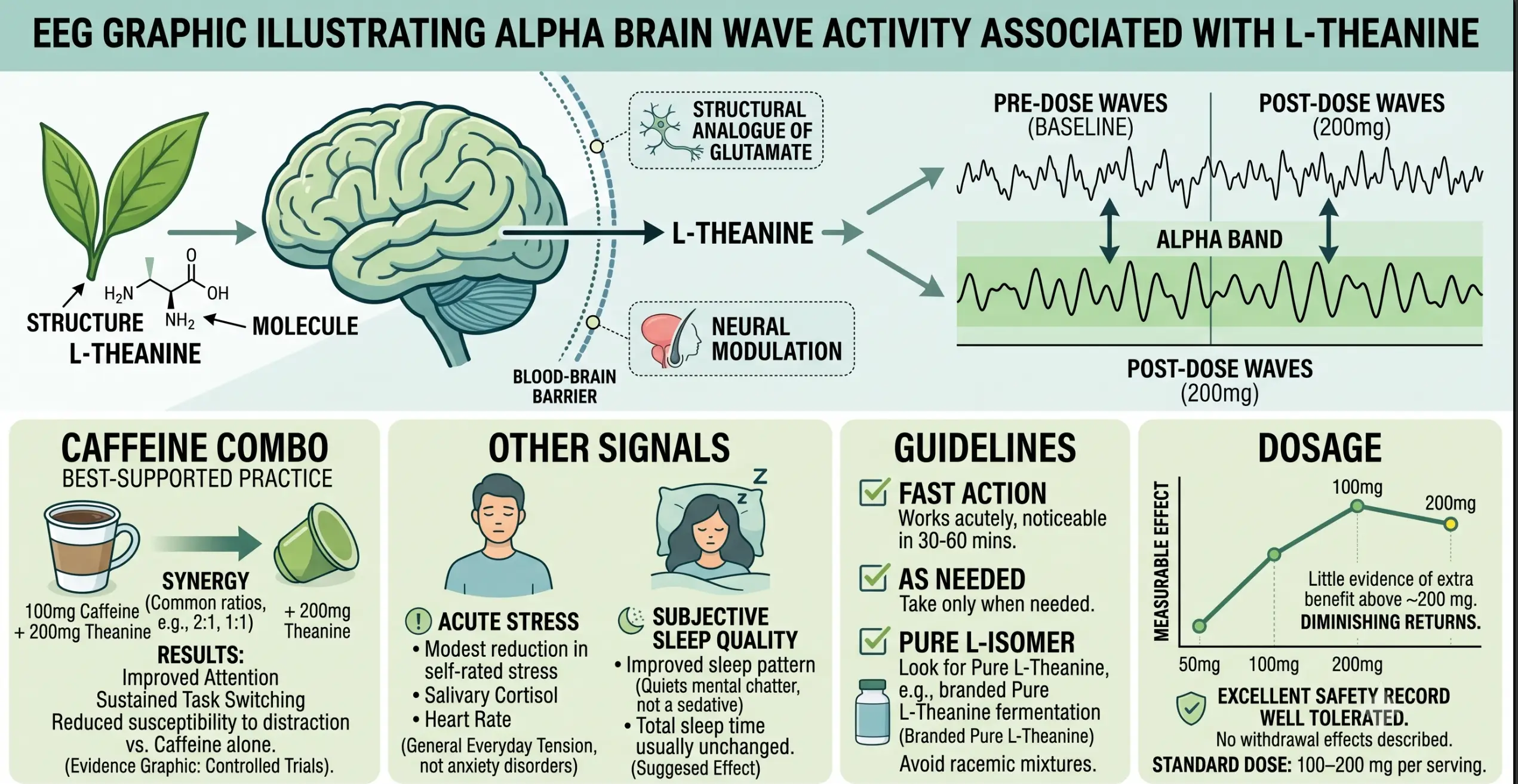
Alpha Brain Wave Activity
This is the most reproducible finding. Human EEG studies report that L-theanine increases activity in the alpha frequency band — the pattern associated with relaxed but alert wakefulness — and that it does so without inducing drowsiness[1]. Effects have been observed within roughly 30 to 60 minutes of a single dose, with a dose-dependent response across the 50–200 mg range.
Worth keeping in perspective: an alpha wave increase is a measurable neurophysiological change, not automatically a meaningful subjective benefit. It is the mechanism, not the outcome.
The Caffeine Combination — the Best-Supported Use
Several controlled trials have examined L-theanine together with caffeine on attention and cognitive task performance, generally reporting improvements in sustained attention, task switching, and reduced susceptibility to distraction relative to caffeine alone, along with less of the jitteriness caffeine can produce. If there is one use with reasonably consistent supporting evidence, this is it. Common ratios are 1:1 or 2:1 theanine to caffeine — for example 100–200 mg of theanine with 100 mg of caffeine.
Acute Stress and Everyday Tension
Small randomized trials in healthy adults have reported reductions in self-rated stress and, in some studies, in salivary cortisol or heart rate during a stressful task. Effects are modest and trials are small, but the safety profile means the risk-to-benefit calculation is favourable for people who want to try it around a presentation or a tense situation. This is general everyday tension — L-theanine is not a treatment for anxiety disorders, and diagnosed anxiety should be discussed with a physician or mental health professional.
Sleep Quality
Some studies report improved subjective sleep quality, though generally without increasing total sleep time — the pattern suggests reduced pre-sleep arousal rather than a sedative effect. Because L-theanine is not a hypnotic and does not cause next-day grogginess in most people, it is often used as a gentle option. The evidence base is preliminary.
Cognition on Its Own
Taken alone, without caffeine, evidence for improved memory or cognitive performance is limited and inconsistent, with some studies in middle-aged and older adults reporting modest gains on specific measures.
What the Evidence Does and Doesn't Show
| Use | Strength of evidence | Notes |
|---|---|---|
| Increasing alpha wave activity | Well replicated | Mechanism; measurable within 30–60 min |
| With caffeine, for attention and reduced jitters | Moderate | The best-supported practical use |
| Acute stress and tension | Modest / preliminary | Small trials; not for diagnosed anxiety |
| Subjective sleep quality | Preliminary | Not a sedative; total sleep time usually unchanged |
| Cognition without caffeine | Limited | Inconsistent findings |
3. Shop Smart: How to Choose the Right Theanine
Step 1: Confirm It Is the L-Isomer
Only the L-isomer is biologically relevant. Cheaper synthetic production can yield a racemic mixture (a blend of L- and D-theanine), which delivers less active material per milligram. Labels should say "L-theanine" rather than simply "theanine." Suntheanine is a well-known branded, fermentation-produced pure L-theanine used in much of the published research — a reasonable choice, though not the only acceptable one.
Step 2: Powder vs. Capsules
L-theanine has a mildly sweet, savoury taste and dissolves readily in water or tea, so powder and capsules are both practical. Powder makes it easier to adjust the dose; capsules are more convenient. There is no meaningful absorption difference.
Step 3: Watch the Rest of the Formula
Many "calm" and "focus" products combine L-theanine with caffeine, other botanicals, or melatonin. If you are pairing it with your own coffee, check whether the product already contains caffeine. Look for third-party verification (USP, NSF), and avoid proprietary blends that do not disclose the theanine amount.
4. Everyday Habits: Natural Sources and Timing
- Green tea and matcha: Matcha delivers more theanine than brewed green tea because the whole leaf is consumed. Shade-grown Japanese teas contain the highest natural levels. Enjoyable and healthy — just not equivalent to a supplement dose.
- Timing for focus: Taken with or shortly before your morning coffee, at roughly 1:1 or 2:1 with the caffeine dose. Effects are noticeable within about 30–60 minutes.
- Timing for wind-down: 30–60 minutes before bed. Because it is not sedating, it works better for quieting mental chatter than for producing sleepiness.
- It is not cumulative: Unlike adaptogens, L-theanine acts acutely — you do not need to build it up over weeks, and taking it only when useful is a perfectly reasonable pattern.
- The bigger levers: Total caffeine intake and its timing, sleep regularity, and daylight exposure affect focus and calm far more than any supplement. L-theanine is best used to smooth the edges of a routine that already works.
5. The Perfect Match: Synergies and Incompatibilities
Nutrients rarely work in isolation, and L-theanine is unusual in that its best-evidenced use is a combination.
✅ Combinations That Work Well Together
- Caffeine: The pairing with the most supporting research. Caffeine provides alertness while theanine appears to reduce the associated jitteriness and blood pressure response. A 1:1 or 2:1 theanine-to-caffeine ratio is the usual approach.
- Magnesium: Frequently combined in evening formulas. Note that the clinical evidence for magnesium and sleep is itself limited, so this is a sensible low-risk pairing rather than a proven one.
- B-Complex Vitamins: Support normal nervous system function and are often depleted alongside sustained stress.
- Glycine: Another amino acid studied for sleep onset and subjective sleep quality; sometimes combined, with a similarly preliminary evidence base.
❌ Requiring Caution
- Blood pressure medication: L-theanine may modestly lower blood pressure. If you take antihypertensives, monitor and mention it to your physician.
- Sedatives, sleep medication, and alcohol: Additive drowsiness is possible in sensitive individuals, even though theanine is not itself sedating.
- Stimulant medication: If you take prescription stimulants, discuss adding theanine with your prescriber rather than self-adjusting.
- Before surgery: Stop as your surgical team advises, given possible blood pressure effects.
6. Dosage, Timing, and Safety
Typical Ranges
- Standard dose: 100–200 mg per serving is the most studied and most commonly used range. Effects on alpha activity have been reported from around 50 mg upward, with diminishing returns above roughly 200 mg.
- Higher doses: Studies have used up to 400 mg daily. There is little evidence that going higher adds benefit.
- Timing: Acute — take it when you want the effect, with or without food.
Tolerability
L-theanine has an excellent safety record and is generally very well tolerated, with few reported side effects. Occasional reports include headache, mild dizziness, or gastrointestinal upset. It is not known to be habit-forming and no withdrawal syndrome has been described.
Persistent anxiety, panic symptoms, or insomnia that affects your daily functioning deserves proper assessment. L-theanine is a mild, short-acting supplement — using it to manage a problem that needs treatment can delay effective care.
7. Frequently Asked Questions
Q. Can I just drink green tea instead?
A. Green tea is a healthy habit, but a cup contains only around 6–8 mg of theanine versus the 100–200 mg used in studies. You would need an impractical number of cups — and a great deal of caffeine with them.
Q. Will it make me drowsy at work?
A. Generally no — the defining feature in EEG research is relaxation without sedation. A minority of people do report mild drowsiness, so try it on a low-stakes day first.
Q. How much should I take with my coffee?
A. Roughly 100–200 mg of theanine per 100 mg of caffeine is the range used in the combination research.
Q. Do I need to take it every day?
A. No. It acts acutely rather than accumulating, so taking it only when you want the effect is entirely reasonable.
Q. Is it addictive?
A. It is not known to be habit-forming, and no withdrawal effects have been described in the literature.
8. Conclusion and Precautions
L-theanine is one of the more straightforward entries in this category: a well-tolerated compound with a reproducible, measurable effect on brain wave activity, a genuinely useful pairing with caffeine, and modest supporting evidence for everyday tension and subjective sleep quality. It works acutely, does not need building up, and carries very little risk. The honest limits are that the effects are subtle, that it is not a treatment for anxiety or insomnia, and that tea alone will not deliver the studied dose.
⚠️ Precautions: The FDA has not evaluated L-theanine for the treatment of any medical condition, and this article is not medical advice. Generally well tolerated, with studied doses of 100–200 mg per serving. It may modestly lower blood pressure — consult your physician if you take antihypertensive medication, sedatives, or prescription stimulants. Safety data are insufficient for pregnancy and breastfeeding. Persistent anxiety or insomnia should be assessed by a healthcare professional rather than self-managed.
9. Sources and References
- Nobre AC, Rao A, Owen GN — L-theanine, a natural constituent in tea, and its effect on mental state. Asia Pac J Clin Nutr. 2008;17 Suppl 1:167-8 (PubMed)
https://pubmed.ncbi.nlm.nih.gov/18296328/ - Harvard Health Publishing — Managing stress and anxiety
https://www.health.harvard.edu - Mayo Clinic — Supplements for stress and sleep
https://www.mayoclinic.org - Cleveland Clinic — L-Theanine
https://my.clevelandclinic.org - NIH National Center for Complementary and Integrative Health (NCCIH) — Anxiety and complementary health approaches
https://www.nccih.nih.gov - Memorial Sloan Kettering Cancer Center — Theanine (Integrative Medicine herb database)
https://www.mskcc.org
© 2026 Healing-Finder. All rights reserved.