The Complete B-Complex Guide: Energy Metabolism, Nervous System Support, and Active Forms
1. Why B Vitamins Matter
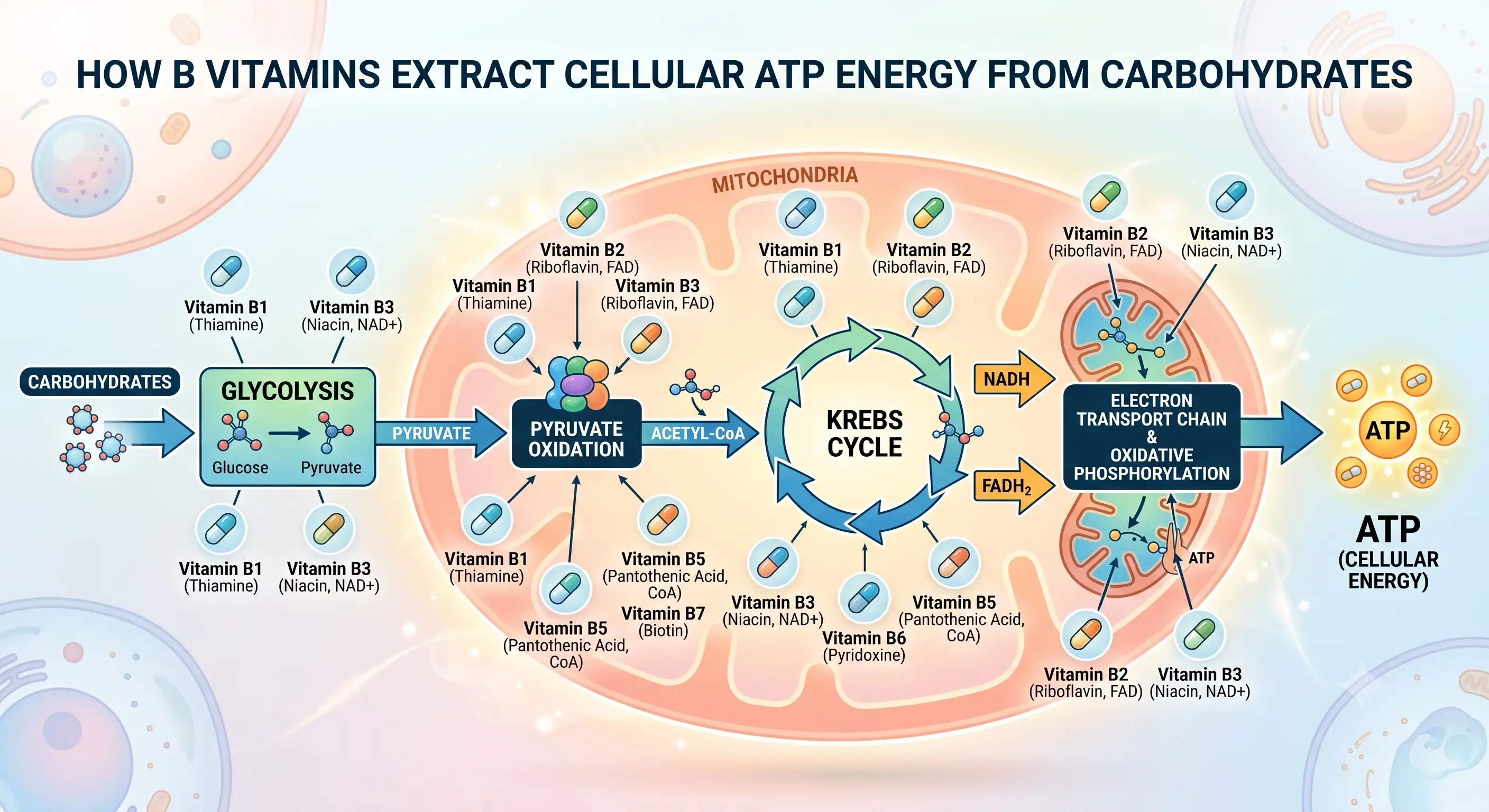
The B-Complex is a family of eight water-soluble vitamins that act as coenzymes throughout metabolism. They do not contain energy themselves, but they are required for the enzymatic steps that extract usable energy (ATP) from the food you eat[1]. This distinction matters: B vitamins enable energy production, they do not supply it, which is why supplementing beyond your needs does not create extra energy.
Because they are water-soluble, the body stores most of them only in small amounts — vitamin B12 is the notable exception, with liver reserves that can last for years. Chronic stress, high alcohol intake, restrictive dieting, certain medications, and gastrointestinal conditions can all reduce B-vitamin status over time. For people dealing with fatigue or brain fog, a B-complex is a commonly used supplement that may help support normal energy metabolism as part of a broader routine — but it is not a diagnosis or a treatment for unexplained tiredness, which deserves proper medical evaluation.
The Eight at a Glance
| Vitamin | Main roles | Common food sources |
|---|---|---|
| B1 — Thiamine | Carbohydrate metabolism, nerve function | Whole grains, pork, legumes |
| B2 — Riboflavin | Energy production, antioxidant enzyme support | Dairy, eggs, almonds |
| B3 — Niacin | NAD/NADH production, cellular metabolism | Meat, fish, peanuts |
| B5 — Pantothenic acid | Coenzyme A, fat and hormone metabolism | Widely distributed in food |
| B6 — Pyridoxine | Amino acid metabolism, neurotransmitter synthesis | Poultry, fish, potatoes, bananas |
| B7 — Biotin | Fat and amino acid metabolism, keratin production | Egg yolk, liver, nuts |
| B9 — Folate | DNA synthesis, cell division, fetal development | Leafy greens, legumes, fortified grains |
| B12 — Cobalamin | Red blood cell formation, myelin maintenance | Meat, fish, eggs, dairy, fortified foods |
Who Is Genuinely at Higher Risk of Deficiency
- Vegans and strict vegetarians: B12 occurs naturally almost exclusively in animal foods. Supplementation or fortified foods are considered necessary, not optional.
- Adults over about 50: Reduced stomach acid impairs release of B12 from food, which is why fortified foods or supplements are commonly recommended in this age group.
- People taking metformin long term or acid-reducing medication (PPIs, H2 blockers): Both are associated with reduced B12 absorption.
- People with heavy alcohol use: Particularly at risk of thiamine (B1) deficiency, which can cause serious neurological illness and requires medical treatment.
- People with celiac disease, Crohn's disease, or after bariatric surgery: Malabsorption affects several B vitamins.
- Pregnant women and those planning pregnancy: Adequate folate before conception and in early pregnancy is one of the best-established nutritional interventions in medicine, for reducing the risk of neural tube defects. Follow your obstetric provider's guidance on dose.
2. A Deep Dive Into B Vitamins' Key Roles
Energy Metabolism and Fatigue
Vitamins B1, B2, B3, and B5 are involved in the pathways that convert carbohydrate, fat, and protein into ATP. When intake is insufficient, these pathways operate less efficiently, which can contribute to feelings of sluggishness. Correcting a genuine shortfall may help — but in people who are already replete, additional B vitamins have not been shown to increase energy levels. Persistent fatigue has many possible causes, including thyroid disease, anemia, sleep disorders, and depression, and warrants medical assessment rather than a supplement trial.
Nervous System and Cognitive Health
Vitamins B6, B9 (folate), and B12 participate in neurotransmitter synthesis and in maintaining the myelin sheath that insulates nerves. Deficiencies in these vitamins have been associated in research studies with mood changes, memory difficulties, and peripheral neuropathy such as tingling in the hands and feet[2]. Correcting a deficiency is not the same as treating a diagnosed condition — anyone experiencing these symptoms should be evaluated by a physician, since untreated B12 deficiency in particular can cause nerve damage that becomes irreversible.
Homocysteine and Cardiovascular Markers
B6, B9, and B12 are involved in clearing homocysteine, an amino acid whose elevated levels have been associated with cardiovascular risk. Supplementation reliably lowers homocysteine — but large trials testing whether this translates into fewer cardiovascular events have largely not shown the benefit that was hoped for. This is a useful reminder that improving a biomarker does not automatically improve outcomes.
Blood Formation
B12 and folate are both required for normal red blood cell production, and deficiency in either can cause a form of anemia. Because their deficiencies can look similar on a blood count but require different treatment, diagnosis should be made by a physician, not inferred from symptoms.
3. Shop Smart: How to Choose the Right B-Complex
Step 1: Understanding "Active" and Methylated Forms
Methylated B-complexes — using methylfolate (5-MTHF) instead of folic acid and methylcobalamin instead of cyanocobalamin — have become popular, and they are perfectly good options. The reasoning usually given deserves a more accurate framing than it often receives:
- MTHFR variants are common, but their impact is usually modest. Variants in the MTHFR gene are widespread in the general population and can somewhat reduce the efficiency of converting folic acid to its active form. For most people this does not produce a clinically meaningful problem, and folic acid remains the form used in the fortification and pregnancy research that has demonstrably reduced neural tube defects. If you have concerns about MTHFR, discuss testing and interpretation with a physician rather than a supplement label.
- Cyanocobalamin is not a safety concern at supplement doses. It contains a trace cyanide group that the body removes and excretes; the quantity is far below any harmful level, and cyanocobalamin is stable, inexpensive, and well studied. Methylcobalamin and adenosylcobalamin are also good choices and may be preferred by some people — this is a reasonable preference, not a safety issue.
- Practical takeaway: Choose the form you tolerate and can afford consistently. Some people report that methylated forms feel over-stimulating, in which case standard forms are a sensible alternative.
Step 2: Balance and Dose
B vitamins work as a team, and taking very high doses of a single B vitamin over long periods can mask or contribute to imbalance elsewhere. A complete B-complex containing all eight, at doses reasonably close to daily requirements, is usually a more sensible choice than a "mega-dose" product delivering thousands of percent of the daily value. Higher is not better here, and in the case of B6 it can be actively harmful — see Section 6.
Step 3: Check for Third-Party Testing
Look for verification seals (USP, NSF, Informed Choice) confirming that the product contains what the label says. Also check whether the product duplicates B vitamins you already get from a multivitamin, a fortified drink, or an energy product, since stacking these can push intakes higher than intended.
4. Everyday Habits: Getting B Vitamins From Food
- Whole Grains and Legumes: Brown rice, oats, lentils, and black beans supply B1, B2, B3, B5, and folate.
- Meat, Fish, and Eggs: The most bioavailable sources of B6 and B12. Fish such as salmon and sardines are particularly rich in B12.
- Dairy: A leading source of riboflavin (B2) in many diets.
- Leafy Greens: Spinach, romaine, asparagus, and broccoli provide folate — best preserved by light steaming rather than prolonged boiling.
- Nutritional Yeast: A staple for vegans; check the label, as only fortified nutritional yeast reliably contains B12.
- Cooking matters: B vitamins are water-soluble and heat-sensitive. Using cooking liquid in soups and sauces, and avoiding long boiling times, preserves more of them.
5. The Perfect Match: Synergies and Incompatibilities
Nutrients rarely work in isolation. Sensible combinations support complementary functions; a few pairings are worth spacing apart.
✅ Combinations That Work Well Together
- Magnesium: Vitamin B6 is involved in magnesium metabolism, and the two are frequently combined in formulas aimed at supporting normal nervous system and muscle function.
- B12 with folate: These two work together in the same metabolic cycle. Supplementing folate alone at high doses can correct the anemia of B12 deficiency while allowing nerve damage to progress undetected — which is precisely why a balanced complex, or medical testing, is preferable to isolated high-dose folate.
- Vitamin C and iron: Relevant for people addressing fatigue, since iron deficiency is a common cause and vitamin C supports non-heme iron absorption.
- Taken with a meal: Improves tolerability and, for B12 from food-bound sources, aligns with normal digestive release.
❌ Points to Watch
- Very high-dose Vitamin C alongside B12: Older laboratory work suggested large vitamin C doses might degrade B12 in the digestive tract. The evidence is dated and not considered strong, but spacing them by a couple of hours costs nothing if you take mega-doses of either.
- Alcohol: Impairs absorption and increases loss of several B vitamins, particularly thiamine and folate.
- Levodopa (without carbidopa): High-dose B6 can reduce its effectiveness. Most modern formulations combine the two, but discuss B6 supplementation with your neurologist.
- Anticonvulsants and methotrexate: Both interact with folate metabolism. Do not adjust folate intake without physician guidance.
- Metformin and acid-reducing medication: Long-term use is associated with lower B12; periodic testing is often recommended.
6. Dosage, Timing, and Safety
"Water-soluble" is often taken to mean "you simply excrete the excess." That is broadly true for most B vitamins, but there are three genuine exceptions that everyone taking a high-dose complex should know about.
- Niacin (B3): Doses above roughly 30–50 mg of the nicotinic acid form commonly cause flushing — warmth, redness, and itching of the face and upper body. It is harmless but uncomfortable. Much higher doses have been used medically for cholesterol under supervision and can affect the liver and blood sugar; this is a prescription-level intervention, not a self-directed one.
- Folic acid (B9): High intakes can mask a B12 deficiency by correcting the blood picture while nerve damage continues. The upper limit for supplemental folic acid in adults is generally set at 1,000 mcg per day.
- Timing: Morning with food is the usual recommendation. Some people find B vitamins mildly stimulating and sleep worse if they take them late in the day.
- Bright yellow urine: Caused by excess riboflavin (B2) being excreted. Harmless and expected.
When to Get Tested Instead of Guessing
If you have persistent fatigue, numbness, tingling, memory changes, or a diet or medication regimen that puts you at risk, ask your doctor about testing B12 and folate levels before starting high-dose supplementation. Supplementing first can make deficiency harder to detect on a subsequent test.
7. Frequently Asked Questions
Q. Will a B-complex give me more energy?
A. Only if your intake was inadequate to begin with. B vitamins enable energy production rather than supplying it, so topping up beyond your requirement has not been shown to raise energy levels in well-nourished people.
Q. Do I need methylated forms?
A. Most people do not need them specifically, though they are a perfectly good choice. If you have a documented MTHFR-related concern, discuss it with a physician rather than self-diagnosing from a supplement label.
Q. Is my mega-dose B-complex safe?
A. Check the B6 content in particular, and add up everything you take including multivitamins and energy drinks. Amounts approaching or exceeding 100 mg per day of B6, taken long term, carry a documented risk of nerve symptoms.
Q. My face went red and itchy after taking it. Why?
A. That is most likely a niacin flush. It typically subsides within an hour and often becomes less pronounced with continued use, but a lower-dose or "flush-free" formulation is an easy alternative.
Q. Vegan — do I really need B12?
A. Yes. Reliable B12 comes from supplements or fortified foods on a plant-based diet, and deficiency can take years to appear while causing damage in the meantime. This is one of the clearest cases for supplementation in all of nutrition.
8. Conclusion and Precautions
B vitamins are genuinely essential nutrients with well-defined biochemical roles, and correcting a real deficiency can make a substantial difference to how someone feels and functions. A balanced B-complex is a reasonable, low-cost option for people whose diet, age, medication, or medical history puts them at higher risk. For people who are already well nourished, expectations should be modest — and the case for very high doses is weaker than marketing suggests, particularly given the B6 upper limit.
⚠️ Precautions: The FDA has not evaluated B-complex supplements for the treatment of any medical condition, and this article is not medical advice. Do not exceed the upper intake level for vitamin B6, and stop and seek medical advice if you develop numbness or tingling. High-dose folic acid can mask vitamin B12 deficiency. Bright yellow urine after taking a B-complex is a harmless riboflavin effect. Take B vitamins in the morning, as they may disturb sleep in some people, and consult a healthcare professional before starting long-term or high-dose supplementation — especially if you are pregnant, take prescription medication, or have unexplained fatigue or neurological symptoms.
9. Sources and References
- National Institutes of Health (NIH) — B Vitamins Fact Sheets
https://ods.od.nih.gov - Harvard T.H. Chan School of Public Health — B Vitamins
https://www.hsph.harvard.edu - Mayo Clinic — Vitamin B12 and B6
https://www.mayoclinic.org - Cleveland Clinic — B-Complex Vitamins
https://my.clevelandclinic.org - Mount Sinai Health System — Vitamin B-complex
https://www.mountsinai.org - National Institutes of Health (NIH), ODS — Vitamin B6 Fact Sheet (Tolerable Upper Intake Level)
https://ods.od.nih.gov/factsheets/VitaminB6-HealthProfessional/ - Linus Pauling Institute, Oregon State University — Micronutrient Information Center: B Vitamins
https://lpi.oregonstate.edu
© 2026 Healing-Finder. All rights reserved.