The Complete Red Ginseng Guide: Ginsenosides, Vitality, and Synergies
1. What Red Ginseng Is and How It Differs From White
Panax ginseng has been valued in East Asian tradition for centuries as a tonic. In contemporary research it is classified as an "adaptogen" — a term for substances studied for their potential to help the body cope with physical and psychological stress[1]. It is worth noting that "adaptogen" is a research and traditional-use category rather than a regulatory or clinical classification.
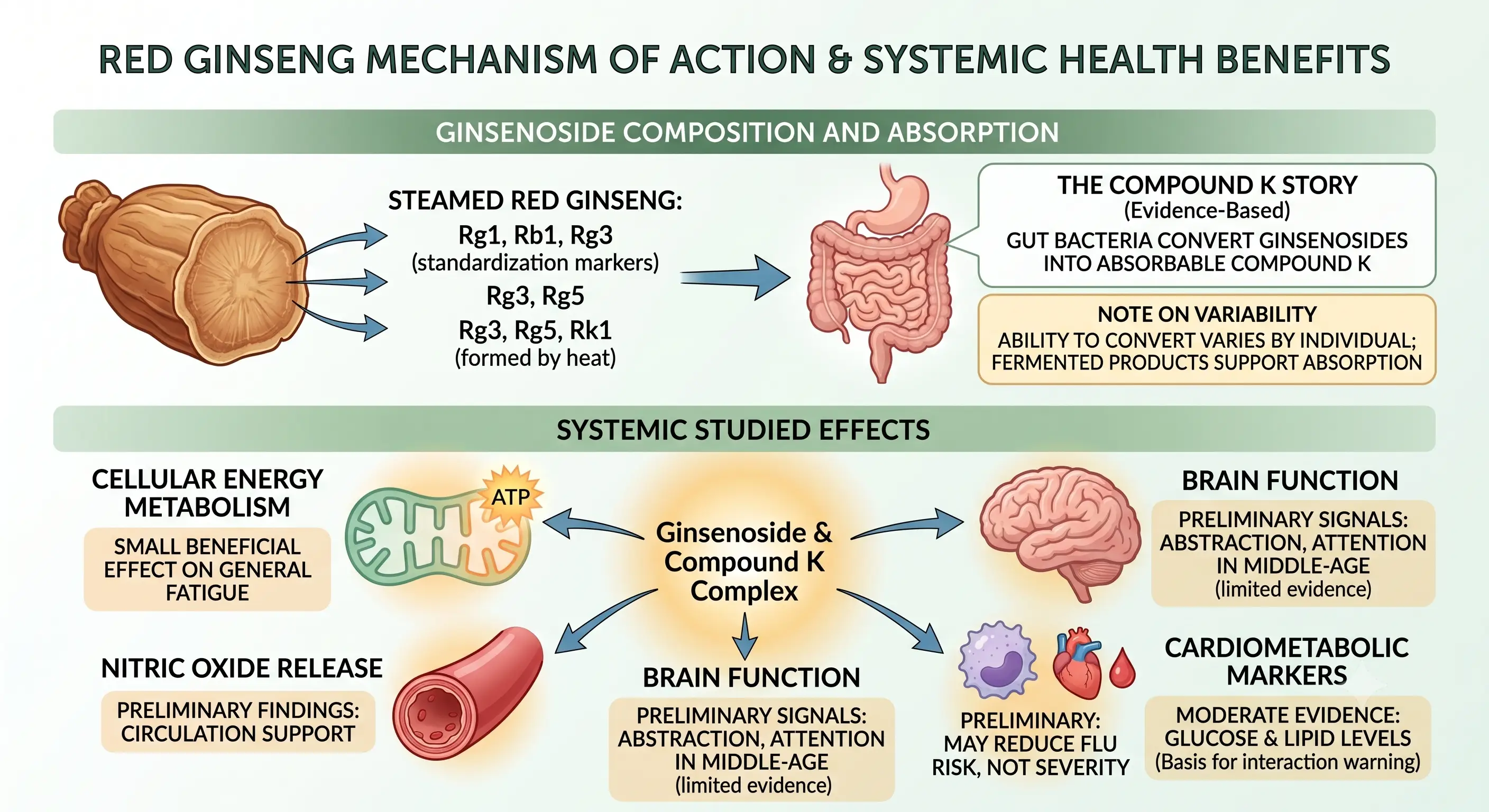
Red ginseng is produced by steaming and drying fresh ginseng root. This processing does more than preserve it — heat converts some of the original ginsenosides into different forms, including Rg3, Rg5, and Rk1, which are largely absent from white ginseng. This is why red and white ginseng have measurably different chemical profiles and are studied somewhat separately.
The active compounds are ginsenosides (also called saponins), of which more than a hundred have been identified. For overworked professionals, students, and older adults, red ginseng is widely used for fatigue and general vitality — a use with modest supporting evidence, described honestly in the next section.
2. A Deep Dive Into Red Ginseng's Studied Effects
Fatigue
This is the most studied use, and the picture is modestly positive. A 2023 review of 19 studies covering more than 2,400 participants suggested that Asian ginseng alone may have a small beneficial effect on general fatigue — fatigue not related to a specific disease — while ginseng-containing herbal formulas showed benefit in chronic fatigue where ginseng alone did not, again with a small effect size. Not all research agrees[1]. Proposed mechanisms include effects on cellular energy metabolism and on the accumulation of metabolic by-products during exertion, though these are not fully established.
Cognitive Function
A limited body of research suggests Asian ginseng may improve aspects of cognitive function — abstract thinking, attention, arithmetic, and reaction time — in middle-aged adults, but not in younger adults. Notably, benefits for memory specifically appeared to depend on ginseng being combined with ginkgo rather than taken alone[1]. This is preliminary rather than established.
Immune Function
Ginsenosides have been studied for effects on immune cell activity, including macrophages and natural killer cells, mainly in laboratory settings. In humans, a very small amount of preliminary research suggests ginseng extract may reduce the risk of developing influenza, though not the severity or duration of symptoms once it occurs[1]. It is not a treatment for any infection.
Cardiometabolic Measures
A 2022 review of 20 studies in people with prediabetes and diabetes reported improvements in several cardiometabolic measures, including fasting glucose, total cholesterol, and certain inflammatory markers[1]. This is a genuinely interesting signal — and also the reason for the blood sugar interaction warning later on this page, since a supplement that lowers glucose can compound the effect of glucose-lowering medication.
Circulation and Nitric Oxide
Ginsenosides have been studied for their effect on nitric oxide release and vascular function, which is the mechanistic basis for research into circulation and, in a number of small trials, erectile function. These studies are small and the evidence is preliminary.
What the Evidence Does and Doesn't Show
| Use | Strength of evidence | Notes |
|---|---|---|
| General fatigue | Small but consistent effect in review | Effect size small; not all studies agree |
| Cardiometabolic markers in prediabetes/diabetes | Moderate | Also the basis for a medication interaction |
| Cognitive measures in middle-aged adults | Preliminary | Memory benefit depended on adding ginkgo |
| Reducing flu risk | Very preliminary | Not severity or duration; not a treatment |
| Circulation / erectile function | Preliminary, small trials | — |
| Curing or treating any disease | Not established | — |
3. Shop Smart: How to Choose the Right Red Ginseng
Step 1: Check the Ginsenoside Content
Korean products are commonly standardised by the combined content of three ginsenosides — Rg1, Rb1, and Rg3 — and a daily serving providing several milligrams of this sum is the usual benchmark for a standardised product. Labels stating only "6-year-old red ginseng" or an extract weight without ginsenoside content tell you much less. Note that ginsenoside sum is a standardisation marker, not a guarantee of effect.
Step 2: Fermented Red Ginseng and Compound K
Many ginsenosides are converted by gut bacteria into compound K, which is more readily absorbed. The capacity to perform this conversion varies considerably between individuals depending on gut microbiome composition, and researchers have proposed this as one explanation for why responses to ginseng differ so much. Fermented red ginseng is pre-processed so that some of this conversion has already occurred, which may help support absorption independently of gut bacteria. Figures quoted for what proportion of people are poor converters vary between studies and should be treated as approximate rather than precise.
Step 3: Form and Third-Party Testing
Extracts, concentrates, sticks, powders, and teas differ substantially in concentration — teas and candies typically deliver far less than an extract. Check for third-party verification or a certificate of analysis, and for heavy metal and pesticide testing, since root crops can accumulate soil contaminants.
4. Everyday Habits: Using It Sensibly
- Take it earlier in the day. Ginseng can interfere with sleep, and sleep problems are among the most commonly reported side effects. Morning or early afternoon is the sensible default; avoid taking it in the evening.
- Give it several weeks. Trials generally run 4 to 12 weeks. Effects, where they occur, are gradual rather than immediate — this is not a stimulant.
- Consider a defined period rather than indefinite use. Some sources suggest limiting continuous use to around three months because of uncertainty about long-term effects[1]. Taking breaks and reassessing is a reasonable approach.
- Culinary use: Ginseng tea and traditional dishes such as samgyetang provide a gentle dietary form, at much lower concentrations than extracts.
- The unglamorous foundations: Sleep duration and regularity, iron and thyroid status, physical activity, and managing workload affect fatigue far more reliably than any supplement. Persistent, unexplained fatigue deserves a medical work-up rather than a supplement trial.
5. The Perfect Match: Synergies and Incompatibilities
Nutrients rarely work in isolation. Several of the cautions below involve prescription medication and deserve genuine attention.
✅ Combinations Commonly Used
- Vitamin C: A common pairing in immune-focused products, contributing to normal immune function through a separate route.
- Ginkgo biloba: Worth singling out — the research suggesting a memory benefit involved ginseng combined with ginkgo rather than ginseng alone. Note that ginkgo has its own bleeding-risk considerations.
- B-Complex Vitamins: Support normal energy metabolism and nervous system function, and are frequently depleted alongside chronic stress.
- Maca or L-Arginine: Sometimes combined for stamina and circulation. Evidence for these specific combinations is limited; treat them as popular pairings rather than established synergies.
❌ Requiring Caution
- Diabetes medication: Ginseng may lower blood glucose. Combining it with insulin or oral glucose-lowering drugs without monitoring could contribute to hypoglycemia — consult your physician[1].
- Warfarin and anticoagulants: Studies on ginseng's effect on warfarin have produced mixed results, and some sources report an increased bleeding risk. Do not combine without physician oversight and INR monitoring.
- Blood pressure medication and calcium channel blockers: Uncertainties exist about interactions; discuss with your prescriber.
- Statins and some antidepressants: Possible interactions have been raised, including with MAOI antidepressants where combination has been associated with agitation and insomnia[1].
- Imatinib and some cancer therapies: Concerns have been reported about increased risk of liver injury; do not use during cancer treatment without oncology approval.
- High-dose caffeine and stimulants: May compound overstimulation, jitteriness, palpitations, and insomnia. Separate them and moderate total intake.
- Immunosuppressants: Ginseng's immune-modulating effects could theoretically oppose them; consult your physician.
6. Dosage, Timing, and Safety
Typical Ranges
- Standardised extract: Trials have commonly used roughly 200–400 mg daily of standardised extract, or 1–3 g daily of root preparations, though protocols vary widely.
- Timing: Morning or early afternoon. Some traditions favour an empty stomach; take with food if it causes discomfort.
- Duration: 4 to 12 weeks to assess, with periodic breaks for long-term users.
Commonly Reported Side Effects
Ginseng is usually well tolerated when taken by mouth. The most frequently reported effects are headaches, sleep problems, and digestive upset[1]. Allergic reactions can occur. Higher doses have been associated with nervousness, palpitations, and elevated blood pressure in some individuals.
In traditional Korean and Chinese practice, red ginseng is regarded as "warming," and people who run hot, flush easily, or have marked night sweats are advised to use it cautiously. This is a traditional framework rather than a clinical finding, but it aligns reasonably with the reported side effects of overstimulation.
7. Frequently Asked Questions
Q. Red ginseng or white ginseng?
A. Steaming changes the ginsenoside profile, creating compounds such as Rg3 not found in white ginseng. Red is the more studied form in Korean research; whether it is clinically superior has not been firmly established.
Q. I felt nothing when I tried ginseng before. Why?
A. One likely explanation is variation in gut bacteria that convert ginsenosides into the more absorbable compound K. Fermented products are designed around this. It may also simply be that the effect sizes reported in research are small.
Q. Is it like caffeine?
A. No. It does not act as a stimulant and effects build over weeks rather than within an hour. That said, it can disturb sleep, so morning dosing is still advised.
Q. Can I take it long term?
A. Some sources suggest limiting continuous use to about three months because long-term safety is less well characterised. Taking periodic breaks and reassessing is sensible.
Q. I have diabetes. Is it safe?
A. Ginseng may lower blood glucose, which is exactly why this needs a conversation with your physician rather than a self-directed trial — particularly if you take glucose-lowering medication.
8. Conclusion and Precautions
Red ginseng is one of the most extensively used botanicals in the world and has a genuine, if modest, evidence base — most consistently for general fatigue, with interesting signals in cardiometabolic measures and preliminary findings in cognition and circulation. The realistic framing is a small effect built over weeks, not a transformation, and one that varies considerably between individuals partly because of gut microbiome differences. Choose a standardised product, take it in the morning, give it a defined period, and take the medication interactions seriously — particularly diabetes and anticoagulant therapy.
⚠️ Precautions: The FDA has not evaluated red ginseng for the treatment of any medical condition, and this article is not medical advice. Avoid during pregnancy, and consult a provider about use while breastfeeding. Ginseng may lower blood sugar — consult your physician if you take diabetes medication — and may interact with anticoagulants, blood pressure medication, statins, antidepressants, and some cancer therapies. The most common side effects are headache, sleep problems, and digestive upset. Do not take it close to bedtime, use cautiously if you have high blood pressure or a hormone-sensitive condition, and stop before scheduled surgery as advised.
9. Sources and References
- NIH National Center for Complementary and Integrative Health (NCCIH) — Asian Ginseng: Usefulness and Safety
https://www.nccih.nih.gov/health/asian-ginseng - Memorial Sloan Kettering Cancer Center — Ginseng (Asian)
https://www.mskcc.org/cancer-care/integrative-medicine/herbs/ginseng-asian - Mayo Clinic — Ginseng: Uses and side effects
https://www.mayoclinic.org - Mount Sinai Health System — Asian ginseng
https://www.mountsinai.org - Cleveland Clinic — Adaptogens: What They Are and How They Work
https://my.clevelandclinic.org - NIH LiverTox — Clinical and Research Information on Drug-Induced Liver Injury
https://www.ncbi.nlm.nih.gov/books/NBK547852/
© 2026 Healing-Finder. All rights reserved.