The Complete L-Carnitine Guide: Fat Transport, Energy, and Synergies
1. What L-Carnitine Does — and What That Doesn't Mean
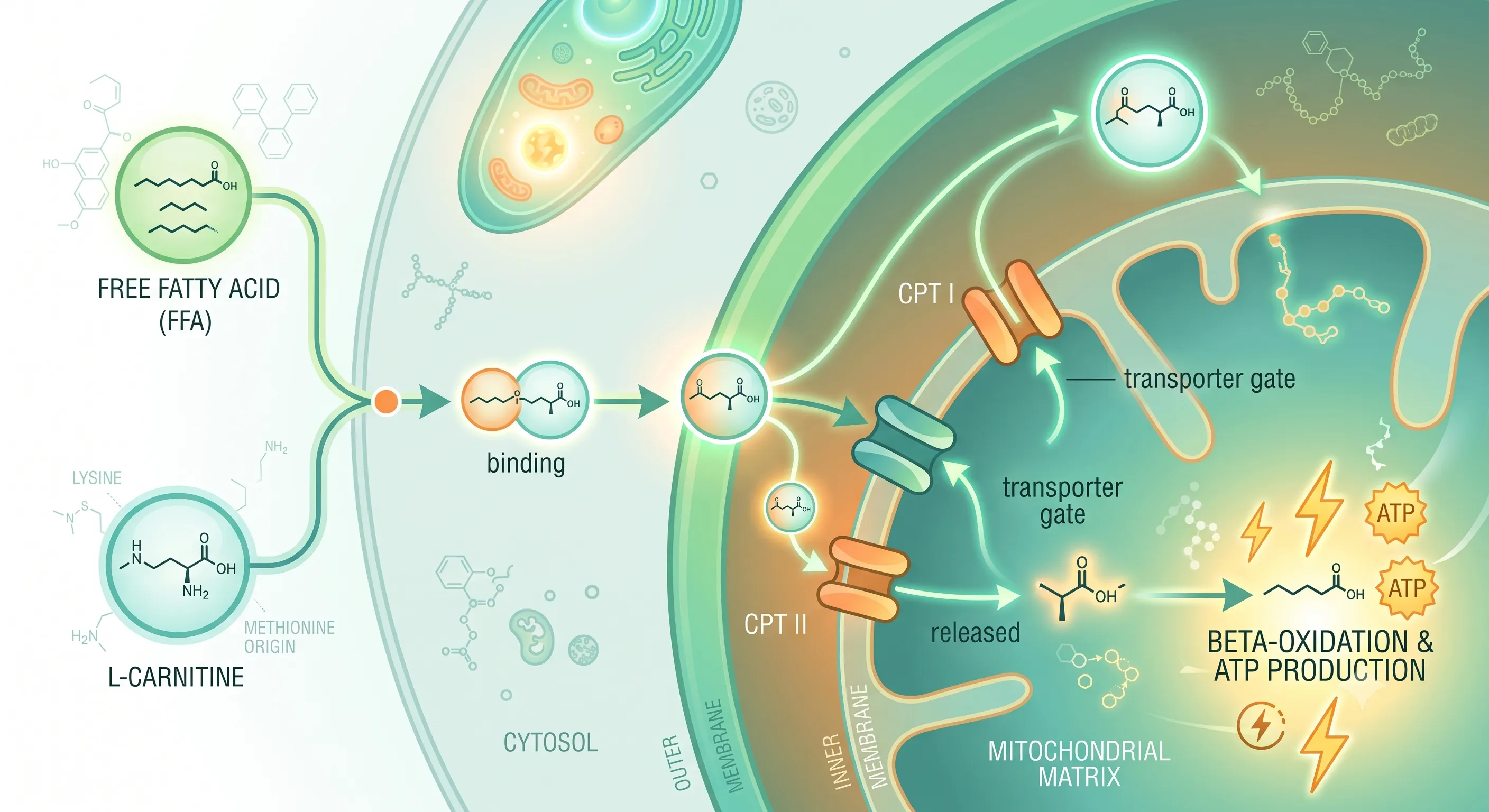
L-Carnitine is a compound derived from the amino acids lysine and methionine. Its central role is well established: long-chain fatty acids cannot cross the inner mitochondrial membrane on their own, and carnitine acts as the shuttle that carries them in to be oxidized for energy[1]. Roughly 95% of the body's carnitine is stored in skeletal and cardiac muscle.
That mechanism is genuine, and it is also the source of the most common misunderstanding in this category. Carnitine being required for fat oxidation does not mean that more carnitine produces more fat burning — any more than adding lanes to a road that is not congested increases traffic. In healthy, well-nourished people, muscle carnitine levels are generally adequate and the shuttle is not the rate-limiting step.
Who Actually Has Low Carnitine Status
- People with certain inherited metabolic disorders or secondary deficiency from conditions such as kidney failure on dialysis — here carnitine (levocarnitine) is a prescription medication managed by physicians, not a wellness supplement.
- Strict vegetarians and vegans, whose intake is lower, though the body compensates by synthesizing more and excreting less; blood levels are typically only modestly lower without clinical consequences.
- People taking certain anticonvulsants (notably valproate) long term, under medical monitoring.
2. A Deep Dive Into L-Carnitine's Studied Effects
Body Weight and Composition
Meta-analyses of carnitine supplementation for weight have reported statistically significant but small average effects — commonly around one kilogram or a little more over several months, with the effect appearing larger in people with obesity and smaller or absent in leaner, active individuals. Some studies suggest it may support fat utilisation when paired with regular cardiovascular exercise. This is a modest adjunct to diet and training, not a fat-loss agent.
Exercise Performance and Recovery
Research here is mixed. Some studies report reduced markers of muscle damage, less soreness, and improved recovery after intense exercise — findings most often associated with L-Carnitine L-Tartrate. Effects on endurance performance and on delaying fatigue have been less consistent, and several well-controlled trials found no meaningful performance benefit[2]. Recovery appears to be the more promising of the two areas.
Acetyl-L-Carnitine and the Nervous System
ALCAR crosses the blood-brain barrier more readily and has been studied separately for cognitive function in older adults and for diabetic peripheral neuropathy, with some encouraging but preliminary results. Neuropathy in particular requires medical evaluation and management; ALCAR is not a treatment for it.
Cardiac and Clinical Contexts
Carnitine has been studied in heart failure, angina, and in dialysis patients, generally as an adjunct within medical care. These are clinical research settings and do not translate into a self-directed use.
What the Evidence Does and Doesn't Show
| Use | Strength of evidence | Notes |
|---|---|---|
| Treating diagnosed carnitine deficiency | Well established | Prescription medication, physician-managed |
| Weight / body composition | Small, statistically significant | ~1 kg average; larger effect in obesity |
| Exercise recovery and soreness | Moderate / promising | Mainly LCLT |
| Endurance performance | Mixed / limited | Several negative trials |
| Cognition (ALCAR) | Preliminary | Mostly in older adults |
| "Fat burning" in healthy active adults | Not supported as a standalone effect | Requires diet and training |
3. Shop Smart: How to Choose the Right L-Carnitine
Step 1: Match the Form to the Goal
- L-Carnitine L-Tartrate (LCLT): The form most studied for exercise recovery and muscle soreness, and the usual choice for training-related goals.
- Acetyl-L-Carnitine (ALCAR): Better able to cross the blood-brain barrier; the form studied for cognitive and neurological outcomes.
- Propionyl-L-Carnitine (and GPLC): Studied more in circulatory contexts such as peripheral arterial disease, generally within clinical research.
- Plain L-Carnitine (tartrate-free): Perfectly serviceable and often cheaper.
- Avoid D-carnitine or DL-carnitine: The D-isomer is not biologically useful and has been associated with interference with L-carnitine function. Reputable products use the L-form only.
Step 2: Liquid vs. Capsules
Because typical doses run to 1,000–2,000 mg or more, liquid formulations are often more practical than swallowing several large capsules, and are convenient before training. There is no strong evidence that liquid is meaningfully better absorbed — choose based on convenience and cost.
Step 3: Third-Party Testing
Look for USP or NSF verification, and for competitive athletes, batch testing under Informed Sport or NSF Certified for Sport. Be cautious with multi-ingredient "fat burner" blends that hide individual amounts behind a proprietary label.
4. Everyday Habits: Using It Sensibly
- Carbohydrate and carnitine uptake — the accurate version: Research does show that raising muscle carnitine content requires substantial insulin elevation, but the studies that achieved it used very large carbohydrate loads (on the order of 80 g twice daily) sustained over many weeks. Taking carnitine with a piece of fruit is a reasonable habit, but it will not replicate those study conditions, and it is worth knowing that this is one of the harder things to accomplish in nutrition rather than a simple trick.
- Timing: Commonly taken before exercise, or split across the day with meals. Consistency matters more than precise timing.
- Food sources: Red meat is by far the richest source, with dairy, poultry, and fish contributing smaller amounts. Plant foods contain very little.
- Pair it with the things that actually work: Energy balance, adequate protein, resistance training, and regular cardiovascular activity determine body composition. Carnitine sits at the margin of that picture, not the centre.
5. The Perfect Match: Synergies and Incompatibilities
Nutrients rarely work in isolation, though several popular carnitine "stacks" are built more on mechanism stories than on outcome data.
✅ Reasonable Combinations
- Omega-3 Fish Oil: Omega-3 incorporates into cell membranes and has been examined alongside carnitine in metabolic research. A sensible pairing on mechanistic grounds; evidence for the specific combination is limited.
- Alpha-Lipoic Acid: A frequently studied mitochondrial pairing with ALCAR, examined in animal and small human studies for cellular ageing and fatigue.
- Carbohydrate at the same meal: The most evidence-based co-factor for carnitine uptake, with the caveat above about the amounts involved.
- Green Tea Extract: Often marketed together as a "fat stack." The mechanistic story is tidy, but evidence that the combination produces meaningful additional fat loss is limited — and green tea extract carries its own liver safety considerations worth reading before combining.
❌ Requiring Caution
- Thyroid hormone replacement: Carnitine has been shown to inhibit the action of thyroid hormone in tissues — enough that it has been studied as a treatment for hyperthyroid symptoms. If you take levothyroxine for an underactive thyroid, discuss carnitine with your endocrinologist before use, as it could theoretically counteract your medication.
- Seizure disorders: There have been reports of increased seizure frequency in people with a history of seizures taking carnitine. Discuss with your neurologist.
- Warfarin: Case reports suggest carnitine may increase the anticoagulant effect; monitoring is advisable.
- Kidney disease: Carnitine handling is altered; use only under medical supervision.
6. Dosage, Timing, and Safety
Typical Ranges
- General supplementation: 500–2,000 mg per day is the common range in research.
- LCLT for recovery: Often around 1,000–2,000 mg daily.
- ALCAR: Typically 500–1,500 mg daily in cognitive studies.
- Timing: With meals, or before training. Splitting the dose reduces digestive upset.
Tolerability
Generally well tolerated at these doses. Reported effects include nausea, abdominal cramping, and diarrhoea, particularly above about 3 g daily. A distinctive "fishy" body odour can occur at higher doses, caused by bacterial production of trimethylamine.
Also consult a healthcare professional before use if you take thyroid medication, have a seizure disorder, take warfarin, have kidney disease, or are pregnant or breastfeeding, where safety data are insufficient. Carnitine supplements are not recommended for children without medical guidance.
7. Frequently Asked Questions
Q. Will L-Carnitine burn fat if I take it and don't exercise?
A. No. The shuttle mechanism only matters when fatty acids are actually being mobilised for energy. Without an energy deficit and activity, there is nothing for it to do.
Q. Is it worth it for a vegetarian or vegan?
A. Intake is lower, but the body compensates through increased synthesis and reduced excretion, and clinical deficiency is not typical. It is a more reasonable candidate than for a regular meat eater, but not a necessity.
Q. LCLT or ALCAR?
A. LCLT for training recovery, ALCAR if your interest is cognitive or neurological. They are not interchangeable in the research.
Q. Should I be worried about TMAO?
A. It is a legitimate open question rather than an established harm. Staying within usual doses, not taking it indefinitely at high amounts, and raising it with your doctor if you have heart disease is a proportionate response.
Q. Why do I smell fishy after taking it?
A. That is trimethylamine produced by gut bacteria, and it is dose-related. Reducing the dose usually resolves it.
8. Conclusion and Precautions
L-Carnitine rests on solid, uncontroversial biochemistry — it is genuinely required for fatty acid oxidation. What the research does not support is the leap from "required" to "supplementing produces meaningful fat loss." The measured effects are small, absorption is limited, and the most promising practical application is exercise recovery rather than body composition. For someone training consistently who wants a modest, low-risk addition, it is a defensible choice; for someone hoping it will substitute for a calorie deficit, it will disappoint.
⚠️ Precautions: The FDA has not evaluated L-Carnitine for the treatment of any medical condition, and this article is not medical advice. Gut bacteria convert carnitine into TMAO, which has been associated with cardiovascular risk in observational research — stay within recommended doses and discuss long-term use with your physician, particularly if you have cardiovascular disease. Consult a healthcare professional before use if you take thyroid medication or warfarin, have a seizure disorder or kidney disease, or are pregnant or breastfeeding.
9. Sources and References
- National Institutes of Health (NIH), ODS — Carnitine Fact Sheet for Health Professionals
https://ods.od.nih.gov/factsheets/Carnitine-HealthProfessional/ - NIH Office of Dietary Supplements — Dietary Supplements for Exercise and Athletic Performance
https://ods.od.nih.gov/factsheets/ExerciseAndAthleticPerformance-HealthProfessional/ - Cleveland Clinic — L-Carnitine
https://my.clevelandclinic.org - Mayo Clinic — Carnitine (L-carnitine)
https://www.mayoclinic.org - Mount Sinai Health System — Carnitine (L-carnitine)
https://www.mountsinai.org - Linus Pauling Institute, Oregon State University — Micronutrient Information Center: L-Carnitine
https://lpi.oregonstate.edu
© 2026 Healing-Finder. All rights reserved.