The Complete Probiotics Guide: Strains, Evidence, and Synbiotics
1. What Probiotics Are — and the One Rule That Changes Everything
Probiotics are defined as live microorganisms that, when administered in adequate amounts, confer a health benefit on the host. The gut microbiome contains trillions of organisms across hundreds of species, and it is shaped by diet, medication, age, and environment[1].
A Second Reality Check: Colonisation
Most supplemented probiotic strains do not permanently colonise the gut. They pass through, exert effects while present, and are largely gone within days to weeks of stopping. This is not a flaw — many benefits occur during transit, through interaction with the gut lining and immune tissue and through metabolites they produce — but it does mean the popular image of "repopulating" or "restoring" the microbiome permanently is not accurate.
What Actually Shapes Your Microbiome
Dietary pattern — particularly the quantity and diversity of plant fibre — has a far larger and more durable influence on gut composition than any capsule. Antibiotics, illness, sleep, and stress also matter. Probiotics are a targeted tool for specific situations, not the foundation of gut health.
2. A Deep Dive Into Probiotics' Studied Effects
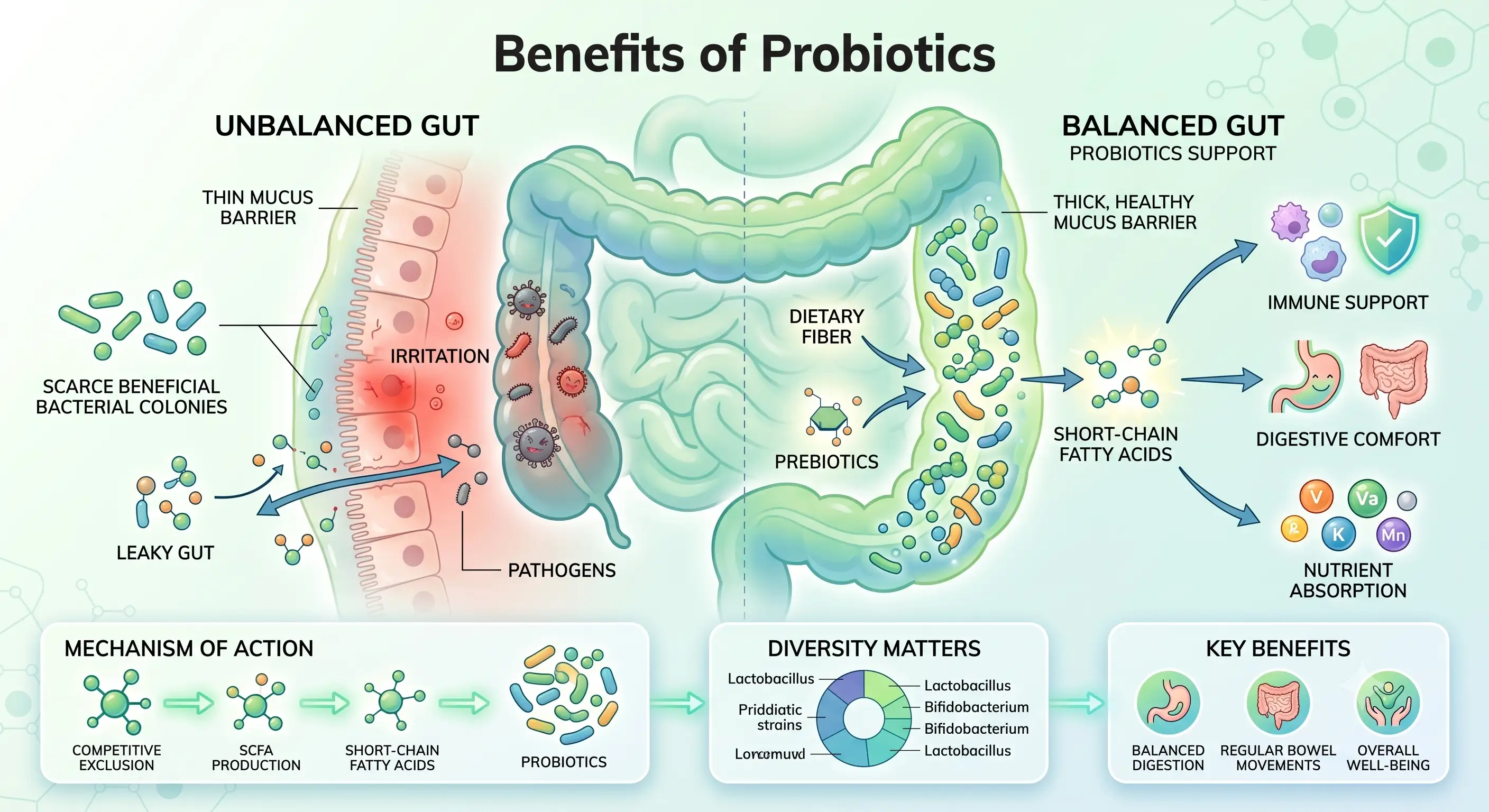
Where the Evidence Is Strongest
Antibiotic-associated diarrhoea is the best-supported use. Multiple trials and meta-analyses report reduced incidence when specific strains — most notably Saccharomyces boulardii and Lactobacillus rhamnosus GG — are taken alongside a course of antibiotics. Acute infectious diarrhoea in children has also been studied extensively, though more recent large trials have been less positive than earlier ones, and guidance has become more cautious.
In hospital settings, specific probiotic protocols have been studied for preventing necrotising enterocolitis in premature infants, and certain strains for pouchitis after colectomy. These are medical applications directed by clinicians, not consumer uses.
Digestive Comfort and IBS
Probiotics may help support digestive comfort, and some studies suggest regular intake eases occasional constipation, loose stools, and certain IBS symptoms — particularly bloating and abdominal discomfort. Being accurate: results vary considerably by strain and by IBS subtype, and major gastroenterology guidance has concluded that the evidence is not yet strong enough to recommend probiotics routinely for IBS outside of a clinical trial context. Many people do report benefit, and a time-limited trial with a specific strain is reasonable — with the expectation that it may not work and that switching strains is sometimes necessary.
Immune Function
A large proportion of the body's immune tissue sits along the gut lining, and probiotics interact with it directly. Some strains have been studied for reducing the frequency or duration of upper respiratory infections, with modest reported effects. This is a plausible and moderately supported area rather than a demonstrated way to "boost immunity."
The Gut-Brain Axis
Communication between gut microbes and the nervous system is a genuine and active field, and certain strains studied for mood or stress outcomes are sometimes called "psychobiotics." The human evidence is early — small trials, short durations, inconsistent results. It is worth noting that although gut bacteria influence serotonin production in the gut, gut-derived serotonin does not cross into the brain, so the popular shorthand about probiotics "making serotonin for your mood" oversimplifies considerably.
What the Evidence Does and Doesn't Show
| Use | Strength of evidence | Notes |
|---|---|---|
| Antibiotic-associated diarrhoea | Moderate to good | Strain-specific: S. boulardii, L. rhamnosus GG |
| Acute infectious diarrhoea in children | Mixed | Recent large trials less positive |
| IBS symptoms | Mixed; not routinely recommended | Strain- and subtype-dependent |
| Respiratory infections | Modest | Strain-specific |
| Mood / gut-brain | Preliminary | Small, short trials |
| Weight loss, detox, general "balance" | Not supported | Marketing outruns data |
3. Shop Smart: How to Choose the Right Probiotic
Step 1: Look for Full Strain Designations
A quality label states genus, species, and strain — for example "Lactobacillus rhamnosus GG" or "Bifidobacterium longum BB536," not just "Lactobacillus blend." If a product will not tell you the strains, you cannot check whether any research supports them for your purpose. Common genera and their general territory:
- Lactobacillus (now reclassified into several genera such as Lacticaseibacillus and Limosilactobacillus): predominantly small intestine; many strains studied for diarrhoea and vaginal health.
- Bifidobacterium: predominantly large intestine; several strains studied for regularity and IBS comfort.
- Saccharomyces boulardii: a yeast rather than a bacterium, which means it is unaffected by antibiotics — the reason it is often used during antibiotic courses.
Step 2: CFU Count Is Not a Quality Measure
Products advertise 50 or 100 billion CFU as though more is automatically better. It is not — the studied dose for a given strain is what matters, and many effective strains were trialled at 1–10 billion CFU. What does matter is that the label guarantees CFU through the end of shelf life, not merely "at time of manufacture," since live organisms die off over time.
Step 3: Delivery and Storage
Stomach acid does reduce survival, and enteric coating or delayed-release capsules can help — but some strains are naturally acid-tolerant, and many studied products used no special coating. Treat it as a useful feature rather than a requirement. Check storage instructions: some products need refrigeration, others are shelf-stable, and storing the wrong type at room temperature in a warm climate reduces viability substantially.
Step 4: Third-Party Testing
Independent analyses have repeatedly found probiotic products containing fewer viable organisms than labelled, or different species than stated. Look for USP or NSF verification or a published certificate of analysis.
4. Everyday Habits: Supporting Your Microbiome
- Eat more plant diversity. This is the intervention with the strongest evidence for microbiome composition — research suggests the number of different plant foods eaten weekly predicts microbial diversity better than total fibre grams alone.
- Fermented foods: Yogurt, kefir, kimchi, sauerkraut, miso, and natto supply live cultures alongside food. A controlled trial found that a diet high in fermented foods increased microbiome diversity and reduced inflammatory markers — a notably strong result for a dietary intervention. Note that kimchi and sauerkraut must be unpasteurised to contain live organisms.
- Prebiotic foods: Garlic, onion, leek, asparagus, banana, oats, and legumes feed existing beneficial bacteria.
- Timing of supplements: Many manufacturers suggest taking with or just before a meal, which buffers stomach acid. Consistency matters more than precision.
- Give it time, then reassess: Four to eight weeks is a reasonable trial. If nothing changes, switching strains or stopping is more sensible than continuing indefinitely.
- Limit unnecessary antibiotics — the single most disruptive common influence on gut microbial communities.
5. The Perfect Match: Synergies and Incompatibilities
Nutrients rarely work in isolation, and probiotics in particular depend on what you feed them.
✅ Combinations That Work Well Together
- Prebiotics (inulin, FOS, GOS, resistant starch): Prebiotics are the fermentable substrate that beneficial bacteria use. Combining them with probiotics creates a "synbiotic." Note that highly fermentable prebiotics commonly cause gas and are poorly tolerated by people with IBS — start low.
- Vitamin D: Involved in intestinal immune regulation and barrier function; adequate status is relevant to gut health generally.
- Polyphenol-rich foods (berries, tea, olive oil, cocoa): interact with gut bacteria and are increasingly studied alongside them.
- Omega-3: Some research suggests it influences microbial composition; a reasonable companion rather than a proven synergy.
❌ Timing and Caution
- Antibiotics: Take bacterial probiotics 2–4 hours apart from each antibiotic dose, and continue for a week or two after the course finishes. S. boulardii, being a yeast, is not killed by antibiotics and can be taken alongside them — though it should be avoided by anyone with a central venous catheter or significant immune compromise.
- Antifungal medication: Will inactivate yeast-based probiotics such as S. boulardii.
- Very hot drinks: Do not mix live cultures into hot liquids.
- SIBO (small intestinal bacterial overgrowth): Some probiotics — and especially prebiotics — can worsen bloating and discomfort. Work with a clinician rather than experimenting.
- Histamine intolerance: Certain strains produce histamine and may aggravate symptoms in sensitive individuals.
6. Dosage, Timing, and Safety
Typical Ranges
- General use: 1–10 billion CFU daily of well-characterised strains is a common and evidence-consistent range.
- Alongside antibiotics: Higher doses of specific strains have been used in trials; follow the product's studied protocol and separate from antibiotic doses.
- Duration: Four to eight weeks to judge, then reassess.
Common Adjustment Effects
Mild gas, bloating, or changes in stool pattern are common in the first few days to two weeks and usually settle. Persistent worsening suggests the strain is not suitable for you.
Preterm and very young infants require particular caution. Regulators including the FDA have warned about the use of probiotic products in preterm infants following reports of invasive, sometimes fatal, infection. Probiotic use in premature or medically fragile infants belongs entirely to neonatal clinicians, never to over-the-counter decision-making.
Also see a physician rather than self-treating if you have persistent diarrhoea, blood in the stool, unexplained weight loss, fever, or severe abdominal pain — these need diagnosis, not a supplement.
7. Frequently Asked Questions
Q. Is a higher CFU count better?
A. Not inherently. What matters is whether the specific strain has evidence at the dose provided. Many well-studied strains were trialled at 1–10 billion CFU.
Q. Do I need to take them forever?
A. Most strains do not permanently colonise, so effects generally fade after stopping. That is a reason to be deliberate about whether it is helping, rather than a reason to take one indefinitely by default.
Q. Yogurt or a supplement?
A. Fermented foods are an excellent everyday option with good supporting evidence for microbiome diversity. A supplement makes more sense when you want a specific studied strain for a specific purpose — such as during antibiotics.
Q. Why did it make my bloating worse?
A. Some strains and especially added prebiotics increase gas, and in conditions like SIBO or IBS this can be pronounced. Try a lower dose, a different strain, or a product without added inulin.
Q. Should I take probiotics with every antibiotic course?
A. It is one of the better-supported uses, particularly with specific strains, and is reasonable for most healthy people. If you are immunocompromised or seriously ill, ask your doctor first.
8. Conclusion and Precautions
Probiotics are a legitimate and genuinely interesting area, with real evidence in specific situations — most clearly alongside antibiotics — and a plausible role in digestive comfort for many people. The gap between that and how they are marketed is wide: benefits are strain-specific rather than generic, CFU counts are a poor quality signal, colonisation is mostly temporary, and dietary diversity does more for your microbiome than any capsule. Choose a product that names its strains, give it a defined trial, and treat it as one tool alongside fibre, fermented foods, and sensible antibiotic use.
⚠️ Precautions: The FDA has not evaluated probiotics for the treatment of any medical condition, and this article is not medical advice. Because they contain live organisms, probiotics can pose an infection risk to people who are immunocompromised, critically ill, have a central venous catheter, or have a damaged intestinal barrier — consult a doctor first. Probiotic products should not be given to preterm or medically fragile infants outside of neonatal clinical care. People with SIBO may find symptoms temporarily worsen. Take bacterial probiotics 2–4 hours apart from antibiotics, and seek medical assessment for persistent diarrhoea, blood in the stool, fever, or unexplained weight loss.
9. Sources and References
- National Institutes of Health (NIH), ODS — Probiotics Fact Sheet for Health Professionals
https://ods.od.nih.gov/factsheets/Probiotics-HealthProfessional/ - World Gastroenterology Organisation (WGO) — Probiotics and Prebiotics Global Guidelines
https://www.worldgastroenterology.org - Harvard Health Publishing — Health benefits of taking probiotics
https://www.health.harvard.edu - Mayo Clinic — Probiotics and prebiotics: What you should know
https://www.mayoclinic.org - Cleveland Clinic — Probiotics
https://my.clevelandclinic.org - NIH National Center for Complementary and Integrative Health (NCCIH) — Probiotics: What You Need To Know
https://www.nccih.nih.gov/health/probiotics-what-you-need-to-know - U.S. Food and Drug Administration — Warning on probiotic products in preterm infants
https://www.fda.gov
© 2026 Healing-Finder. All rights reserved.