The Complete Vitamin C Guide: Antioxidants, Absorption, and Synergies
1. What Vitamin C Does and Why We Need It in the Diet
Vitamin C (ascorbic acid) is a water-soluble vitamin and the body's principal water-phase antioxidant[1]. Unlike most mammals, humans lost the enzyme needed to synthesise it, so every milligram must come from diet or supplements — a genuine evolutionary quirk that makes it one of the few truly essential vitamins in the strictest sense.
Its best-defined role is not as an antioxidant at all, but as an enzyme cofactor. Vitamin C is required by the hydroxylase enzymes that stabilise collagen, and by enzymes involved in carnitine and neurotransmitter synthesis. Scurvy — the deficiency disease — is essentially a collagen failure: bleeding gums, poor wound healing, easy bruising, and joint pain.
Requirements and the Absorption Ceiling
| Group | RDA | Upper limit |
|---|---|---|
| Adult men | 90 mg/day | 2,000 mg/day |
| Adult women | 75 mg/day | 2,000 mg/day |
| Smokers | +35 mg/day above the RDA | 2,000 mg/day |
| Pregnancy / breastfeeding | 85 / 120 mg/day | 1,800–2,000 mg/day |
2. A Deep Dive Into Vitamin C's Key Roles
Collagen Synthesis and Skin
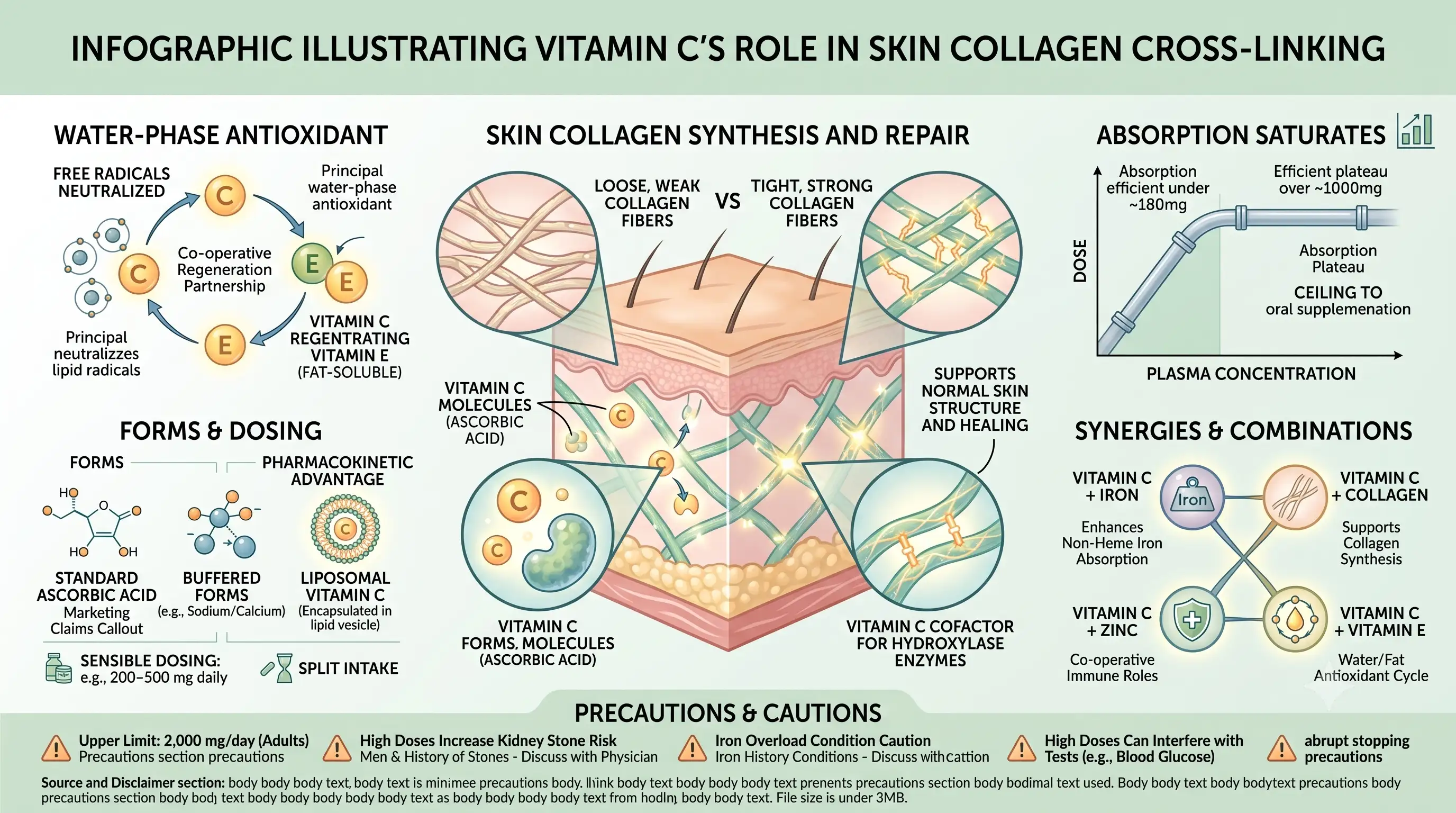
This is the most firmly established role. Vitamin C is a required cofactor for prolyl and lysyl hydroxylase, the enzymes that cross-link and stabilise collagen fibres. Without it, collagen is structurally weak — which is why deficiency produces bleeding gums and impaired wound healing. Adequate vitamin C supports normal skin structure and healing; whether supplementation beyond adequacy improves skin appearance in well-nourished people is much less clear, and topical vitamin C is a separate matter with its own (moderate) evidence base.
Immune Function and the Common Cold — Reported Accurately
Vitamin C accumulates in white blood cells and supports several aspects of immune function, and deficiency impairs immunity. The cold question specifically has been studied extensively, and the findings are consistent and worth stating precisely: regular vitamin C supplementation does not reduce how often the average person catches colds. It does appear to modestly shorten duration — on the order of roughly 8% in adults and 14% in children in pooled analyses — which amounts to a matter of hours to a day. Notably, in people undergoing extreme physical stress such as marathon runners, skiers, and soldiers in subarctic conditions, supplementation has been associated with a substantially reduced incidence of colds. Starting vitamin C after symptoms appear has generally not shown consistent benefit.
So it is neither useless nor the cold preventive it is marketed as. That nuance is the accurate position.
Iron Absorption
Vitamin C markedly increases the absorption of non-heme (plant-source) iron by keeping it in a more soluble form. This is a well-established and practically useful effect — relevant for vegetarians, menstruating women, and anyone advised to increase iron intake. It is also the basis of a caution for people with iron overload conditions, covered below.
Antioxidant Regeneration
Vitamin C regenerates vitamin E after it has neutralised a lipid radical, restoring its activity. This co-operative relationship between the water-soluble and fat-soluble antioxidant systems is well characterised biochemically.
Where Claims Outrun Evidence
Large trials have not supported high-dose vitamin C for preventing cardiovascular disease or cancer. High-dose intravenous vitamin C in oncology is an active research area conducted in clinical settings, and is entirely separate from oral supplements — it should not be used to justify consumer megadosing.
What the Evidence Does and Doesn't Show
| Use | Strength of evidence | Notes |
|---|---|---|
| Preventing/treating scurvy | Definitive | — |
| Collagen synthesis and wound healing | Well established | As a required cofactor |
| Enhancing non-heme iron absorption | Well established | Practically useful |
| Shortening cold duration | Modest but consistent | ~8% adults; not prevention |
| Preventing colds in the general population | Not supported | Exception: extreme physical stress |
| Cancer or cardiovascular prevention | Not supported | Large trials negative |
3. Shop Smart: How to Choose the Right Vitamin C
Step 1: Know Your Forms
- Ascorbic acid: The reference form, inexpensive and well absorbed. Its acidity can cause stomach discomfort in sensitive people, particularly on an empty stomach.
- Buffered forms (sodium, calcium, or magnesium ascorbate): Gentler on the stomach. Note that calcium ascorbate contributes calcium and sodium ascorbate contributes sodium — relevant if you are watching either.
- Liposomal vitamin C: Encapsulated in phospholipid vesicles. Pharmacokinetic studies suggest it can achieve somewhat higher plasma concentrations than standard ascorbic acid at the same dose, which is a reasonable rationale. What has not been demonstrated is that this produces better clinical outcomes, and it costs considerably more — so treat "vastly superior absorption" marketing with appropriate scepticism.
- Ascorbyl palmitate ("fat-soluble vitamin C"): Used mainly as a preservative; not a superior oral form.
- Ester-C: A buffered calcium ascorbate product; gentle on the stomach, with claims of superior retention that remain modestly supported.
Step 2: Dose Sensibly and Split It
The RDA is 75–90 mg, and a diet with a few servings of fruit and vegetables typically covers it. If you supplement, doses in the range of 200–500 mg daily are more than sufficient for saturating tissue levels in most people; going beyond that mainly increases urinary excretion. If you take more than about 500 mg, split it into two doses.
Step 3: Check Additives and Testing
Chewable and gummy forms often contain substantial added sugar, and chewable acidic vitamin C has been associated with dental enamel erosion with frequent use. Look for USP or NSF verification.
4. Everyday Habits: Getting Vitamin C From Food
- The best sources may surprise you: red bell pepper contains substantially more vitamin C per serving than orange, and one medium kiwi or a cup of strawberries exceeds the daily requirement. Broccoli, Brussels sprouts, and cabbage are also excellent.
- Heat and water are the enemies: Vitamin C is both heat-sensitive and water-soluble, so boiling leaches and destroys a large fraction. Steaming, stir-frying briefly, microwaving, or eating raw preserves far more.
- Eat it fresh: Content declines with storage and after cutting. Cut fruit shortly before eating.
- Pair with plant iron: Squeezing lemon over lentils or spinach, or having fruit with a plant-based meal, meaningfully improves iron absorption.
- Smokers need more: Oxidative burden raises requirements by about 35 mg per day.
5. The Perfect Match: Synergies and Incompatibilities
Nutrients rarely work in isolation, and vitamin C is one of the most interactive nutrients in the cabinet.
✅ Combinations That Work Well Together
- Iron (especially plant-based): Vitamin C substantially increases non-heme iron absorption. Taking them together is genuinely useful if you are correcting low iron — and a reason for caution if you are not (see below).
- Vitamin E: Vitamin C regenerates oxidised vitamin E, extending its activity. A well-characterised antioxidant partnership.
- Collagen Peptides: Since vitamin C is required for collagen synthesis, taking them together is mechanistically sensible.
- Zinc: Commonly combined for immune support; the two act through different routes.
❌ Requiring Care
- Iron overload conditions: People with hemochromatosis, thalassemia, or other iron-loading disorders should avoid high-dose vitamin C, precisely because it increases iron absorption and mobilisation.
- Copper and mineral supplements: High-dose vitamin C may reduce copper status with prolonged use, and copper can oxidise vitamin C. Spacing them apart is a simple precaution.
- Vitamin B12: Older laboratory work suggested very high vitamin C doses might degrade B12 in the gut. The evidence is dated and not considered strong, but spacing them by a couple of hours costs nothing if you take megadoses.
- Chemotherapy and radiotherapy: Do not take high-dose antioxidants during cancer treatment without oncology approval.
- Warfarin, statins, and niacin: Interactions have been suggested at high doses; mention your intake to your physician.
- Aluminium-containing antacids: Vitamin C may increase aluminium absorption; relevant particularly in kidney disease.
6. Dosage, Timing, and Safety
Practical Approach
- Typical supplemental dose: 200–500 mg daily is ample for most people; the RDA is 75–90 mg.
- Upper limit: 2,000 mg per day for adults.
- Timing: With food to reduce stomach upset. Split doses above ~500 mg.
Common Side Effects
Vitamin C is generally very safe. Above roughly 1–2 g per day the usual issues are gastrointestinal: diarrhoea, nausea, abdominal cramping, and heartburn, caused by unabsorbed vitamin C drawing water into the bowel. These resolve on reducing the dose.
Also worth knowing: high-dose vitamin C can interfere with laboratory tests — it can produce false readings on some home blood glucose meters and can affect stool occult blood testing. Tell your doctor and laboratory what you take, and ask whether to pause before testing. Finally, abruptly stopping a long-standing very high dose has occasionally been associated with rebound symptoms; tapering is a sensible precaution.
7. Frequently Asked Questions
Q. Will taking vitamin C stop me getting colds?
A. In the general population, no — regular supplementation has not been shown to reduce how often people catch colds. It appears to shorten duration slightly, and it does seem to reduce incidence in people under extreme physical stress such as endurance athletes.
Q. Is 1,000 mg a day a good idea?
A. It is within the safe limit but largely unnecessary — absorption efficiency falls sharply above that range and the excess is excreted. 200–500 mg is ample for most people, and lower doses reduce the kidney stone consideration.
Q. Is liposomal vitamin C worth the price?
A. It does appear to raise plasma levels more than standard ascorbic acid at the same dose, but no clinical advantage has been demonstrated. For most people, standard or buffered vitamin C at a sensible dose is the better value.
Q. I get stomach upset from vitamin C. What should I do?
A. Reduce the dose, take it with food, split it across the day, or switch to a buffered form such as calcium or sodium ascorbate.
Q. Can I get enough from food?
A. Easily — one kiwi, one red pepper, or a cup of strawberries covers the daily requirement. Vitamin C is one of the nutrients a reasonable diet genuinely handles.
8. Conclusion and Precautions
Vitamin C is an essential nutrient with a clearly defined biochemical role, and its importance for collagen, wound healing, and iron absorption is not in question. What is worth recalibrating is the dose: absorption saturates, plasma levels plateau, and the megadose culture around this vitamin is not supported by the physiology. Meeting the RDA comfortably through food, with a modest supplement if your diet is inconsistent, captures essentially all of the available benefit — and avoids the kidney stone and test-interference issues that come with very high intakes.
⚠️ Precautions: The FDA has not evaluated vitamin C supplements for the treatment of any medical condition, and this article is not medical advice. Do not exceed 2,000 mg per day for adults. High doses increase urinary oxalate and may raise kidney stone risk, particularly in men and those with a stone history. Avoid high doses if you have kidney disease, hemochromatosis or another iron overload condition, or G6PD deficiency. High-dose vitamin C can interfere with home glucose meters and some laboratory tests — inform your doctor. Consult a healthcare professional before high-dose use, especially during cancer treatment or if you take prescription medication.
9. Sources and References
- National Institutes of Health (NIH), ODS — Vitamin C Fact Sheet for Health Professionals
https://ods.od.nih.gov/factsheets/VitaminC-HealthProfessional/ - Linus Pauling Institute, Oregon State University — Micronutrient Information Center: Vitamin C
https://lpi.oregonstate.edu - Mayo Clinic — Vitamin C: Uses and risks
https://www.mayoclinic.org - Harvard T.H. Chan School of Public Health, The Nutrition Source — Vitamin C
https://www.hsph.harvard.edu - Mount Sinai Health System — Vitamin C (Ascorbic acid)
https://www.mountsinai.org - Cochrane Library — Vitamin C for preventing and treating the common cold
https://www.cochranelibrary.com
© 2026 Healing-Finder. All rights reserved.