The Complete Astaxanthin Guide: Cellular Protection, Skin and Eye Health, and Synergies
1. What Astaxanthin Is and Why It Behaves Differently
In an environment full of UV radiation, screen glare, and pollution, our cells are continually exposed to oxidative stress. Astaxanthin is a red-orange carotenoid pigment produced by the microalga Haematococcus pluvialis and is what gives salmon, shrimp, krill, and flamingos their pink coloration[1].
Astaxanthin is often described by researchers as one of the most potent carotenoid antioxidants studied to date. Reported comparisons with other antioxidants such as vitamin C and vitamin E vary considerably — commonly cited figures range from roughly 14 to 100 times greater free-radical-neutralizing activity depending on the assay used[4]. These numbers come from laboratory test-tube measurements, not from head-to-head human outcomes, so they describe chemical reactivity rather than a guaranteed real-world advantage.
The Structural Reason It Is Studied So Much
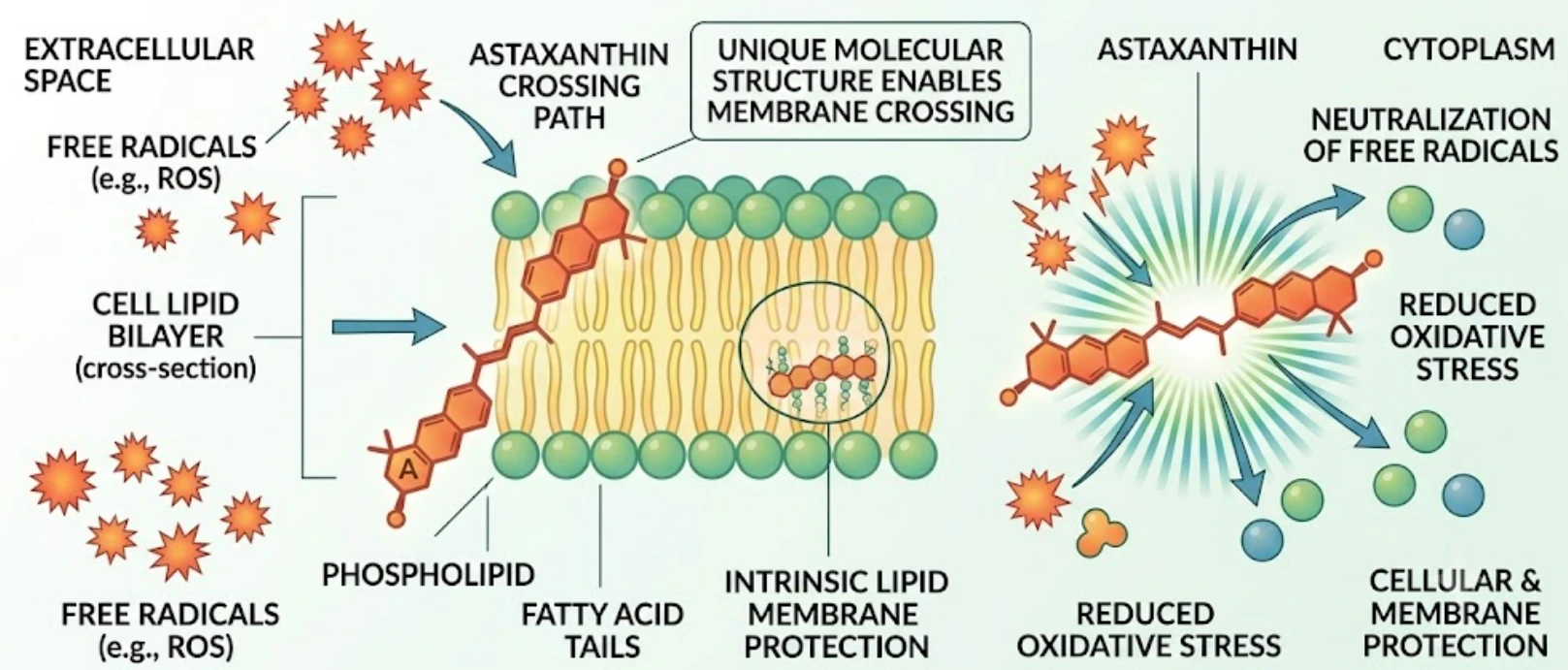
Most antioxidants act mainly in either the watery or the fatty compartment of a cell. Astaxanthin's molecular structure allows it to span the entire lipid bilayer of the cell membrane, with polar ends anchored on both surfaces — so it can interact with free radicals on the inside, the outside, and within the membrane itself. It is also able to cross the blood-brain and blood-retinal barriers, allowing it to reach tissues that many other carotenoids do not readily enter.
Unlike beta-carotene, astaxanthin is not converted into vitamin A in the body, so it does not carry the vitamin A toxicity concerns associated with high-dose retinol. It also does not act as a pro-oxidant under the conditions in which some other carotenoids can.
2. A Deep Dive Into Astaxanthin's Studied Effects
Skin Moisture, Elasticity, and UV-Related Stress
Astaxanthin is sometimes described as an internal complement to sun protection. It does not replace topical SPF, sunscreen, protective clothing, or shade — no oral supplement does. Small clinical studies, several conducted over 8 to 16 weeks, suggest it may help reduce UV-induced skin dryness, support moisture retention, and lessen the appearance of fine lines, with the proposed mechanism being protection of collagen and elastin fibres from oxidative damage[2]. The trials are generally small and often use combined oral and topical protocols, so the results should be read as encouraging rather than definitive.
Eye Comfort and Screen-Related Fatigue
Because astaxanthin reaches ocular tissue, it has been studied for its potential to ease digital eye strain and ciliary muscle fatigue associated with prolonged screen use. Several clinical trials, a number of them conducted in Japan, report improved visual comfort and accommodation with regular supplementation[3]. As with the skin research, sample sizes are modest and replication in larger independent trials would strengthen the case considerably.
Exercise, Recovery, and Muscle Fatigue
Astaxanthin has been investigated in athletes for markers of muscle damage and endurance performance, with mixed results — some trials report benefits in recovery markers, others find no significant difference. This remains an open question rather than a settled benefit.
Cardiovascular and Inflammatory Markers
Studies have examined effects on blood lipid profiles and inflammatory markers such as CRP, with some reporting favourable changes. These are biomarker studies; they do not demonstrate reduced risk of cardiovascular events, and astaxanthin should not be presented or used as a heart disease preventive.
What the Evidence Does and Doesn't Show
| Use | Strength of evidence | Notes |
|---|---|---|
| Skin moisture and elasticity | Preliminary / promising | Small trials, often 8–16 weeks |
| Eye comfort with screen use | Preliminary / promising | Several small trials, mainly from one region |
| Antioxidant activity in the body | Well supported mechanistically | Biomarker changes ≠ clinical outcomes |
| Exercise recovery | Mixed | Inconsistent findings |
| Cardiovascular or cognitive disease prevention | Insufficient | Not demonstrated; do not use for this purpose |
3. Shop Smart: How to Choose the Right Astaxanthin
Step 1: Natural (Haematococcus pluvialis) vs. Synthetic
- Natural (microalgae-derived): Extracted from Haematococcus pluvialis, this is the form used in essentially all human supplement research. It occurs mainly in esterified form and is generally reported to be more bioavailable than synthetic astaxanthin, though the size of the difference varies by study. Check the label for this source.
- Synthetic: Produced petrochemically and used largely in aquaculture feed to colour farmed fish. It has a different isomer profile and is generally considered less bioavailable; it is not the form studied in human trials.
- Krill or algae oil blends: Contain astaxanthin at low levels, typically as a natural stabilizer rather than at research-level doses. Check the actual milligram amount.
Step 2: Oil-Based Softgels
Astaxanthin is strongly fat-soluble. Softgels suspended in an oil base, taken alongside a meal containing fat, help support absorption into the bloodstream. Dry powder forms and gummies are generally less reliable for this reason.
Step 3: Dose, Freshness, and Testing
Look for a clearly stated milligram amount of astaxanthin (not just "algae extract" weight). Because carotenoids degrade with light and heat, opaque packaging and a visible expiry date matter more than they do for many other supplements. Independent testing seals (USP, NSF, Informed Choice) provide reassurance about identity and potency.
4. Everyday Habits: Getting Astaxanthin From Food
- Wild-Caught Salmon: Wild salmon acquire their pink hue from astaxanthin-rich microalgae and small crustaceans in the food chain. A typical serving contains a few milligrams at most — meaningful dietary intake, but generally lower than supplemental doses.
- Krill, Shrimp, and Crab: Good seafood sources of natural astaxanthin, alongside protein and omega-3 fatty acids.
- Trout and Red Sea Bream: Other coloured fish that accumulate carotenoids from their diet.
- Eat it with fat: Since absorption depends on dietary fat, pairing seafood or a supplement with a meal containing olive oil, avocado, or nuts is a practical habit.
- Complementary habits: For skin, consistent sunscreen use, sleep, and not smoking have far more established effects than any supplement. For eyes, regular breaks from screens, adequate blinking, and appropriate lighting remain the first-line approach.
5. The Perfect Match: Synergies and Incompatibilities
Nutrients rarely work in isolation. Thoughtful combinations can support absorption and complementary functions.
✅ Combinations That Make Sense Together
- Omega-3 Fatty Acids: A natural pairing — because astaxanthin is fat-soluble, omega-3 oils act as a carrier that supports absorption, and the two are frequently combined in eye and cardiovascular formulas.
- Vitamin E and Vitamin C: These act primarily in different cellular compartments, so combining them with astaxanthin covers a broader range of the antioxidant network.
- Lutein and Zeaxanthin: Carotenoids that concentrate in the macula and are the best-studied nutrients for the retina. They complement astaxanthin's role in eye comfort rather than duplicating it.
- A fat-containing meal: Not a supplement, but the single most practical factor in absorption.
❌ Points of Caution
- Few documented drug interactions: Astaxanthin has a good tolerability record in the studies conducted so far, and significant interactions have not been widely reported. That said, "few reported interactions" reflects a limited research base rather than proof of complete safety.
- Blood pressure and anticoagulant medication: Theoretical additive effects have been raised in the literature. Discuss with your physician if you take these medications.
- Immunosuppressants: Because astaxanthin has been studied for immune-modulating effects, consult your physician if you take these.
- Very high doses: Can temporarily impart a mild pinkish or orange tint to the skin (a carotenoid effect), which is harmless and reverses on stopping.
6. Dosage, Timing, and Safety
Typical Ranges Used in Research
- Common study range: 4–12 mg per day, with 6 mg and 12 mg being frequent choices in skin and eye trials.
- Timing: With a meal containing fat. Splitting a higher dose across two meals may support more consistent absorption.
- Duration: Skin and eye studies generally run 8 to 16 weeks, so a trial of at least two to three months is reasonable before judging.
Tolerability
Current research suggests astaxanthin from Haematococcus pluvialis is generally well tolerated at the doses studied. Occasionally reported effects include mild digestive upset, softer stools, and a temporary reddish tint to the skin at high intakes.
7. Frequently Asked Questions
Q. Can astaxanthin replace sunscreen?
A. No. It has been studied as a possible complement to sun protection, not a substitute. Continue using topical sun protection as recommended by dermatologists.
Q. How long before I might notice anything?
A. Studies typically measure outcomes after 8 to 16 weeks. Skin and eye changes, where they occur, are gradual and modest rather than dramatic.
Q. Why did my skin take on a slight orange tone?
A. This is a known, harmless carotenoid effect at higher intakes and reverses after reducing or stopping the supplement.
Q. Is more than 12 mg better?
A. Higher doses have been used in some studies, but there is no clear evidence that exceeding the common research range produces better results. Staying within studied amounts is the sensible default.
Q. Can I get enough from food alone?
A. Regular wild salmon and shellfish contribute meaningfully, but reaching the doses used in trials through diet alone would require unusually large intakes.
8. Conclusion and Precautions
Astaxanthin is a well-characterized carotenoid with a distinctive molecular structure and a genuine, if still developing, body of clinical research behind it. The most encouraging findings concern skin hydration and elasticity and comfort during prolonged screen use — from small studies that merit larger replication. It may help support skin, eye, and cellular health as part of a broader approach to everyday oxidative stress, with the understanding that sun protection, screen habits, sleep, and diet remain the foundation.
⚠️ Precautions: The FDA has not evaluated astaxanthin for the treatment of any medical condition, and this article is not medical advice. Most studies use daily doses between 4 mg and 12 mg taken with a fat-containing meal. Avoid if you have an allergy to algae or shellfish-derived sources, and consult a healthcare professional before starting long-term use — particularly if you are pregnant, breastfeeding, taking anticoagulant or blood pressure medication, or scheduled for surgery.
9. Sources and References
- National Institutes of Health (NIH) / PubMed — Astaxanthin: A Cellular Health Antioxidant
https://pubmed.ncbi.nlm.nih.gov/22021598/ - Ito et al., 2018 — The Protective Role of Astaxanthin for UV-Induced Skin Deterioration in Healthy People (Nutrients, PubMed)
https://pubmed.ncbi.nlm.nih.gov/29941810/ - Effects of diet containing astaxanthin on visual function in healthy individuals: a randomized, double-blind, placebo-controlled study (PubMed)
https://pubmed.ncbi.nlm.nih.gov/36777084/ - Astaxanthin: A Compound in the Prevention of Chronic Diseases and as a Potential Adjuvant Treatment Agent (PMC)
https://www.ncbi.nlm.nih.gov/pmc/articles/PMC12189495/ - Astaxanthin's role in cardiovascular, neuroprotective, hepatoprotective, and dermatological health — review (Inflammopharmacology, Springer)
https://link.springer.com/10.1007/s10787-025-02090-5 - Linus Pauling Institute, Oregon State University — Micronutrient Information Center: Carotenoids
https://lpi.oregonstate.edu
© 2026 Healing-Finder. All rights reserved.