The Complete Selenium Guide: Thyroid Function, Selenoproteins, and Synergies
1. Why Selenium Matters — and Why the Dose Range Is Narrow
Selenium is an essential trace mineral. The body incorporates it into around 25 selenoproteins, which carry out antioxidant defence, thyroid hormone metabolism, DNA synthesis, and immune functions[1].
Selenium content in food depends heavily on the soil where crops were grown, which varies enormously by region — soils in parts of China, Europe, and New Zealand are naturally low, while much of North America is relatively selenium-rich. This is why selenium status differs so much between populations, and why blanket statements about deficiency should be read with the local context in mind.
Requirements
| Group | RDA | Upper limit |
|---|---|---|
| Adults | 55 mcg/day | 400 mcg/day |
| Pregnancy | 60 mcg/day | 400 mcg/day |
| Breastfeeding | 70 mcg/day | 400 mcg/day |
| Children | Lower by age | Substantially lower — check age-specific limits |
Who Is More Likely to Be Low
- People living in regions with selenium-poor soil who eat mostly local produce
- People on long-term dialysis, or living with HIV
- People with severe gastrointestinal malabsorption, including after bariatric surgery or with Crohn's disease
- People on long-term exclusive parenteral (intravenous) nutrition without added selenium
Frank deficiency is uncommon in most developed countries. It has been associated historically with Keshan disease, a heart muscle disorder observed in selenium-poor regions of China, and with a form of joint disease — both in populations with severely low intakes, not in typical Western or Korean diets.
2. A Deep Dive Into Selenium's Studied Roles
Thyroid Hormone Metabolism
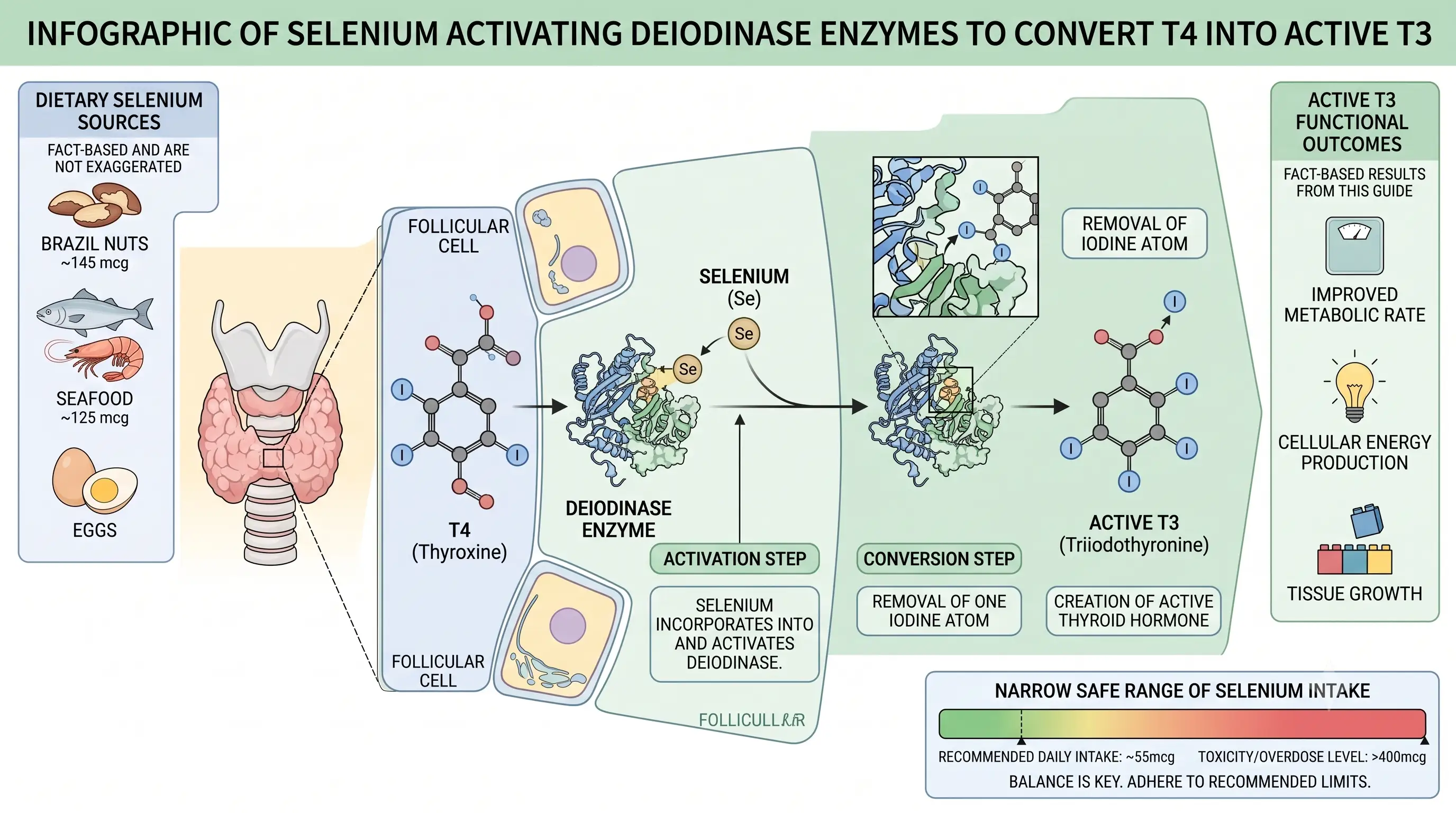
The thyroid contains the highest selenium concentration per gram of tissue in the body, and for good reason: the deiodinase enzymes that convert the relatively inactive T4 into active T3 are selenoproteins, as are the glutathione peroxidases that protect thyroid tissue from the oxidative stress generated during hormone synthesis[2]. This is well-established biochemistry.
What selenium supplementation does clinically is more nuanced. In autoimmune thyroiditis (Hashimoto's), several trials have reported reductions in thyroid peroxidase (TPO) antibody levels with selenium supplementation, though whether this translates into better thyroid function or clinical outcomes remains unresolved, and guidelines have not adopted routine supplementation. The clearest positive is elsewhere: in mild Graves' orbitopathy (thyroid eye disease), a randomized trial found benefit from a six-month course of selenium, and European thyroid guidance reflects that. That is a specific medical indication, managed by a specialist — not a general reason for anyone with thyroid concerns to start supplementing.
Antioxidant Defence
Glutathione peroxidases and thioredoxin reductases are selenium-dependent enzymes that neutralise peroxides and protect cell membranes from lipid peroxidation. Selenium is therefore genuinely central to the body's antioxidant system — though this is a reason to maintain adequate status, not a reason to take high doses.
Immune Function and Reproduction
Selenium status influences immune cell function, and deficiency has been associated with impaired responses. Selenoprotein P and glutathione peroxidase 4 also have roles in sperm development and male fertility.
Cancer Prevention — an Important Negative Result
Selenium was once one of the most promising candidates for cancer prevention, based on earlier trial data. The large SELECT trial then tested selenium and vitamin E for prostate cancer prevention in over 35,000 men and found no benefit; follow-up analyses raised concerns, including an increased risk of prostate cancer in some subgroups taking selenium. Separately, long-term selenium supplementation in a selenium-replete population was associated with an increased risk of type 2 diabetes in secondary analysis of an earlier trial. These findings are why the current position is clear: selenium supplementation is not recommended for cancer prevention, and high-dose long-term use in people who are already replete may do harm rather than good.
What the Evidence Does and Doesn't Show
| Use | Strength of evidence | Notes |
|---|---|---|
| Correcting deficiency | Well established | Relevant mainly in low-soil regions or malabsorption |
| Mild Graves' orbitopathy | Supported in guidance | Specialist-directed, time-limited course |
| Lowering TPO antibodies in Hashimoto's | Moderate; clinical meaning unclear | Not routinely recommended |
| Antioxidant enzyme function | Well established biochemistry | Adequacy matters, not excess |
| Cancer prevention | Not supported; possible harm | SELECT trial negative |
| General "immunity" or anti-ageing at high doses | Not supported | Risk rises with dose |
3. Shop Smart: How to Choose the Right Selenium
Step 1: Organic vs. Inorganic Forms
- Selenomethionine (organic): The predominant form in food. Well absorbed and incorporated into body proteins, giving better tissue retention. Note that this also means it accumulates, which matters for long-term high-dose use.
- Selenium-enriched yeast: Contains selenomethionine plus other selenium compounds; used in several major trials.
- Sodium selenite and selenate (inorganic): Less efficiently retained but not incorporated into general body protein, so they do not accumulate in the same way. Selenite is more sensitive to interactions with vitamin C.
Step 2: Dose — Lower Than You Might Expect
Most standalone selenium supplements provide 100–200 mcg, and many multivitamins already contain 55–70 mcg. Given that the RDA is 55 mcg and food contributes as well, adding up all your sources is essential — combining a multivitamin, a separate selenium supplement, and daily Brazil nuts can quietly approach or exceed the upper limit.
Step 3: Third-Party Testing
For a nutrient with this narrow a range, label accuracy matters more than usual. Look for USP or NSF verification or a published certificate of analysis.
4. Everyday Habits: Dietary Sources
- Brazil nuts — the most concentrated source, and the one to be careful with. A single Brazil nut can contain anywhere from roughly 70 to over 90 mcg of selenium, depending entirely on where it was grown, and some nuts contain far more. One nut can exceed the entire daily requirement. Eating a handful daily is a genuine route to excess intake — a small number per week is a reasonable habit, and reported cases of selenium toxicity from heavy Brazil nut consumption exist.
- Seafood: Tuna, sardines, shrimp, and halibut are reliable sources.
- Meat, poultry, and eggs: Beef, pork, chicken, and eggs contribute steadily.
- Organ meats: Beef liver and kidney are particularly rich.
- Whole grains and dairy: Contribute variable amounts depending on soil selenium.
- Practical point: For most people eating a varied diet including seafood or meat, selenium requirements are met without supplementation. This is a nutrient where testing status — via a physician, if there is a clinical reason — makes more sense than assuming.
5. The Perfect Match: Synergies and Incompatibilities
Nutrients rarely work in isolation, and selenium's relationships with iodine and vitamin E are particularly well characterised.
✅ Combinations That Work Well Together
- Iodine: The two work together in thyroid hormone production — iodine as the raw material, selenium in the enzymes that activate and protect. Correcting selenium deficiency without adequate iodine, or vice versa, can produce unintended effects on thyroid function, which is why thyroid nutrition is best handled with medical input rather than self-directed.
- Vitamin E: A classic antioxidant partnership — vitamin E intercepts lipid radicals in membranes and selenium-dependent enzymes regenerate the system. Adequate status of both matters more than high doses of either.
- Zinc: Also involved in thyroid hormone metabolism and immune function; commonly combined in trace mineral formulas at modest doses.
- N-Acetyl Cysteine (NAC): Supplies cysteine for glutathione, the substrate that selenium-dependent glutathione peroxidase uses.
❌ Points to Watch
- High-dose vitamin C with sodium selenite: Large doses of vitamin C taken simultaneously can reduce selenite to a poorly absorbed form. Separate them by a couple of hours, or use selenomethionine.
- Stacking multiple supplements: Multivitamins, "thyroid support" blends, prostate formulas, and antioxidant complexes frequently all contain selenium. This is the most common route to unintentional excess.
- Cisplatin and some chemotherapy agents: Selenium may interact; do not add during cancer treatment without oncology approval.
- Statin and niacin therapy: Some research has suggested antioxidant combinations including selenium may blunt the HDL-raising effect of these therapies. Discuss with your physician if relevant.
- Anticoagulants: Possible modest effects on clotting at high doses; inform your doctor.
6. Dosage, Timing, and Safety
Practical Approach
- If supplementing at all: 50–100 mcg daily is sufficient for most people, alongside dietary intake. Doses of 200 mcg are common in products but exceed what most people need.
- Never exceed 400 mcg per day from all sources combined without medical direction.
- Timing: With food, which improves tolerability. Absorption is generally good regardless.
- Duration: Because selenomethionine accumulates in tissue, indefinite high-dose use is the pattern most associated with problems. Periodic reassessment is sensible.
Check with a healthcare professional before supplementing if you: have a thyroid condition (particularly Hashimoto's or Graves' disease — selenium use here should be specialist-directed and time-limited); have diabetes or are at risk of it, given the signal from long-term high-dose use; are undergoing cancer treatment; take anticoagulants; or are pregnant or breastfeeding, where the recommended amounts are modest and prenatal vitamins usually cover them. Do not give selenium supplements to children without paediatric guidance, since age-specific upper limits are considerably lower.
7. Frequently Asked Questions
Q. Should I eat a Brazil nut every day?
A. A few per week is a reasonable way to cover selenium needs. Daily consumption of several is a real route to excess, because the selenium content per nut varies enormously and can be very high.
Q. I have Hashimoto's. Should I take selenium?
A. Some trials show reduced TPO antibodies, but whether that improves anything clinically is unresolved and guidelines do not recommend it routinely. This is a decision for your endocrinologist, not a self-directed one.
Q. Does selenium prevent cancer?
A. No. The large SELECT trial found no benefit for prostate cancer prevention, and follow-up analyses raised concerns about increased risk in some men. It should not be taken for this purpose.
Q. How do I know if I'm deficient?
A. Blood selenium or glutathione peroxidase activity can be measured, but testing is not routine and is usually reserved for people with malabsorption, on dialysis, or with a clinical reason. Dietary pattern and region are better first indicators.
Q. My breath smells like garlic since starting a supplement. Is that related?
A. Possibly — that is a recognised early sign of excess selenium. Stop, add up your total intake from all sources, and speak with a healthcare professional.
8. Conclusion and Precautions
Selenium is genuinely essential, with a well-defined and important role in thyroid hormone activation and antioxidant enzyme systems. It is also the clearest example on this site of a nutrient where adequacy is the goal and excess is a real risk — the gap between the recommended 55 mcg and the 400 mcg ceiling is unusually small, and the cancer prevention story ended in a negative trial rather than a triumph. For most people eating a varied diet with seafood or meat, no supplement is needed. Where supplementation makes sense — malabsorption, low-selenium regions, or a specialist-directed course for thyroid eye disease — modest doses and periodic reassessment are the right approach.
⚠️ Precautions: The FDA has not evaluated selenium supplements for the treatment of any medical condition, and this article is not medical advice. Do not exceed 400 mcg per day from all sources combined; add up multivitamins, blends, and Brazil nuts. Excess selenium (selenosis) causes garlic-like breath, hair loss, brittle nails, digestive upset, and neurological symptoms. Selenium is not recommended for cancer prevention. Consult a healthcare professional before supplementing if you have a thyroid condition, diabetes, are undergoing cancer treatment, are pregnant or breastfeeding, or are considering it for a child.
9. Sources and References
- National Institutes of Health (NIH), ODS — Selenium Fact Sheet for Health Professionals
https://ods.od.nih.gov/factsheets/Selenium-HealthProfessional/ - American Thyroid Association — Thyroid and nutrition resources
https://www.thyroid.org - Linus Pauling Institute, Oregon State University — Micronutrient Information Center: Selenium
https://lpi.oregonstate.edu - Harvard T.H. Chan School of Public Health, The Nutrition Source — Selenium
https://www.hsph.harvard.edu - Mayo Clinic — Selenium: Uses and risks
https://www.mayoclinic.org - Cleveland Clinic — Selenium
https://my.clevelandclinic.org
© 2026 Healing-Finder. All rights reserved.