The Complete Vitamin E Guide: Cellular Protection, Tocopherols, and Synergies
1. What Vitamin E Is and What It Actually Does
Vitamin E is not one compound but a family of eight: four tocopherols and four tocotrienols (alpha, beta, gamma, delta of each). Only alpha-tocopherol is recognised as meeting human requirements, because the liver has a specific transport protein that preferentially retains it and returns it to circulation while the other forms are largely metabolised and excreted[1].
Its defined biological function is narrow and well characterised: vitamin E embeds in cell membranes and lipoproteins and interrupts the chain reaction of lipid peroxidation — the process by which one oxidised fat molecule damages the next. It is the body's principal fat-phase antioxidant. It also has roles in immune function and in cell signalling.
Requirements and Limits
| Group | RDA (alpha-tocopherol) | Upper limit (supplemental) |
|---|---|---|
| Adults | 15 mg/day (≈22 IU natural, 33 IU synthetic) | 1,000 mg/day |
| Breastfeeding | 19 mg/day | 1,000 mg/day |
| Children | Lower by age | Substantially lower by age |
2. A Deep Dive Into Vitamin E's Studied Effects
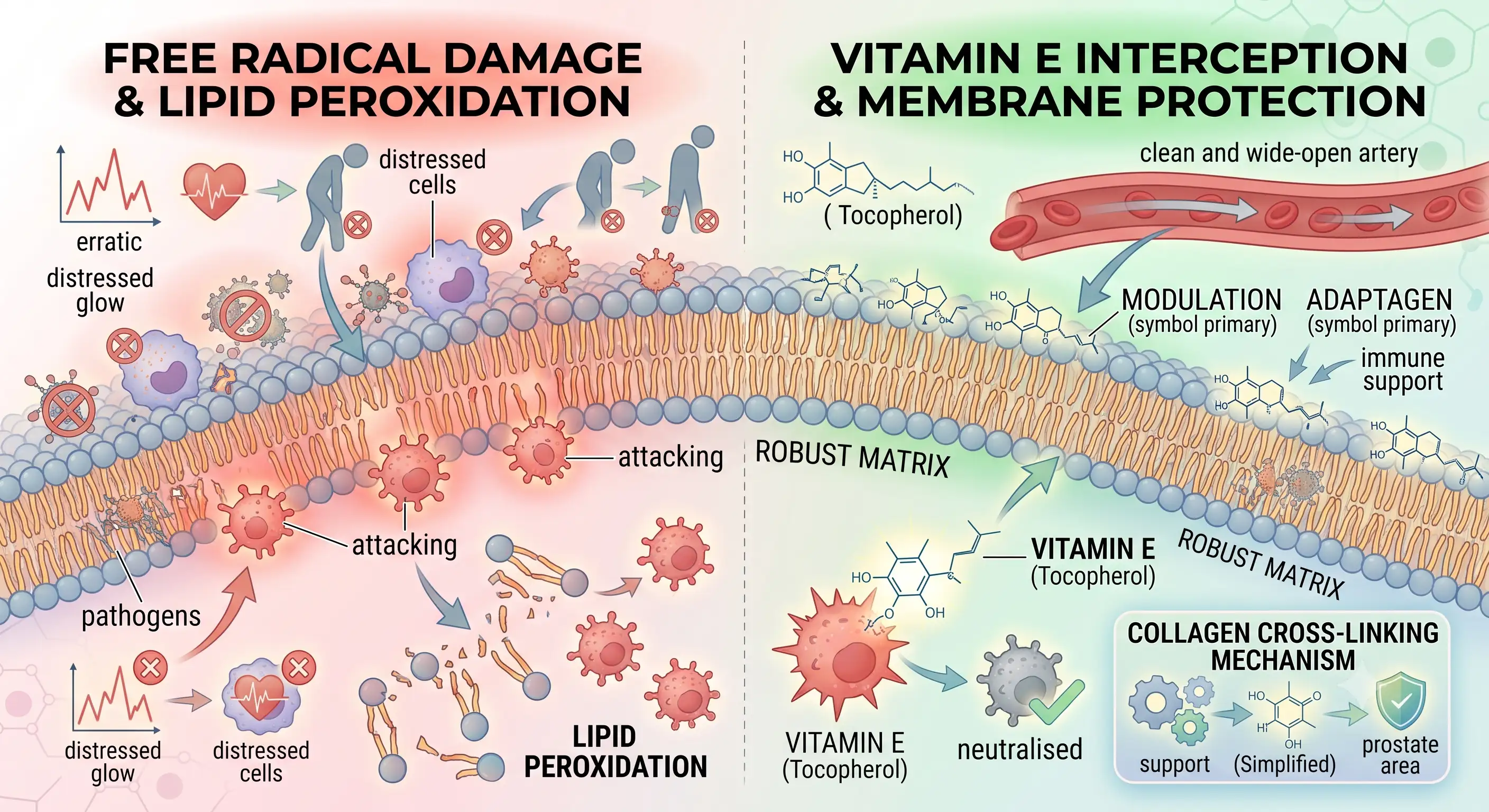
Membrane Antioxidant Protection
This role is not in dispute. Vitamin E terminates lipid peroxidation chain reactions in cell membranes and in circulating LDL particles, and it is regenerated by vitamin C after doing so. Adequate vitamin E status is genuinely part of the body's antioxidant defence system.
Cardiovascular Health — Where Theory Met Trials
The reasoning was compelling: oxidised LDL drives atherosclerotic plaque formation, vitamin E prevents LDL oxidation, therefore vitamin E should reduce heart disease. Large randomized trials tested this over years in tens of thousands of participants and did not find a reduction in cardiovascular events. Some trials also reported an increase in hemorrhagic stroke. This is one of the clearest cases in nutrition of a plausible mechanism failing to deliver a clinical outcome, and it is why this page does not present vitamin E as a heart health supplement.
Skin
Vitamin E is present in skin and in sebum and contributes to protection against oxidative damage, and it is widely used in topical formulations. Two honest qualifications: oral supplementation has not been shown to meaningfully improve skin appearance in well-nourished people, and the popular practice of applying vitamin E oil to scars has been examined in controlled studies that found no improvement in scar appearance, with a substantial proportion of participants developing contact dermatitis. That is worth knowing before piercing a capsule.
Eye Health
Vitamin E is one component of the AREDS2 formulation shown to slow progression in people with intermediate-to-advanced age-related macular degeneration. It was tested as part of a combination, not on its own — see our lutein guide for the details of who that applies to.
Liver — a Specific Medical Context
High-dose vitamin E has been studied in non-diabetic adults with biopsy-confirmed non-alcoholic steatohepatitis (NASH), and hepatology guidance mentions it as an option in that setting. This is a physician-directed use at doses well above the RDA, weighed against the safety considerations below — not a general recommendation.
What the Evidence Does and Doesn't Show
| Use | Strength of evidence | Notes |
|---|---|---|
| Preventing/treating deficiency | Definitive | Rare outside malabsorption conditions |
| Membrane antioxidant function | Well established | Biochemical role |
| AMD progression (as part of AREDS2) | Supported, in combination | Specific patient group only |
| Cardiovascular event prevention | Not supported | Large trials negative |
| Scar appearance (topical) | Not supported | Contact dermatitis common |
| Prostate cancer prevention | Negative — increased risk | See safety section |
3. Shop Smart: How to Choose the Right Vitamin E
Step 1: Natural (d-) vs. Synthetic (dl-)
Check the prefix carefully. d-alpha-tocopherol (also written RRR-alpha-tocopherol) is the natural form, and the liver's transport protein binds it preferentially. "dl-alpha-tocopherol" (all-rac-alpha-tocopherol) is synthetic and a mixture of eight stereoisomers, only some of which the body retains — which is why natural vitamin E is roughly twice as biologically available per unit weight. Note that the conversion between IU and mg differs between the two forms, so comparing products by IU alone can mislead. The natural form is the better choice.
Step 2: Mixed Tocopherols Over Isolated Alpha
Most supplements contain alpha-tocopherol alone. There is a reasonable argument for mixed tocopherols: high-dose alpha-tocopherol supplementation lowers blood levels of gamma-tocopherol, which is the predominant form in the diet and has its own studied properties. A mixed tocopherol product avoids skewing the balance. Tocotrienol products exist and are an area of research interest, with a thinner evidence base.
Step 3: Modest Doses and Verification
Many products supply 400 IU (about 268 mg natural) or more — far above the 15 mg RDA and in the range associated with the safety concerns in Section 6. A product providing roughly the RDA, or modestly above it, is the more defensible choice for general use. Look for USP or NSF verification, and check whether your multivitamin already supplies vitamin E.
4. Everyday Habits: Food Sources and Absorption
- Nuts and seeds: Sunflower seeds and almonds are outstanding — a small handful of sunflower seeds can supply a large share of the daily requirement. Hazelnuts and peanuts also contribute.
- Vegetable oils: Wheat germ oil is exceptionally rich; sunflower, safflower, and olive oil are good everyday sources.
- Greens, avocado, and fortified foods: Spinach, broccoli, avocado, and many fortified cereals contribute.
- Take with fat: As a fat-soluble vitamin, absorption depends on dietary fat. A softgel on an empty stomach is largely wasted.
- Food beats supplements here: This is a nutrient where the dietary form appears in observational research to be associated with good outcomes while the supplemental form has failed in trials. A handful of nuts is a better bet than a 400 IU capsule.
5. The Perfect Match: Synergies and Incompatibilities
Nutrients rarely work in isolation, and vitamin E's antioxidant partnerships are well characterised — as is its most important drug interaction.
✅ Combinations That Work Well Together
- Vitamin C: Regenerates oxidised vitamin E back to its active form, allowing it to continue protecting the membrane. A genuine, well-described biochemical partnership between the water- and fat-phase antioxidant systems.
- Selenium: Selenium-dependent glutathione peroxidase works alongside vitamin E in the same protective system. Keep selenium within recommended amounts, as it has a narrow safe range of its own.
- Dietary fat: Required for absorption.
- Omega-3: Quality fish oils include small amounts of vitamin E as a stabiliser against oxidation — a practical rather than physiological pairing.
❌ Requiring Real Caution
- Anticoagulant and antiplatelet medication: This is the most important interaction. High-dose vitamin E inhibits platelet aggregation and interferes with vitamin K-dependent clotting factors. Combined with warfarin, clopidogrel, or even regular aspirin, it can meaningfully increase bruising and bleeding risk. Discuss with your physician before combining.
- Before surgery: Stop high-dose vitamin E well in advance, following your surgical team's specific instructions.
- Chemotherapy and radiotherapy: Do not take high-dose antioxidants during cancer treatment without oncology approval.
- Statins and niacin: Some research suggested antioxidant combinations may blunt the HDL-raising effect of these therapies; mention your supplement use.
- Orlistat and bile acid sequestrants: Reduce absorption of fat-soluble vitamins.
6. Dosage and Safety
Practical Approach
- RDA: 15 mg of alpha-tocopherol daily, readily achievable from food.
- If supplementing: Doses near the RDA, or in a mixed tocopherol form, are the more defensible choice for general use.
- Upper limit: 1,000 mg/day of supplemental alpha-tocopherol — but note that the concerns below appear at doses well below that ceiling.
- Timing: With a fat-containing meal.
Prostate cancer: the large SELECT trial randomised over 35,000 men to vitamin E (400 IU daily), selenium, both, or placebo. Vitamin E supplementation was associated with a statistically significant increase in prostate cancer incidence — roughly 17% higher than placebo in extended follow-up. Men, and particularly those concerned about prostate health, should not take high-dose vitamin E supplements.
Bleeding and mortality: high-dose vitamin E increases bleeding tendency, and some trials reported an increase in hemorrhagic stroke. A widely discussed meta-analysis also suggested that daily doses at or above 400 IU may be associated with increased all-cause mortality — a finding that has been debated methodologically but has not been dismissed.
Consult a healthcare professional before high-dose use if you: take anticoagulant or antiplatelet medication; have a bleeding disorder or a history of hemorrhagic stroke; have vitamin K deficiency; are scheduled for surgery; are undergoing cancer treatment; or are pregnant or breastfeeding. Do not give high-dose vitamin E supplements to children.
7. Frequently Asked Questions
Q. Should I take a 400 IU vitamin E capsule daily?
A. For most people, no. That dose is far above the RDA, sits in the range associated with the prostate cancer and bleeding findings, and has not shown benefit in large trials. Getting vitamin E from nuts, seeds, and oils is the better approach.
Q. Does vitamin E oil help scars?
A. Controlled studies found no improvement in scar appearance, and a substantial proportion of participants developed contact dermatitis. It is a popular practice without supporting evidence.
Q. Natural or synthetic?
A. Natural (d-alpha-tocopherol / RRR) is roughly twice as bioavailable as synthetic (dl-alpha). If you supplement, choose natural — and be careful comparing products by IU, since the conversion differs by form.
Q. Am I likely to be deficient?
A. Very unlikely unless you have a fat malabsorption condition. Vitamin E is abundant in ordinary foods, and dietary deficiency is essentially unknown in healthy people.
Q. My eye supplement contains vitamin E. Is that a problem?
A. The AREDS2 formulation was tested as a complete combination in people with intermediate-to-advanced AMD, and should be used under an eye care professional's guidance. Do not add a separate high-dose vitamin E capsule on top of it.
8. Conclusion and Precautions
Vitamin E is an essential nutrient with a clearly defined and genuinely important role as the body's principal fat-phase antioxidant. It is also a cautionary tale about extrapolating from mechanism to supplementation: the large trials testing high-dose vitamin E for heart disease were negative, the prostate cancer finding was actively unfavourable, and the bleeding risk is real. Adequate intake matters and is easy to achieve from nuts, seeds, and oils. High-dose supplementation is a different proposition, and for most people it is not a good one.
⚠️ Precautions: The FDA has not evaluated vitamin E supplements for the treatment of any medical condition, and this article is not medical advice. High-dose supplementation was associated with increased prostate cancer incidence in a large trial, and with increased bleeding tendency and hemorrhagic stroke in others. Do not exceed 1,000 mg/day of supplemental alpha-tocopherol, and prefer doses near the 15 mg RDA. Stop high-dose vitamin E before scheduled surgery as your surgical team advises. Consult a healthcare professional before use if you take anticoagulant or antiplatelet medication, have a bleeding disorder, or are undergoing cancer treatment.
9. Sources and References
- National Institutes of Health (NIH), ODS — Vitamin E Fact Sheet for Health Professionals
https://ods.od.nih.gov/factsheets/VitaminE-HealthProfessional/ - Linus Pauling Institute, Oregon State University — Micronutrient Information Center: Vitamin E
https://lpi.oregonstate.edu - National Cancer Institute — Selenium and Vitamin E Cancer Prevention Trial (SELECT)
https://www.cancer.gov - Harvard T.H. Chan School of Public Health, The Nutrition Source — Vitamin E
https://www.hsph.harvard.edu - Mayo Clinic — Vitamin E: Uses and risks
https://www.mayoclinic.org - Cleveland Clinic — Vitamin E
https://my.clevelandclinic.org
© 2026 Healing-Finder. All rights reserved.