The Complete Lutein Guide: Macular Pigment, Blue Light, and Zeaxanthin Synergies
1. What Lutein Does in the Eye
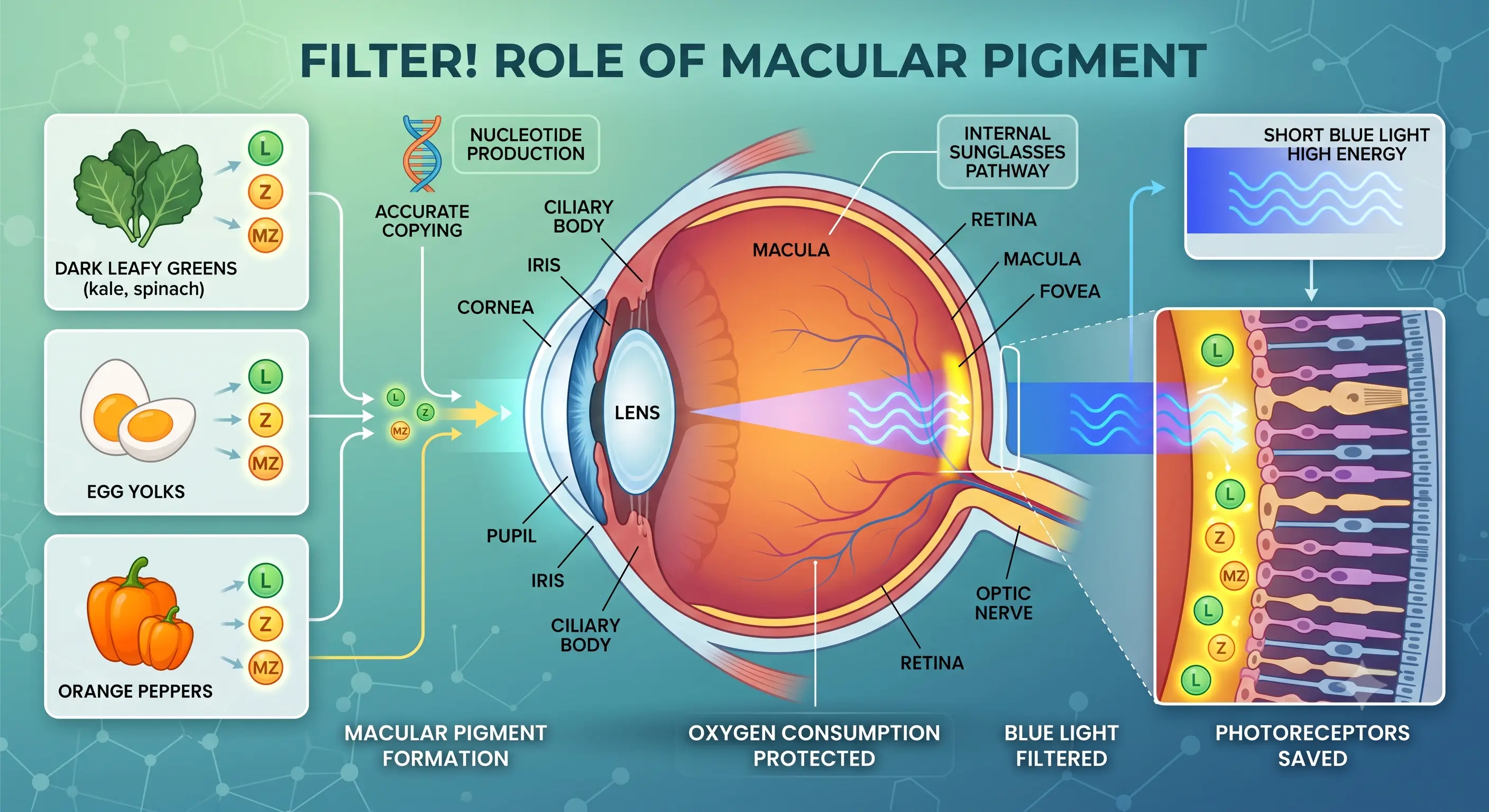
Lutein and its close relative zeaxanthin are dietary carotenoids that the body cannot synthesize. Uniquely among carotenoids, they accumulate selectively in the macula — the small central region of the retina responsible for sharp detail vision — where together with meso-zeaxanthin they form the yellow macular pigment[1].
That pigment has two proposed functions. It absorbs high-energy short-wavelength (blue) light before it reaches the photoreceptors, and it acts as a local antioxidant in a tissue with exceptionally high oxygen consumption and light exposure. This is why lutein is often described as "internal sunglasses" — a useful metaphor, provided it is not read as protection equivalent to actual sunglasses or UV protection.
Macular pigment density varies widely between individuals, is influenced by dietary intake, and tends to be lower in smokers and in people with low vegetable consumption. Supplementation reliably raises blood levels and, over months, macular pigment optical density — that much is well established. What that translates to functionally is where the evidence needs care.
2. A Deep Dive Into Lutein's Studied Effects
AREDS2 and Macular Degeneration — What It Actually Found
The Age-Related Eye Disease Studies (AREDS and AREDS2) are the reference point for this entire category, and they are frequently misdescribed. AREDS2, run by the National Eye Institute, tested adding lutein and zeaxanthin to the original AREDS antioxidant and zinc formulation in people who already had intermediate AMD, or advanced AMD in one eye[2].
Reported accurately: in the primary analysis, adding lutein/zeaxanthin did not produce a statistically significant additional reduction in progression compared with the original formulation. However, secondary analyses and the ten-year follow-up found that the lutein/zeaxanthin formulation performed better than the beta-carotene version, and that participants with the lowest dietary lutein intake benefited most. On that basis — and because beta-carotene increased lung cancer risk in current and former smokers — the NEI-recommended AREDS2 formulation now uses lutein and zeaxanthin in place of beta-carotene.
Two things follow, and both matter. The AREDS2 formulation slows progression in people who already have intermediate-to-advanced AMD; it has not been shown to prevent AMD in the general population, nor to help those with early AMD or no AMD. And anyone concerned about macular degeneration should be examined by an eye care professional, since AMD is diagnosed by examination and its treatment depends on the type and stage.
Screen Fatigue, Glare, and Visual Comfort
Several smaller randomized trials have examined lutein and zeaxanthin in healthy adults with heavy screen exposure, reporting improvements in measures such as glare recovery time, contrast sensitivity, and self-reported eye strain over 6 to 12 months. The findings are moderately encouraging but come from small studies, some industry-funded, and the subjective nature of eye strain makes placebo effects substantial. Increased macular pigment density is a consistent and objectively measurable finding; the functional benefits are more variable.
Cataract
Observational studies have associated higher dietary lutein and zeaxanthin intake with lower rates of cataract requiring surgery. In AREDS2 itself, lutein/zeaxanthin supplementation did not significantly reduce cataract progression overall, though a benefit appeared in participants with the lowest dietary intake. Diet appears to matter more here than supplementation.
Cognition and Other Areas
Lutein also accumulates in brain tissue, and small studies have explored associations with cognitive measures. This is early-stage research and does not support claims.
What the Evidence Does and Doesn't Show
| Use | Strength of evidence | Notes |
|---|---|---|
| Raising macular pigment density | Well established | Objectively measurable over months |
| Slowing progression of intermediate-to-advanced AMD (AREDS2 formula) | Supported, in that specific population | Under eye care supervision |
| Preventing AMD in the general population | Not established | Common marketing overreach |
| Glare recovery, contrast, screen-related eye strain | Preliminary / moderate | Small trials, some industry-funded |
| Cataract prevention | Dietary association; supplement effect unclear | AREDS2 largely neutral |
3. Shop Smart: How to Choose the Right Lutein
Step 1: Lutein and Zeaxanthin Together
- Lutein alone: Concentrates in the outer macula. Useful, but covers only part of the tissue.
- Lutein + Zeaxanthin: Zeaxanthin predominates at the very centre of the macula, so the pair covers the full area. The AREDS2 formulation used 10 mg lutein and 2 mg zeaxanthin — a 5:1 ratio that has become the practical reference point.
- Meso-zeaxanthin: Formed in the retina from lutein and included in some products. Whether adding it orally offers extra benefit is not well established.
Step 2: Free Form vs. Ester Form
Free-form lutein (as found in vegetables, and used in patented ingredients such as FloraGLO) is absorbed directly. Esterified lutein, typically from marigold, must be cleaved by intestinal enzymes first. Free form is generally reported to be more efficiently absorbed milligram for milligram; note that ester products sometimes list the higher pre-cleavage weight, so compare the actual free lutein content.
Step 3: Oil Base and Verification
Lutein is fat-soluble, so softgels in an oil base — taken with a meal containing fat — support absorption better than dry tablets. Look for third-party verification (USP, NSF) and note that carotenoids degrade with light and heat, so opaque packaging and a clear expiry date matter.
4. Everyday Habits: Getting Lutein From Food
- Dark leafy greens: Kale, spinach, and Swiss chard are by far the densest dietary sources — a single cooked cup of spinach can supply well over 10 mg.
- Egg yolks: Lower in total lutein than greens, but the accompanying fat and phospholipids make it unusually well absorbed. A practical everyday source.
- Corn, peas, broccoli, and orange peppers: Useful additions, with orange peppers being notably rich in zeaxanthin specifically.
- Cook with fat: Lightly sautéing greens in olive oil substantially increases the amount you absorb — one of the clearest food-preparation effects in nutrition.
- The habits that protect vision most: Not smoking (the strongest modifiable risk factor for AMD), managing blood pressure, wearing UV-blocking sunglasses outdoors, regular eye examinations, and the 20-20-20 rule for screen work — every 20 minutes, look 20 feet away for 20 seconds. Dry eye from reduced blinking at screens is also worth addressing directly.
5. The Perfect Match: Synergies and Incompatibilities
Nutrients rarely work in isolation, and carotenoid absorption in particular is affected by what else is in the gut at the same time.
✅ Combinations That Work Well Together
- Zeaxanthin: The natural partner, covering the central macula. Most quality products already combine them.
- Omega-3 (DHA): DHA is highly concentrated in the retina and, being an oil, aids absorption of fat-soluble lutein. Note that in AREDS2 itself, adding omega-3 did not further slow AMD progression — so this pairing is sensible for absorption and general eye health rather than proven for AMD.
- Vitamin C, Vitamin E, and Zinc: These are the other components of the AREDS2 formulation, which was tested as a complete combination — not as individual ingredients.
- Dietary fat at the same meal: The simplest and most effective absorption factor.
❌ Points to Watch
- High-dose beta-carotene: Competes with lutein for the same absorption pathways and can meaningfully reduce lutein uptake. Beyond that, beta-carotene supplements increased lung cancer risk in smokers in earlier trials — which is precisely why AREDS2 replaced it. Separate them, and see the warning below.
- Fat-blocking agents (orlistat) and very low-fat diets: Both substantially reduce carotenoid absorption.
- Bile acid sequestrants and some cholesterol medications: May reduce absorption of fat-soluble nutrients; space them apart.
- Plant sterol supplements: Can modestly lower carotenoid absorption with regular use.
6. Dosage, Timing, and Safety
Typical Ranges
- AREDS2 formulation: 10 mg lutein + 2 mg zeaxanthin daily, as part of the complete formula.
- General eye support: Commonly 10–20 mg lutein daily. There is no established benefit to exceeding this.
- Timing: With the largest fat-containing meal of the day.
- Duration: Macular pigment builds slowly — studies typically measure changes over 3 to 12 months. This is a long-horizon supplement, not one that produces noticeable short-term effects.
Tolerability
Lutein has an excellent safety record and is widely consumed in food. The main reported effect at very high long-term intakes is carotenemia — a harmless, reversible yellowing of the skin. Rare case reports have described crystalline deposits in the retina with extremely high prolonged intake, which resolved after stopping.
Also: see an eye care professional rather than self-treating if you have blurred vision, distorted or wavy straight lines, a dark or empty area in your central vision, sudden floaters or flashes, or any sudden change in vision — some of these are urgent. And if you have been diagnosed with AMD or another eye condition, supplement choice should be part of your ophthalmologist's plan. Safety data in pregnancy for high-dose supplements are limited; dietary intake is not a concern.
7. Frequently Asked Questions
Q. Will lutein prevent macular degeneration?
A. That has not been shown. The AREDS2 evidence concerns slowing progression in people who already have intermediate-to-advanced AMD. For general prevention, not smoking, blood pressure control, and a vegetable-rich diet have better support.
Q. Does it help with screen eye strain?
A. Some small trials suggest modest improvements in glare recovery and comfort over several months. It is worth trying if screen fatigue bothers you, alongside screen-break habits and addressing dry eye — but expect gradual, subtle change rather than a fix.
Q. How long until anything happens?
A. Macular pigment increases measurably over roughly 3 to 6 months. Any subjective change follows that timeline, not days or weeks.
Q. Can I get enough from food?
A. Yes, comfortably — a serving of cooked spinach or kale can exceed the AREDS2 amount. Food is the better first option, with the caveat that AMD patients following the AREDS2 protocol should use the tested formulation.
Q. Should I take it with my multivitamin?
A. Check whether your multivitamin contains beta-carotene, which competes for absorption — and which you should avoid entirely if you smoke or used to.
8. Conclusion and Precautions
Lutein and zeaxanthin are among the better-grounded supplements in the eye category: they have a specific, measurable biological role, they demonstrably increase macular pigment, and they form part of a formulation recommended by the National Eye Institute for a defined patient group. The important nuance is who that group is — the AREDS2 evidence is about slowing progression in existing intermediate-to-advanced AMD, not about prevention in healthy eyes. For general use, they may help support eye comfort and healthy ageing, particularly for people with low vegetable intake or heavy screen exposure, with realistic expectations and a long time horizon.
⚠️ Precautions: The FDA has not evaluated lutein for the treatment or prevention of any medical condition, and this article is not medical advice. Smokers and former smokers should avoid supplements containing beta-carotene, which is present in older AREDS-formula eye products. Very high long-term intakes can cause harmless, reversible yellowing of the skin. Stick to around 10–20 mg daily, take it with a fat-containing meal, and consult an eye care professional if you have a diagnosed eye condition or any sudden change in vision.
9. Sources and References
- National Institutes of Health (NIH), Office of Dietary Supplements — Lutein and Zeaxanthin
https://ods.od.nih.gov - National Eye Institute (NEI) — Age-Related Eye Disease Studies (AREDS/AREDS2)
https://www.nei.nih.gov/eye-health-information/clinical-trials/age-related-eye-disease-studies-aredsareds2 - Harvard Health Publishing — Protecting your eyes from macular degeneration
https://www.health.harvard.edu - American Optometric Association (AOA) — Lutein & Zeaxanthin
https://www.aoa.org - Mayo Clinic — Macular degeneration and nutritional supplements
https://www.mayoclinic.org - American Academy of Ophthalmology — Nutrition and eye health
https://www.aao.org
© 2026 Healing-Finder. All rights reserved.