The Complete Zinc Guide: Immunity, Hormones, and Forms
1. Why Zinc Matters
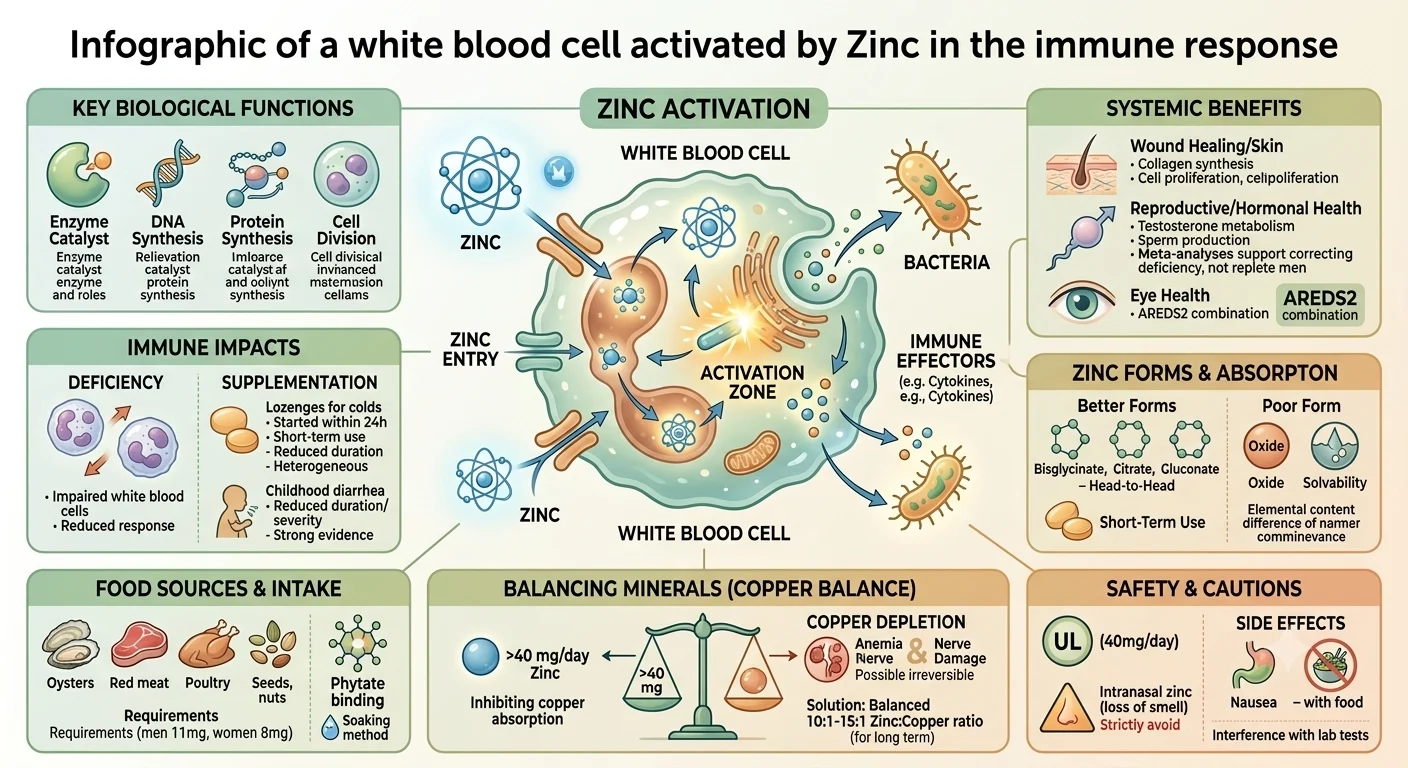
Zinc is an essential trace mineral that serves as a structural or catalytic component for hundreds of enzymes and for a large family of "zinc finger" transcription factors that regulate gene expression. It is involved in DNA synthesis, cell division, protein synthesis, immune function, wound healing, and the senses of taste and smell[1].
The body has no dedicated zinc storage system, so a steady dietary supply matters. Deficiency develops gradually rather than suddenly, and can present as impaired immune function, slow wound healing, hair loss, reduced appetite, altered taste or smell, and skin changes — though all of these have many other causes and none of them confirms zinc deficiency on its own.
Requirements and the Upper Limit
| Group | RDA | Upper limit |
|---|---|---|
| Adult men | 11 mg/day | 40 mg/day |
| Adult women | 8 mg/day | 40 mg/day |
| Pregnancy | 11–12 mg/day | 34–40 mg/day |
| Breastfeeding | 12–13 mg/day | 34–40 mg/day |
| Children | Lower by age | Substantially lower by age |
Who Is More Likely to Be Low
- Vegetarians and vegans: Plant foods contain phytates that bind zinc and reduce absorption, and requirements may be up to 50% higher on a plant-based diet.
- Older adults: Lower intake and reduced absorption efficiency.
- People with malabsorption: Crohn's disease, celiac disease, chronic diarrhoea, or after bariatric surgery.
- People with chronic heavy alcohol use, which reduces absorption and increases urinary loss.
- People on long-term diuretics or certain medications, which increase excretion.
- People with sickle cell disease and some chronic conditions.
2. A Deep Dive Into Zinc's Studied Effects
Immune Function and the Common Cold
Zinc is required for the development and function of neutrophils, natural killer cells, and T-lymphocytes, and deficiency measurably impairs immune responses. That much is well established.
On colds specifically: pooled analyses suggest that zinc lozenges started within 24 hours of symptom onset may shorten cold duration, with reported reductions varying considerably between studies. The evidence is genuinely heterogeneous — trials differ in the zinc salt used, the dose, and whether the lozenge formulation released free zinc ions, and results differ accordingly. Zinc acetate and gluconate lozenges at relatively high doses appear in the more positive studies. Taking zinc continuously to prevent colds has weaker support, and the doses used in the lozenge studies are well above the daily upper limit, which is why they are intended for short-term use only[2].
Childhood Diarrhoea — the Strongest Public Health Application
Zinc supplementation reduces the duration and severity of acute diarrhoea in children in settings where deficiency is common, and it is part of standard World Health Organization guidance alongside oral rehydration. This is one of the best-evidenced uses of any micronutrient supplement.
Wound Healing and Skin
Zinc participates in collagen synthesis, cell proliferation, and inflammatory regulation, and deficiency impairs wound healing. Supplementation accelerates healing in people who are deficient; evidence that it helps in those already replete is limited. Zinc has also been studied in acne, with some trials reporting modest improvement — generally less than standard treatments, but a reasonable adjunct to discuss with a dermatologist.
Reproductive and Hormonal Health
Zinc is concentrated in the prostate and is involved in testosterone metabolism and sperm production. Correcting deficiency can improve these measures; there is no good evidence that supplementing beyond adequacy raises testosterone in men who are already replete, despite the marketing.
Eye Health
Zinc is a component of the AREDS2 formulation shown to slow progression in intermediate-to-advanced age-related macular degeneration — tested as part of a combination, in a specific patient group, under eye care supervision.
What the Evidence Does and Doesn't Show
| Use | Strength of evidence | Notes |
|---|---|---|
| Correcting deficiency | Definitive | — |
| Childhood diarrhoea (deficient settings) | Strong; WHO guidance | Public health application |
| Shortening cold duration (lozenges, within 24h) | Moderate but heterogeneous | Short-term use only; high doses |
| Preventing colds with daily use | Weaker | — |
| AMD progression (as part of AREDS2) | Supported, in combination | Specific patient group |
| Raising testosterone in replete men | Not supported | Common marketing claim |
3. Shop Smart: How to Choose the Right Zinc
Step 1: Form and Elemental Content
- Zinc picolinate, citrate, gluconate, and bisglycinate: All reasonably well absorbed and generally well tolerated. Picolinate is often described as the best absorbed, though the head-to-head evidence is thinner than the marketing implies — any of these is a sound choice.
- Zinc oxide: Inexpensive and high in elemental zinc by weight, but poorly soluble and less well absorbed. Common in cheap multivitamins.
- Zinc sulfate: Effective but more likely to cause nausea.
- Zinc acetate or gluconate lozenges: The forms used in cold studies, designed to release free zinc ions in the throat. Distinct from daily supplementation.
- Zinc carnosine: A specialised form studied in Japan for gastric mucosal support, including alongside standard medical care. Diagnosis and treatment of ulcers requires a physician.
Always read the elemental zinc figure. "Zinc gluconate 50 mg" may provide only around 7 mg of elemental zinc, while "zinc 50 mg" usually means 50 mg elemental — a difference of sevenfold, and a common source of confusion.
Step 2: Dose Within the Limit and Consider Copper
15–30 mg of elemental zinc daily is more than sufficient for most adults as a maintenance dose, against an RDA of 8–11 mg. If you plan to take more than 25–30 mg daily for longer than a few weeks, a product including a small amount of copper is sensible — see Section 6.
Step 3: Third-Party Testing
Look for USP or NSF verification. Also check whether your multivitamin, prostate formula, or immune blend already contains zinc, since stacking is the usual way people end up above 40 mg without realising.
4. Everyday Habits: Getting Zinc From Food
- Oysters: By a wide margin the richest food source — a single serving can supply several times the daily requirement.
- Red meat and poultry: Beef, lamb, and dark poultry meat are the main dietary contributors in most diets, and animal-source zinc is well absorbed.
- Crab, shrimp, and shellfish: Good sources.
- Pumpkin seeds, hemp seeds, cashews, lentils, chickpeas: Useful plant sources, though phytates reduce absorption.
- Improve plant-source absorption: Soaking, sprouting, fermenting, and leavening bread with yeast all reduce phytate content and meaningfully improve zinc availability — traditional food preparation methods that turn out to have a nutritional rationale.
- Take supplements with food: Zinc on an empty stomach is a well-known cause of sudden, intense nausea. Taking it mid-meal or at the end of a meal largely prevents this, at the cost of slightly reduced absorption — a trade-off worth making.
5. The Perfect Match: Synergies and Incompatibilities
Nutrients rarely work in isolation, and zinc has one of the most consequential mineral interactions in the cabinet.
✅ Combinations That Work Well Together
- Vitamin C: Commonly paired for immune support. The two act through different routes and are frequently combined; the pairing is sensible rather than synergistic in a strict sense.
- Vitamin A: A genuine and well-described relationship — zinc is required to produce retinol-binding protein, which transports vitamin A out of the liver. Zinc deficiency can produce functional vitamin A deficiency.
- Copper — as a balance, not a booster: The most important pairing for anyone on long-term zinc. A ratio in the region of 10:1 to 15:1 zinc to copper is commonly used in supplements designed for extended use.
- Quercetin: Described in laboratory research as a zinc ionophore that facilitates zinc movement into cells. This is an in vitro observation, and claims that the combination halts viral replication in people go well beyond what has been demonstrated — treat it as an interesting hypothesis rather than an established use.
❌ Separate These or Use Caution
- Copper depletion: Zinc and copper compete for the same intestinal transporter, and sustained high-dose zinc induces a protein that traps copper in intestinal cells. This is the single most important long-term risk — see Section 6.
- Iron and Calcium: High doses compete with zinc for absorption. Separate supplemental doses by at least two hours.
- Quinolone and tetracycline antibiotics: Zinc binds them and substantially reduces absorption. Separate by at least 2 hours before or 4–6 hours after, as your pharmacist directs.
- Penicillamine and bisphosphonates: Zinc reduces their absorption and effectiveness.
- Thiazide diuretics: Increase urinary zinc loss with long-term use.
- High-phytate meals: Whole grains and legumes reduce zinc absorption; not a reason to avoid them, but a reason not to take a zinc supplement with a large bran-heavy meal.
6. Dosage, Timing, and Safety
Practical Approach
- Maintenance: 15–30 mg of elemental zinc daily is ample; the RDA is 8–11 mg.
- Upper limit: 40 mg/day from all sources for adults.
- Cold lozenges: Used at higher short-term doses started within 24 hours of symptoms, for no more than about a week. Not a daily regimen.
- Timing: With or just after food, to avoid nausea. Separate from iron, calcium, and the antibiotics listed above.
Other Cautions
- Acute high doses cause nausea, vomiting, abdominal cramps, headache, and a metallic taste.
- Kidney disease: Impaired clearance; supplement only under medical supervision.
- Pregnancy and breastfeeding: Stay within recommended amounts; prenatal vitamins usually cover requirements.
- Children: Upper limits are much lower by age; do not give adult supplements.
- Before surgery or if taking multiple medications: Mention zinc to your clinician, given the absorption interactions.
7. Frequently Asked Questions
Q. Does zinc actually help with colds?
A. Lozenges started within 24 hours of symptoms may shorten duration, though results across studies vary considerably by formulation and dose. Taking zinc daily to prevent colds has weaker support, and the lozenge doses are short-term only.
Q. Is 50 mg a day safe?
A. It exceeds the 40 mg upper limit. Short-term use is unlikely to cause problems, but months at that dose risks copper deficiency. For ongoing use, 15–30 mg is the sensible range.
Q. Will zinc raise my testosterone?
A. Correcting a deficiency can improve hormone measures. There is no good evidence that supplementing beyond adequacy raises testosterone in men who are already replete.
Q. Why does zinc make me feel sick?
A. Zinc on an empty stomach commonly causes sudden nausea, and zinc sulfate is the worst offender. Take it mid-meal and consider switching to picolinate, citrate, or bisglycinate.
Q. Do I need copper with my zinc?
A. Not for short courses or modest doses. If you take more than about 25–30 mg daily for months, a product including a small amount of copper is a sensible precaution.
Q. I'm vegetarian — do I need more?
A. Possibly. Phytates in grains and legumes reduce absorption, and requirements may be up to 50% higher. Soaking, sprouting, and fermenting help meaningfully.
8. Conclusion and Precautions
Zinc is a genuinely essential mineral with well-defined roles in immunity, cell division, wound healing, and the chemical senses, and it has one of the strongest public health track records of any micronutrient in childhood diarrhoea. For colds, the lozenge evidence is real but heterogeneous and applies to short-term use started early. The main thing to get right is the dose: 15–30 mg daily covers most people, 40 mg is the ceiling, and the long-term risk in this category is copper depletion from quietly stacking products — not deficiency.
⚠️ Precautions: The FDA has not evaluated zinc supplements for the treatment of any medical condition, and this article is not medical advice. Do not exceed 40 mg of elemental zinc per day from all sources; prolonged higher intakes cause copper deficiency, which can produce anemia and potentially irreversible nerve damage. Do not use intranasal zinc products, which have been associated with long-lasting or permanent loss of smell. Zinc reduces the absorption of quinolone and tetracycline antibiotics, bisphosphonates, iron, and calcium — separate doses. Take with food to avoid nausea, and consult a healthcare professional before long-term use, especially if you have kidney disease or take prescription medication.
9. Sources and References
- National Institutes of Health (NIH), ODS — Zinc Fact Sheet for Health Professionals
https://ods.od.nih.gov/factsheets/Zinc-HealthProfessional/ - Mayo Clinic — Zinc: Uses and risks
https://www.mayoclinic.org - Harvard T.H. Chan School of Public Health, The Nutrition Source — Zinc
https://www.hsph.harvard.edu - Cleveland Clinic — Zinc supplements
https://my.clevelandclinic.org - Linus Pauling Institute, Oregon State University — Micronutrient Information Center: Zinc
https://lpi.oregonstate.edu - U.S. Food and Drug Administration — Consumer warning on intranasal zinc products
https://www.fda.gov - World Health Organization — Zinc supplementation in the management of childhood diarrhoea
https://www.who.int
© 2026 Healing-Finder. All rights reserved.