The Complete Saw Palmetto Guide: Prostate Comfort, DHT, and Synergies
1. What Saw Palmetto Is and the Rationale Behind It
Saw Palmetto (Serenoa repens) is a small palm native to the southeastern United States. Its dark berries have a long history of traditional use for urinary and reproductive health, and extracts of the berry are among the most widely sold men's health supplements worldwide[1].
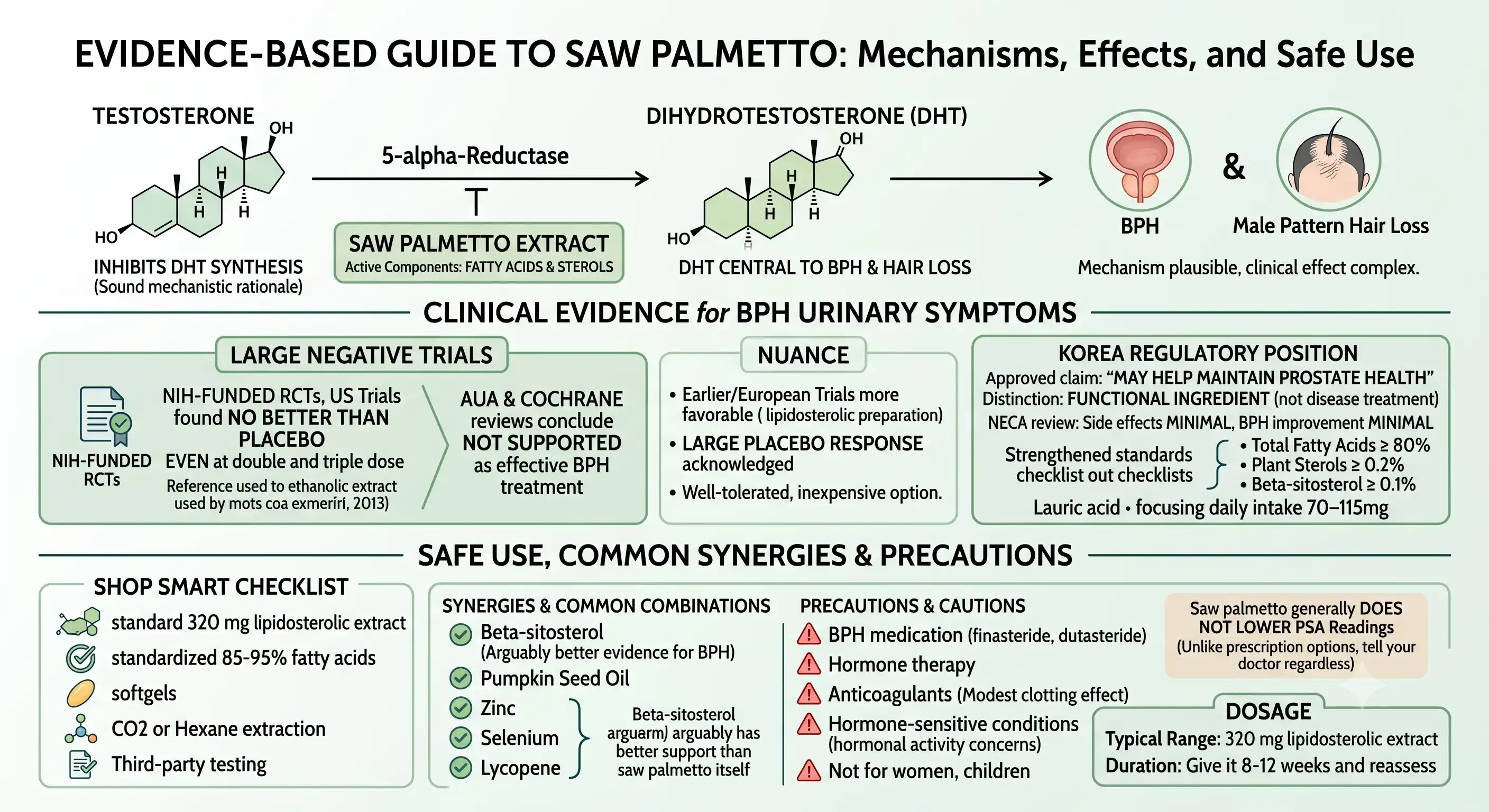
The biological rationale is straightforward. The enzyme 5-alpha-reductase converts testosterone into dihydrotestosterone (DHT), and DHT is central to both benign prostatic hyperplasia (BPH) and male pattern hair loss — which is why prescription 5-alpha-reductase inhibitors are used for both. Laboratory studies indicate that saw palmetto's fatty acids and sterols inhibit this enzyme and may also affect androgen receptor binding and inflammatory signalling in prostate tissue.
2. A Deep Dive Into Saw Palmetto's Studied Effects
BPH and Urinary Symptoms — the Honest Account
BPH causes the prostate to enlarge and press on the urethra, producing weak flow, night-time urination, urgency, and a sense of incomplete emptying. It requires medical diagnosis, both to confirm the cause and to exclude other conditions.
Earlier reviews of saw palmetto were positive, and a number of European trials — particularly of a specific hexane-extracted lipidosterolic preparation — reported symptom improvement. Then two large, well-conducted, NIH-funded randomized trials tested it rigorously in American men. Both found saw palmetto no better than placebo for urinary symptom scores, and the second continued to find no benefit even at double and triple the usual dose. Subsequent Cochrane reviews reached the same conclusion, and the American Urological Association's BPH guidance does not recommend it[1][4].
Two things keep this from being a simple verdict. First, the negative trials used a specific ethanolic extract, and proponents argue that extract type and processing matter — the European hexanic extract literature remains more favourable, though it is also more often industry-sponsored. Second, BPH symptom trials show large placebo responses, and many men do report feeling better on saw palmetto. The fair summary: the best available evidence does not support saw palmetto as an effective BPH treatment, while acknowledging it is well tolerated, inexpensive, and that some men choose to try it knowing this.
Hair Loss
Evidence here is considerably thinner than for the prostate — a handful of small studies, some using topical formulations or combinations with other ingredients, reporting modest changes. It is not comparable to the evidence base behind established medical treatments for pattern hair loss, and a dermatologist can discuss those options.
Other Areas
Saw palmetto has been examined for chronic prostatitis and for lower urinary tract symptoms in women, with limited and inconclusive results.
What the Evidence Does and Doesn't Show
| Use | Strength of evidence | Notes |
|---|---|---|
| BPH urinary symptoms | Large trials negative | Not recommended in AUA guidance; European hexanic extract data more favourable |
| Shrinking the prostate | Not supported | No meaningful reduction shown |
| Male pattern hair loss | Very limited | Small studies; established treatments exist |
| Tolerability | Good | Side effects generally mild in trials |
| Effect on PSA readings | Little or none | Practically useful — see Section 6 |
3. Regulatory Status in Korea: What "Functional Ingredient" Means
Saw palmetto occupies a position in Korea that is worth understanding in detail, because it explains how a product can be an officially recognised functional food ingredient while the clinical trial evidence for treating BPH remains unfavourable. These two facts are not in conflict — they sit at different regulatory levels.
The Recognised Claim — and Its Deliberate Limits
Korea's Ministry of Food and Drug Safety (MFDS) recognises saw palmetto berry extract as a health functional food (건강기능식품) ingredient. The approved functional claim is that it "may help maintain prostate health" — worded as support for maintaining health, not as treatment of a disease. The designated functional component is lauric acid, with a daily intake of 70–115 mg of lauric acid[7].
That wording is not marketing softness; it is the legal boundary of what was assessed. A functional ingredient designation in Korea means an ingredient met the evidentiary bar for a maintenance-level claim. It is not a finding that the ingredient treats, improves, or prevents a diagnosed condition.
The 2022 National Evidence Review
In 2022 Korea's National Evidence-based healthcare Collaborating Agency (NECA) published a public information statement on saw palmetto, motivated by concern that population ageing and rising BPH prevalence were leading to over-use and misuse of the supplement. Its assessment was that side effects were minimal, but improvement in benign prostatic hyperplasia was also minimal: studies reporting benefit were methodologically imprecise, and seven systematic studies found no objective improvement[8]. This is consistent with the large international trials described in Section 2.
MFDS's response to that review drew the distinction precisely: it stated that it had not evaluated disease treatment effect at all, and had assessed only whether the ingredient may help maintain a healthy prostate[8].
Why Quality Standards Were Tightened
In 2022 MFDS moved to add specifications for saw palmetto extract after finding that some manufacturers were blending other cheap vegetable oils into the product — meaning consumers buying a prostate supplement could be consuming largely ordinary cooking oil. The amended standards introduced fatty acid and plant sterol requirements: total fatty acids of at least 80%, plant sterols of at least 0.2%, and beta-sitosterol of at least 0.1%[9].
This is genuinely useful when buying. Those three figures are a concrete, verifiable checklist — a product that states them is one whose composition has been characterised, and a product that states nothing beyond an extract weight has told you nothing about what is actually inside the softgel. See Section 4 for how to apply this.
A Note on Adverse Event Reporting
If you experience a suspected side effect from a health functional food in Korea, it can be reported through the MFDS food safety reporting system. Reporting matters: post-market surveillance is how quality and safety problems like the oil-blending issue above come to light in the first place.
4. Shop Smart: How to Choose the Right Saw Palmetto
Step 1: Fatty Acid Standardization and Extraction
The compounds of interest are lipophilic — free fatty acids, phytosterols, and related lipids. Look for an extract standardized to 85–95% total fatty acids. Supercritical CO2 extraction and hexane extraction both produce lipidosterolic extracts; note that the European trials with more favourable results used a specific hexanic extract, while the large negative US trials used an ethanolic extract. Extract type is a genuine variable, not just marketing.
Step 2: Softgels Over Dry Berry Powder
Because the active constituents are oils, dried whole-berry powder capsules deliver much less of them. Oil-based softgels are the appropriate format, ideally taken with food.
Step 3: Third-Party Testing and Composition Specs
Independent analyses have found saw palmetto products varying widely in fatty acid content, with some containing little active material. Look for USP or NSF verification, or a certificate of analysis stating the fatty acid percentage — given the uncertainty about efficacy, there is no reason to add uncertainty about content as well.
For products sold in Korea, the specifications described in Section 3 give you an unusually concrete checklist: total fatty acids ≥ 80%, plant sterols ≥ 0.2%, and beta-sitosterol ≥ 0.1%, with the functional component stated as lauric acid at 70–115 mg per day. A label that discloses these figures is meaningfully more transparent than one listing only "saw palmetto extract 320 mg."
5. Everyday Habits: What Actually Helps Urinary Symptoms
- Get a proper assessment first. Urinary symptoms in older men can stem from BPH, but also from infection, bladder dysfunction, medication side effects, diabetes, or prostate cancer. A urologist's evaluation — including PSA where appropriate — comes before any supplement.
- Fluid timing: Reducing fluids in the two to three hours before bed, and limiting alcohol and caffeine in the evening, often noticeably reduces night-time waking.
- Double voiding and timed voiding are simple behavioural techniques with real evidence behind them in BPH management.
- Review your medications: Decongestants, some antihistamines, and certain antidepressants can worsen urinary retention.
- Exercise and weight management: Both associated with lower BPH symptom severity.
- Effective medical options exist — alpha-blockers, 5-alpha-reductase inhibitors, combination therapy, and minimally invasive procedures — and they have far stronger evidence than any supplement discussed here. If symptoms are affecting your sleep or quality of life, that conversation is worth having.
6. The Perfect Match: Synergies and Incompatibilities
Nutrients rarely work in isolation, though it is worth noting that combining two supplements with limited individual evidence does not produce strong combined evidence.
✅ Commonly Combined
- Pumpkin Seed Oil / Extract: Shares phytosterols and fatty acids and is frequently paired with saw palmetto in prostate formulas. Some combination products have been studied with modest results; the pairing is reasonable rather than proven.
- Beta-sitosterol: A plant sterol that has its own body of BPH research, with several reviews reporting symptom improvement. Arguably has better supporting data than saw palmetto itself.
- Zinc and Selenium: Trace minerals concentrated in prostate tissue. Keep both within recommended amounts — high-dose selenium in particular has its own risks.
- Lycopene: A carotenoid concentrated in the prostate, studied mainly in observational research.
❌ Requiring Caution
- Finasteride, dutasteride, and other BPH medications: Combining a supplement acting on the same pathway with prescription therapy should be discussed with your urologist, not assumed to be additive.
- Hormone therapy and anti-androgens: Discuss with your physician.
- Anticoagulant and antiplatelet medication: Saw palmetto may modestly affect clotting; inform your doctor and stop before surgery as your surgical team advises.
- Oral contraceptives and hormone-sensitive conditions: Because of potential hormonal activity, women — particularly those pregnant or breastfeeding — should avoid it.
7. Dosage, Timing, and Safety
Typical Ranges
- Standard dose: 320 mg daily of a lipidosterolic extract, either once daily or as two 160 mg doses — the amount used in most trials.
- Timing: With food, which improves tolerability and absorption of the oil-based extract.
- Duration: Trials typically ran 6 to 12 months. If you are trying it, give it at least 8 to 12 weeks and reassess honestly — and be aware that improvement may reflect the substantial placebo response seen in urinary symptom research.
Tolerability
Saw palmetto was well tolerated in the large trials, with side effect rates similar to placebo. Reported effects are usually mild: digestive upset, nausea, headache, or dizziness — mostly avoidable by taking it with food. Rare case reports have described liver or pancreatic inflammation, and while causation is not established, they are worth knowing about.
Also consult a healthcare professional before use if you take anticoagulant or antiplatelet medication, hormone therapy, or prescription BPH medication; if you have liver disease; or before any scheduled surgery. Saw palmetto is not appropriate for women who are pregnant or breastfeeding, or for children.
8. Frequently Asked Questions
Q. Does saw palmetto actually work for BPH?
A. The largest and best-designed trials found it no better than placebo, even at higher doses, and urology guidelines do not recommend it. Some European extract research is more favourable, and it is well tolerated — so it is a low-risk thing to try, but you should know the odds before spending money on it.
Q. Will it regrow my hair?
A. The evidence is very limited and far weaker than for established treatments. A dermatologist can discuss options with real supporting data.
Q. Does it lower testosterone?
A. Studies have generally not found meaningful changes in testosterone levels at typical doses.
Q. Will it interfere with my PSA test?
A. Unlike finasteride, saw palmetto has generally not been found to significantly lower PSA. Still, tell your doctor what you take.
Q. How long should I try it before deciding?
A. Eight to twelve weeks is reasonable. If symptoms are meaningfully affecting your sleep or daily life, seeing a urologist is a better use of that time.
9. Conclusion and Precautions
Saw palmetto has a sound mechanistic rationale, centuries of traditional use, and an excellent tolerability record — and the largest, best-designed trials did not show it works for BPH symptoms. Presenting it otherwise would not be honest. What can fairly be said is that it is inexpensive, safe for most men, that extract type may matter and the European literature differs, and that some men choose to try it with realistic expectations. Korea's regulatory position captures the distinction well: saw palmetto is a recognised functional ingredient for maintaining prostate health, and that is a different and much narrower statement than treating benign prostatic hyperplasia. What it must not do is delay a proper prostate assessment or substitute for treatments that are known to work.
⚠️ Precautions: The FDA has not evaluated saw palmetto for the treatment of any medical condition, and this article is not medical advice. Urinary symptoms need medical evaluation — do not rely on a supplement to rule out prostate cancer or other causes. Can cause mild digestive upset; take with food. May modestly affect blood clotting, so inform your surgeon or dentist before procedures. Consult a healthcare professional before use if you take anticoagulants, hormone therapy, or prescription BPH medication. Not for use by women who are pregnant or breastfeeding, or by children.
10. Sources and References
- NIH National Center for Complementary and Integrative Health (NCCIH) — Saw Palmetto
https://www.nccih.nih.gov/health/saw-palmetto - Mayo Clinic — Saw palmetto: Uses and side effects
https://www.mayoclinic.org - Cleveland Clinic — Enlarged prostate (BPH)
https://my.clevelandclinic.org - American Urological Association (AUA) — Benign Prostatic Hyperplasia Guideline
https://www.auanet.org - NIH National Institute of Diabetes and Digestive and Kidney Diseases (NIDDK) — Prostate Enlargement (BPH)
https://www.niddk.nih.gov - Memorial Sloan Kettering Cancer Center — Saw Palmetto (Integrative Medicine herb database)
https://www.mskcc.org - Ministry of Food and Drug Safety (MFDS, 식품의약품안전처) — Health Functional Food standards and specifications: saw palmetto berry extract
https://www.mfds.go.kr - National Evidence-based healthcare Collaborating Agency (NECA, 한국보건의료연구원) — Public information statement on saw palmetto extract efficacy and safety (2022)
https://www.neca.re.kr - Ministry of Food and Drug Safety (MFDS) — Partial amendment to Health Functional Food standards adding fatty acid and plant sterol specifications (2022)
https://www.mfds.go.kr
© 2026 Healing-Finder. All rights reserved.