The Complete Tart Cherry Guide: Recovery, Uric Acid, Sleep, and Synergies
1. What Tart Cherry Is and What's Actually In It
Tart Cherry (Prunus cerasus), particularly the Montmorency variety, is rich in anthocyanins — the polyphenol pigments responsible for its deep red colour — along with other flavonoids and phenolic acids. It has been studied in two fairly distinct contexts: musculoskeletal recovery and joint comfort on one hand, and sleep on the other.
Laboratory research indicates that cherry anthocyanins inhibit COX-1 and COX-2 enzymes, the same pathway targeted by non-steroidal anti-inflammatory drugs. This mechanism is often quoted as though tart cherry works like ibuprofen; it is more accurate to say that the enzyme inhibition has been demonstrated in laboratory conditions, and that the effects seen in humans at realistic intakes are considerably more modest.
2. A Deep Dive Into Tart Cherry's Studied Effects
Exercise Recovery and Muscle Soreness
This is the strongest area. Multiple randomized trials — in marathon runners, cyclists, and resistance-trained participants — have reported reduced markers of muscle damage and inflammation, faster recovery of strength, and less perceived soreness when tart cherry juice or concentrate was taken for several days before and after strenuous exercise. Meta-analyses generally describe a small-to-moderate benefit, most consistent for recovery of muscle function rather than for soreness ratings alone[4].
One nuance worth knowing: because part of the training adaptation to exercise is driven by oxidative and inflammatory signalling, some researchers have questioned whether routinely blunting that response with high-dose antioxidants could reduce long-term training adaptations. This is unresolved, but it argues for using tart cherry around competitions and unusually hard sessions rather than every single day of a training block.
Gout and Uric Acid
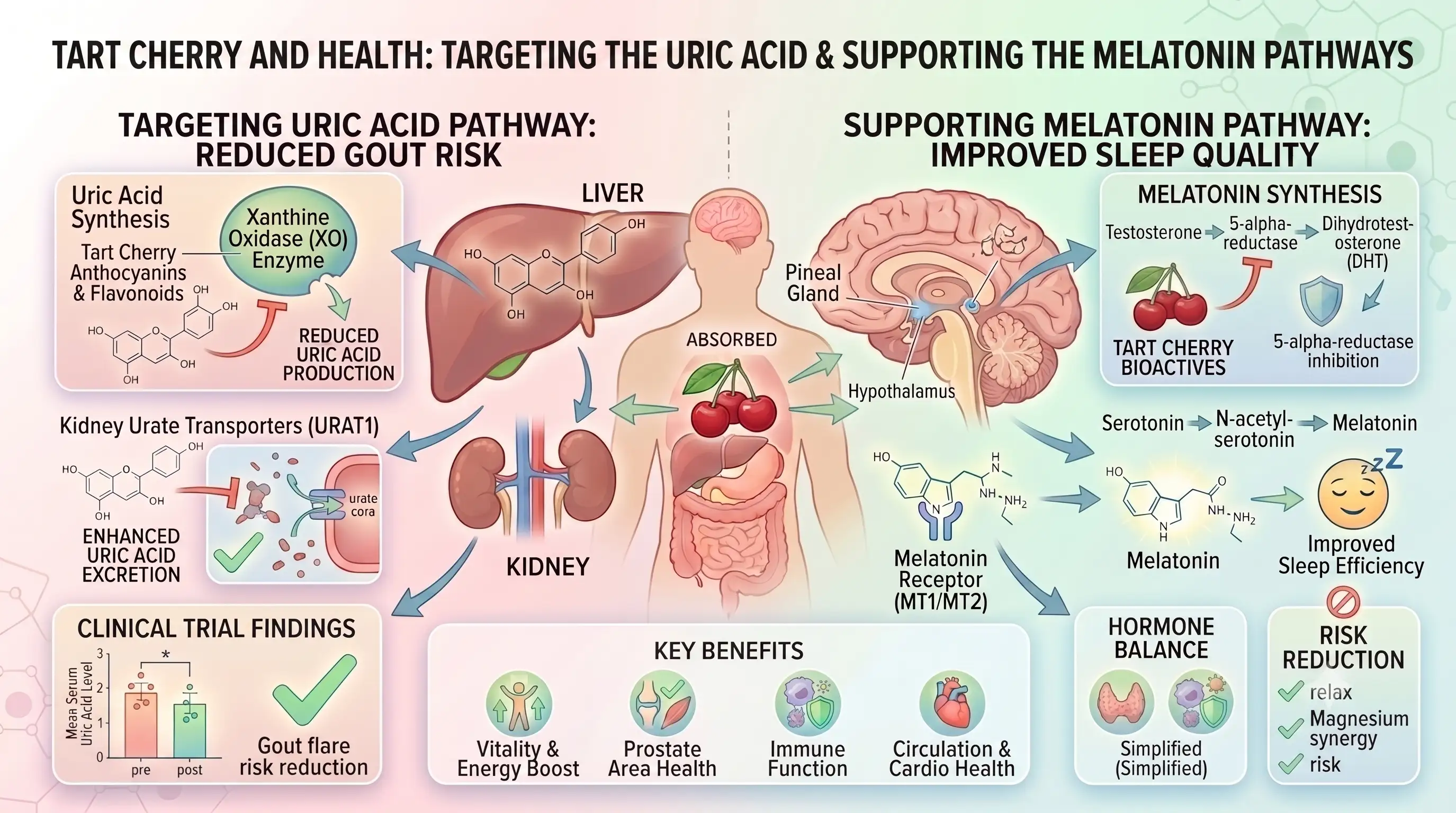
Observational research has associated cherry intake with a lower risk of gout attacks, and small studies have reported modest reductions in serum uric acid. It is a genuinely interesting signal — and it is important to be clear about its limits. The studies are small, the observational data cannot establish cause, and rheumatology guidelines do not recommend cherry products as a treatment for gout. Gout is managed with urate-lowering therapy that brings uric acid below a target level, and untreated gout damages joints over time.
Tart cherry may be a reasonable complementary addition for someone managing gout under a doctor's care. It is not a substitute for prescribed urate-lowering medication, and it should not be used to treat an acute flare.
Sleep
Several small trials — mostly in older adults or people with insomnia — have reported modest increases in total sleep time and sleep efficiency with tart cherry juice taken twice daily for one to two weeks. Reported improvements have ranged from around 20 to 80 minutes of additional sleep in different studies. The trials are small, and effects in healthy young sleepers are less clear. Worth trying, not worth overselling.
Blood Pressure and Other Areas
Some studies have reported small reductions in blood pressure and improvements in markers of oxidative stress. These are preliminary.
What the Evidence Does and Doesn't Show
| Use | Strength of evidence | Notes |
|---|---|---|
| Exercise recovery / muscle function | Moderate | Best around hard efforts, not necessarily daily |
| Sleep duration and efficiency | Preliminary / modest | Small trials, mainly older adults |
| Lowering uric acid | Small, preliminary | Not a gout treatment; guidelines do not recommend it |
| Joint comfort in osteoarthritis | Limited / mixed | Small studies |
| Blood pressure | Preliminary | Small reported effects |
3. Shop Smart: How to Choose the Right Tart Cherry
Step 1: Juice, Concentrate, or Capsule
- Juice and concentrate: The form used in most of the positive research, particularly the exercise recovery trials. The drawback is sugar — even unsweetened tart cherry juice contains natural fruit sugars, and 240 ml delivers a meaningful carbohydrate load. Concentrate diluted in water (typically 30 ml per serving) reduces the volume considerably.
- Capsules and powdered extract: Avoid the sugar entirely and are more convenient. The trade-off is that much less research has used them, and anthocyanin content varies widely between products. If you choose capsules, look for a stated anthocyanin content rather than just "cherry powder."
Step 2: Montmorency Specifically
Most of the clinical research has used Montmorency tart cherries, and sweet cherry varieties have a different anthocyanin profile. Check that the label names the variety rather than simply saying "cherry."
Step 3: Check What Else Is In It
Many "tart cherry" drinks are blends with apple or grape juice, which dilutes the active content while adding sugar. Read the ingredient list for added sugars and juice concentrates from other fruits. For capsules, look for third-party verification (USP, NSF) or a certificate of analysis.
4. Everyday Habits: Timing and Context
- For recovery: Research protocols typically start 4 to 7 days before a hard event and continue for 2 to 3 days afterward, taken twice daily. Starting the day after a race is unlikely to reproduce those results.
- For sleep: Trials generally used a serving in the morning and another one to two hours before bed, over one to two weeks. A single dose on one night is not how it was studied.
- For uric acid: Consistent daily intake rather than reactive use during a flare, alongside — never instead of — medical management.
- Hydration and diet for gout: Adequate fluid intake, limiting alcohol (particularly beer), reducing high-fructose drinks, and moderating high-purine foods all matter, and weight management has good supporting evidence.
- For sleep generally: Consistent wake times, morning daylight, limiting late caffeine and alcohol, and a cool dark bedroom have far stronger evidence than any beverage.
5. The Perfect Match: Synergies and Incompatibilities
Nutrients rarely work in isolation, though combining supplements with modest individual evidence does not create strong combined evidence.
✅ Commonly Combined
- Magnesium Glycinate: A popular evening pairing for sleep and muscle relaxation. Note that the clinical evidence for magnesium and sleep is itself limited, so this is a reasonable low-risk combination rather than a proven one.
- Celery Seed Extract: Frequently paired for gout on the basis of traditional use and laboratory work on uric acid. Evidence in humans is very limited — treat it as folk practice with a plausible rationale, not as a substitute for medical management.
- Vitamin C: Modest uric acid-lowering effects have been reported in some studies, and it supports collagen synthesis relevant to connective tissue.
- Protein after training: The single most important recovery input; tart cherry complements it rather than replacing it.
❌ Requiring Caution
- Anticoagulants and antiplatelet medication: Cherries contain salicylates and polyphenols that may modestly affect clotting. Combining concentrated products with warfarin or aspirin warrants medical oversight.
- Aspirin sensitivity: Those with salicylate sensitivity should be cautious.
- Sedatives and sleep medication: If used for sleep, discuss combining with prescription sedatives with your doctor.
- Diabetes: Juice and concentrate carry a real sugar load; capsules are the more sensible option, and blood glucose is worth monitoring.
- Kidney disease: Cherry juice is relatively high in potassium, which matters for people with impaired kidney function or on potassium-restricted diets.
- Sorbitol sensitivity or IBS: Cherries contain sorbitol, and larger juice volumes can cause bloating, gas, or loose stools.
6. Dosage, Timing, and Safety
Typical Ranges Used in Research
- Juice: Around 240 ml (8 oz) twice daily in many trials.
- Concentrate: Roughly 30 ml diluted in water, twice daily — approximately equivalent to the juice dose.
- Capsules/powder: Commonly around 400–500 mg of extract, though comparability to juice doses is uncertain.
- Duration: Recovery protocols run about a week around the event; sleep and uric acid studies typically 1 to 4 weeks.
Tolerability
Tart cherry is a food and is generally very well tolerated. The most common issues relate to volume and sugar rather than to the cherry itself: digestive upset, loose stools from sorbitol, and the calorie load of drinking juice twice daily — roughly 250–300 calories per day at typical research doses, which is worth accounting for.
Consult a healthcare professional before using concentrated products if you take anticoagulant or antiplatelet medication, have diabetes (sugar content of juice), have kidney disease (potassium content), are sensitive to salicylates, or are pregnant or breastfeeding — food amounts are fine, but concentrated supplement doses have limited safety data.
7. Frequently Asked Questions
Q. Will tart cherry stop my gout attacks?
A. It is not a treatment and guidelines do not recommend it for that. Observational data are encouraging enough that it is a reasonable addition alongside prescribed therapy, but it should never replace urate-lowering medication.
Q. Is the melatonin in tart cherry enough to make me sleepy?
A. Almost certainly not on its own — the amount is a tiny fraction of a typical melatonin supplement. If it helps your sleep, other compounds are likely involved.
Q. Juice or capsules?
A. Juice and concentrate are what most positive research used. Capsules avoid the sugar and calories but have far less supporting data. If sugar is a concern, capsules are the pragmatic choice with lower expectations.
Q. Should I take it every day if I train?
A. There is a reasonable argument for using it around hard sessions and competitions rather than continuously, since blunting exercise-induced inflammatory signalling every day may theoretically reduce training adaptations.
Q. Do sweet cherries work the same way?
A. They have a different anthocyanin profile and far less research behind them. Montmorency tart cherry is what has been studied.
8. Conclusion and Precautions
Tart cherry is one of the more likeable entries in this category: it is a food rather than an isolated compound, it is well tolerated, and it has real supporting research — strongest for exercise recovery, promising but preliminary for sleep, and interesting but not guideline-endorsed for uric acid. Used the way it was studied — Montmorency, twice daily, around hard training or for a defined sleep trial — it may help support recovery, joint comfort, and more restful sleep. What it is not is a gout treatment or a substitute for medical care.
⚠️ Precautions: The FDA has not evaluated tart cherry for the treatment of any medical condition, and this article is not medical advice. Gout requires medical management; do not use tart cherry in place of prescribed urate-lowering therapy, and seek urgent care for a hot, severely painful joint with fever. Juice and concentrate carry a significant natural sugar and calorie load relevant to people with diabetes, and juice is relatively high in potassium, which matters in kidney disease. Consult a healthcare professional before using concentrated products if you take anticoagulant or antiplatelet medication or are sensitive to salicylates.
9. Sources and References
- Cleveland Clinic — Benefits of Tart Cherry Juice
https://my.clevelandclinic.org - Arthritis Foundation — Cherries and gout
https://www.arthritis.org - Mayo Clinic — Gout: Diagnosis and treatment
https://www.mayoclinic.org - Harvard Health Publishing — Tart cherry juice and exercise recovery
https://www.health.harvard.edu - American College of Rheumatology — Gout management guideline
https://rheumatology.org - NIH National Institute of Arthritis and Musculoskeletal and Skin Diseases (NIAMS) — Gout
https://www.niams.nih.gov/health-topics/gout
© 2026 Healing-Finder. All rights reserved.