The Complete Curcumin Guide: Inflammation, Joint Comfort, and Bioavailability
1. What Curcumin Is and Why Absorption Is the Whole Story
Chronic, low-grade inflammation is studied as a contributing factor in many modern health concerns, from cardiovascular health to joint comfort and cognitive ageing. Curcumin, the bright yellow polyphenol in turmeric root (Curcuma longa), is among the most heavily researched botanical compounds in this area[1].
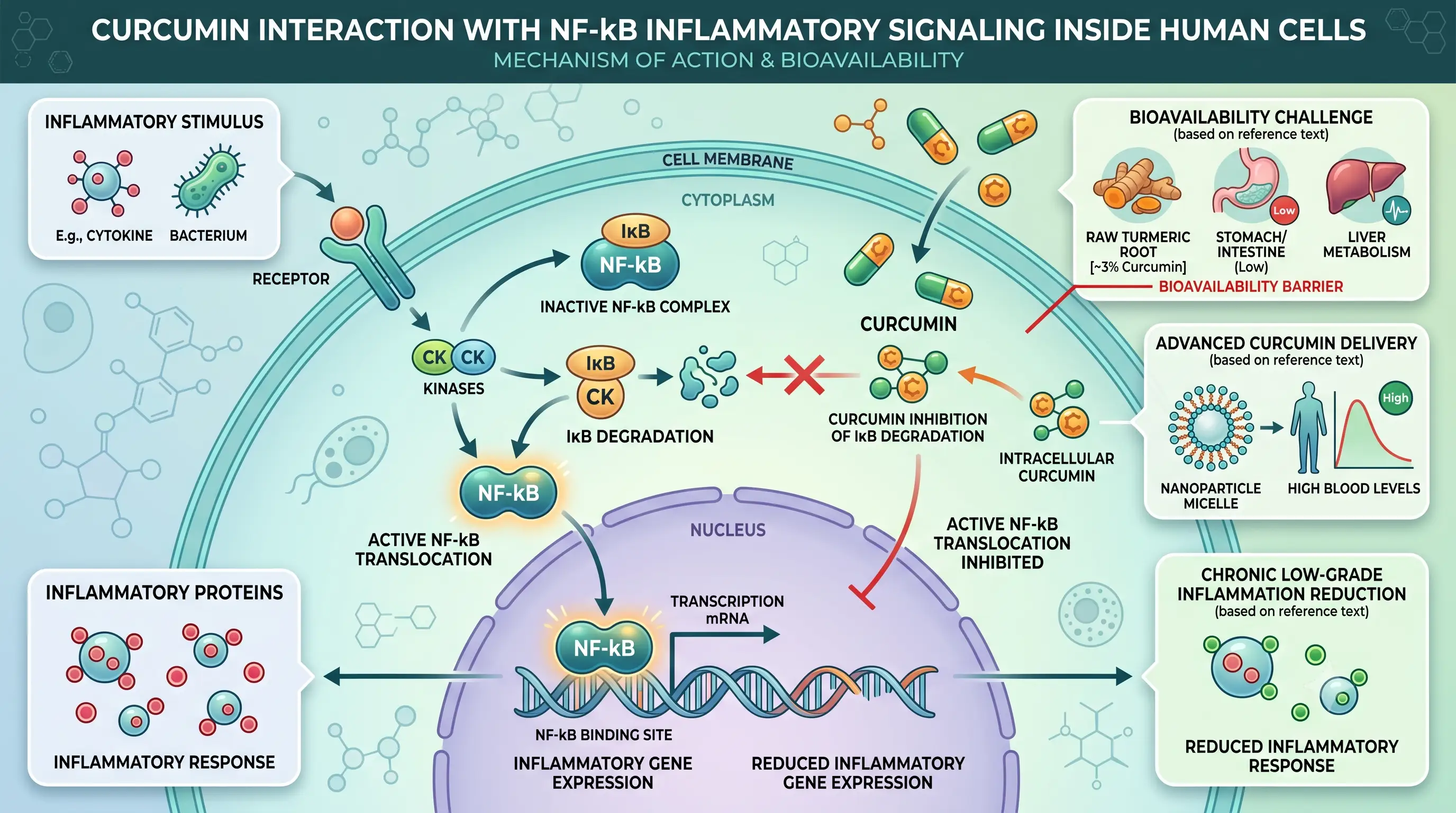
Two facts set the realistic frame for everything that follows. First, dried turmeric powder contains only around 2–5% curcuminoids by weight, so culinary turmeric delivers modest amounts. Second, curcumin on its own is poorly absorbed, rapidly metabolised in the intestinal wall and liver, and quickly excreted — meaning that plain curcumin taken by mouth produces very low blood concentrations. This is why formulation matters more for curcumin than for almost any other supplement, and also why laboratory results using direct cell exposure do not automatically translate to what happens after you swallow a capsule.
2. A Deep Dive Into Curcumin's Studied Effects
Interaction With Inflammatory Signalling
At the molecular level, curcumin has been studied for its interaction with NF-κB, a transcription factor that switches on genes involved in the inflammatory response, and with enzymes including COX-2 and lipoxygenase[1]. Some laboratory research describes its anti-inflammatory activity as comparable to certain reference compounds under experimental conditions. That comparison belongs to the laboratory: it should not be read as equivalent to any specific medication's real-world effectiveness or safety profile, and curcumin is not a substitute for prescribed anti-inflammatory therapy.
Joint Comfort
This is the most studied practical application. A number of randomized trials in people with knee osteoarthritis have reported reductions in pain and stiffness scores with standardized curcumin extracts over 6 to 12 weeks, and meta-analyses have generally described a modest but measurable average benefit[2]. The literature is limited by small sample sizes, short duration, varied formulations, and frequent industry funding, and professional guideline bodies differ on whether the evidence is strong enough to recommend it. Curcumin should be used alongside — not in place of — a physician's treatment plan for osteoarthritis.
Inflammatory and Metabolic Markers
Trials have reported reductions in circulating markers such as CRP and IL-6 in various populations, and some have examined blood lipids and glucose measures. Changing a biomarker is not the same as changing a health outcome, and long-term outcome trials are not available.
Digestive Comfort and Other Areas
Turmeric has a long traditional use in digestive complaints, and small studies have looked at curcumin in functional dyspepsia and inflammatory bowel conditions with preliminary results. Research into mood, cognition, and exercise recovery exists but is early-stage. None of these areas currently supports confident claims.
What the Evidence Does and Doesn't Show
| Use | Strength of evidence | Notes |
|---|---|---|
| Knee osteoarthritis discomfort | Moderate but mixed | Several RCTs showing modest benefit; guidelines differ |
| Inflammatory markers (CRP, IL-6) | Moderate | Biomarker change, not outcome change |
| Digestive comfort | Preliminary | Small studies; traditional use |
| Mood, cognition, exercise recovery | Insufficient | Early-stage research |
| Preventing or treating cancer or serious disease | Not established | Mostly laboratory work; do not use for this purpose |
3. Shop Smart: How to Choose the Right Curcumin
Step 1: Enhanced Bioavailability Formulations
Because plain curcumin is so poorly absorbed, most quality products use a delivery technology. Common approaches include:
- Phytosome / lecithin-bound (e.g. Meriva): Curcumin complexed with phospholipids, reported to reach higher blood levels than standard extracts.
- Solid lipid or colloidal dispersions (e.g. Longvida, NovaSOL): Formulations designed to improve stability and uptake.
- Curcumin with piperine (black pepper extract): The most familiar approach. A widely cited 1998 study reported a very large percentage increase in curcumin absorption when combined with piperine, achieved by slowing curcumin's breakdown in the liver. That headline figure comes from a single small study measuring a rise from a very low baseline, and it is often quoted with more confidence than the original data supports. Piperine also carries a real interaction caveat — see Section 5.
Step 2: Standardized Extract
Look for an extract standardized to around 95% total curcuminoids, with the delivery system and the actual curcumin content both stated. Note that "1,000 mg turmeric" and "1,000 mg curcuminoids" are very different things.
Step 3: Third-Party Testing Matters Here
Turmeric supply chains have documented quality problems, including adulteration with synthetic dyes and, in some regions, lead-containing pigments used to brighten colour. Independent verification (USP, NSF, Informed Choice, or a published certificate of analysis including heavy metals) is a meaningful signal rather than a nicety.
4. Everyday Habits: Cooking With Turmeric
- Pair with fat: Curcuminoids are fat-soluble, so cooking turmeric in olive oil, ghee, or coconut milk supports baseline absorption from food.
- Golden milk: Warm milk or plant milk with turmeric, black pepper, and cinnamon — a traditional preparation that combines fat, piperine, and gentle heat.
- Add black pepper when cooking: The amounts involved are small and are a normal part of many cuisines.
- Keep expectations proportionate: Culinary turmeric supplies far less curcumin than the doses used in trials. Cooking with it is a good habit, not a substitute for a studied extract if you are seeking the researched effects.
- The rest of the anti-inflammatory picture: Sleep, regular movement, body composition, fibre intake, and not smoking all influence inflammatory markers more consistently than any single supplement.
5. The Perfect Match: Synergies and Incompatibilities
Nutrients rarely work in isolation. Some combinations support absorption; several interactions here are clinically important and deserve genuine attention.
✅ Combinations That Make Sense Together
- Healthy fats: Because curcumin is fat-soluble, taking it with a meal containing fat supports uptake.
- Piperine (black pepper extract): Studied for its ability to slow curcumin's breakdown, increasing how much reaches the bloodstream. Effective, but read the caution below.
- Omega-3 Fatty Acids: Frequently combined in joint-support formulas; the two act through different pathways and both have been studied for joint comfort.
- Vitamin D: Not a curcumin booster, but adequate vitamin D status is relevant to musculoskeletal comfort generally.
❌ Combinations Requiring Caution
- Anticoagulant and antiplatelet medication: Curcumin may affect platelet activity. Combining high doses with warfarin, aspirin, clopidogrel, or similar medication could increase bleeding risk, and requires medical supervision. Stop before scheduled surgery as your surgical team advises.
- Piperine and prescription medication: Piperine works by inhibiting enzymes that also metabolise many drugs, so it can raise blood levels of other medications. If you take prescription medicine, discuss piperine-containing supplements with a pharmacist rather than assuming they are inert.
- Iron supplements and iron deficiency: Curcumin binds iron and has been reported to reduce iron absorption. People with low ferritin or iron-deficiency anemia should be cautious and separate the two.
- Gallbladder disease: Curcumin may stimulate gallbladder contraction. Avoid with gallstones or bile duct obstruction.
- Diabetes medication: Possible additive glucose-lowering effects; monitor if you take these.
- Chemotherapy: Do not add during cancer treatment without oncology approval, given potential interactions.
6. Dosage, Timing, and Safety
Typical Ranges Used in Research
- Standard 95% extract: Trials commonly use 500–1,500 mg of curcuminoids daily, usually split into two doses.
- Enhanced-bioavailability formulations: Used at lower amounts, reflecting higher absorption — follow the specific product's studied dose rather than matching milligram-for-milligram.
- Timing: With meals containing fat. Duration in joint trials is typically 8 to 12 weeks, so judge it over months rather than days.
Common Side Effects
Generally well tolerated. The most frequently reported effects are gastrointestinal: nausea, reflux, loose stools, or abdominal discomfort, more likely at higher doses or on an empty stomach.
Who Should Avoid or Check First
- Pregnancy and breastfeeding: Culinary amounts are considered fine; supplemental doses are not recommended due to insufficient safety data.
- Gallstones or bile duct obstruction: Avoid.
- Iron deficiency: Discuss with your physician before regular use.
- Anyone on anticoagulants, diabetes medication, or multiple prescriptions: Check with a pharmacist.
- Before surgery: Stop as advised by your surgical team.
7. Frequently Asked Questions
Q. Is turmeric powder from the kitchen enough?
A. For general dietary purposes it is a good ingredient, but it delivers far less curcumin than the doses used in studies. It is a healthy habit rather than an equivalent to a standardized extract.
Q. Do I need a product with piperine?
A. Not necessarily — several other delivery systems achieve improved absorption without it. If you take prescription medication, a non-piperine formulation may be the simpler choice.
Q. How long before I would notice a difference in joint comfort?
A. Studies generally measure outcomes at 8 to 12 weeks. Curcumin is not a fast-acting painkiller and should not be treated as one.
Q. Is a higher dose better?
A. Not demonstrably. Higher doses increase the likelihood of digestive side effects, and with enhanced-absorption products the studied doses are deliberately lower.
Q. Can I take it with my arthritis medication?
A. Ask your physician or pharmacist. Curcumin is sometimes used alongside conventional treatment, but that decision belongs with your care team — particularly if you take anticoagulants.
8. Conclusion and Precautions
Curcumin is one of the most researched botanical compounds available, with a plausible mechanism and a real, if modest and somewhat inconsistent, body of human trial evidence — strongest for joint comfort and inflammatory markers. Choosing a standardized, well-absorbed formulation and giving it two to three months is the approach most consistent with how it has been studied. It may help support joint and cellular health as part of a broader routine, with the liver and interaction cautions above treated as genuine considerations rather than formalities.
⚠️ Precautions: The FDA has not evaluated curcumin for the treatment of any medical condition, and this article is not medical advice. Can cause stomach upset at higher doses. Avoid if you have gallstones, bile duct obstruction, or liver disease, and stop immediately if signs of liver problems appear. Not recommended during pregnancy or breastfeeding at supplemental doses. Consult a healthcare professional before starting supplementation, especially if you take blood-thinning, diabetes, or other prescription medication, or are scheduled for surgery.
9. Sources and References
- Menon VP, Sudheer AR — Antioxidant and anti-inflammatory properties of curcumin. Adv Exp Med Biol. 2007;595:105-25 (PubMed)
https://pubmed.ncbi.nlm.nih.gov/17569207/ - Arthritis Foundation — Turmeric and Curcumin Guide
https://www.arthritis.org - Cleveland Clinic — Health Benefits of Turmeric
https://my.clevelandclinic.org - Mayo Clinic — Turmeric: Uses, Benefits, and Side Effects
https://www.mayoclinic.org - NIH National Center for Complementary and Integrative Health (NCCIH) — Turmeric
https://www.nccih.nih.gov/health/turmeric - NIH LiverTox — Clinical and Research Information on Drug-Induced Liver Injury (Turmeric / Curcumin)
https://www.ncbi.nlm.nih.gov/books/NBK548561/ - Harvard Health Publishing — Understanding Inflammation
https://www.health.harvard.edu
© 2026 Healing-Finder. All rights reserved.