The Complete Milk Thistle Guide: Silymarin, Liver Support, and Synergies
1. What Milk Thistle Is and What Silymarin Does
The liver processes nutrients, medications, alcohol, and metabolic by-products continuously. Milk Thistle (Silybum marianum) has been used for liver complaints for two thousand years and is among the most researched botanicals in this area[1]. Its active fraction, silymarin, is a complex of flavonolignans — chiefly silybin (silibinin), silydianin, and silychristin — extracted from the seeds.
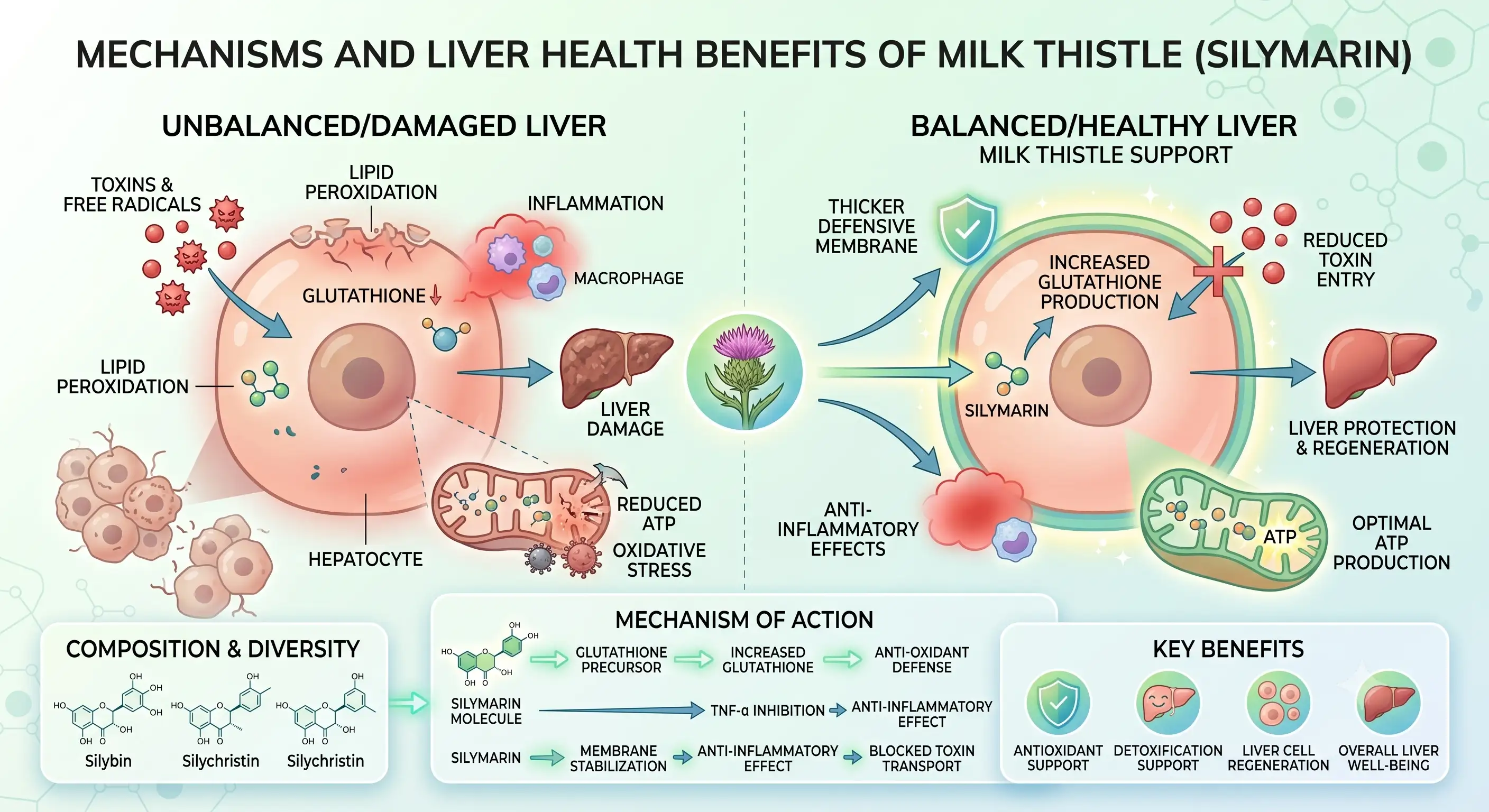
The proposed mechanisms are reasonably well characterised in laboratory work: silymarin acts as an antioxidant, appears to stabilise hepatocyte membranes against certain toxins, has been shown to support protein synthesis in liver cells, and influences inflammatory signalling. These are plausible and consistently reported at the cellular level.
Elevated Liver Enzymes Are a Reason to See a Doctor
If a blood test shows raised ALT or AST, that finding needs evaluation — the causes range from fatty liver and medication effects to viral hepatitis and autoimmune conditions, and they are managed very differently. Reaching for a supplement instead of an explanation is the wrong order of operations, and can delay a diagnosis that matters.
2. A Deep Dive Into Milk Thistle's Studied Effects
Liver Cell Support and Antioxidant Activity
Silymarin has been studied for its capacity to support liver cell membranes and protein synthesis, and to raise cellular levels of glutathione, the liver's principal endogenous antioxidant. Higher glutathione capacity is relevant to how the liver handles oxidative stress and metabolic waste. These findings come largely from laboratory and animal work, with human data more limited.
Non-Alcoholic Fatty Liver Disease (NAFLD)
This is arguably the most active area. Several randomized trials and meta-analyses have reported modest reductions in liver enzymes (ALT and AST) and, in some studies, improvements in imaging measures of liver fat in people with NAFLD. Reviewers consistently note small sample sizes, short durations, and variable extract quality, and conclude that the findings are promising rather than definitive. Any use in NAFLD should sit alongside the interventions with established benefit — weight reduction, reduced alcohol, less added sugar and fructose, and increased physical activity — under medical supervision.
Alcohol-Related Liver Disease and Hepatitis
Milk thistle has been extensively studied in these settings, and the results have been disappointing. Trials in hepatitis C, including a well-conducted study using higher-dose silymarin, did not show meaningful improvement in viral or liver measures, and reviews of alcohol-related liver disease have not found clear benefit[1]. For hepatitis in particular, effective antiviral treatments now exist, and a supplement is not a substitute for them.
Amanita Mushroom Poisoning — an Important Clarification
Milk thistle marketing often cites the use of silibinin in death cap mushroom poisoning. That use involves intravenous silibinin administered in hospital as emergency medical treatment — an entirely different preparation, route, and dose from an oral supplement. Mushroom poisoning is a medical emergency requiring immediate hospital care, and no oral supplement plays any role in it.
Other Areas Under Study
Silymarin has been examined for blood glucose measures in type 2 diabetes, for reducing chemotherapy-related liver enzyme elevations in children (a specific clinical research setting), and topically for certain skin conditions. Each is preliminary.
What the Evidence Does and Doesn't Show
| Use | Strength of evidence | Notes |
|---|---|---|
| NAFLD — liver enzymes and fat measures | Preliminary / promising | Small trials; alongside lifestyle change |
| Antioxidant and glutathione support | Mechanistic | Mostly laboratory and animal data |
| Hepatitis C | Not supported | Trials negative; effective antivirals exist |
| Alcohol-related liver disease | Not clearly supported | Reducing alcohol is the intervention that works |
| Amanita poisoning | IV silibinin in hospital only | Not an oral supplement use |
| General "detox" or liver cleansing | Not a scientific concept | The liver detoxifies on its own |
3. Shop Smart: How to Choose the Right Milk Thistle
Step 1: Check Silymarin Standardization
"1,000 mg of milk thistle extract" means little on its own. Look for a product standardized to 70–80% silymarin, and note the actual silymarin milligrams per serving. Some higher-quality products also state silybin content specifically, since silybin is the most studied component.
Step 2: Absorption-Enhanced Forms
Silymarin is poorly water-soluble and poorly absorbed in its standard form — a genuine limitation and a plausible reason some trials were negative. Phytosome preparations bind silybin to phosphatidylcholine and are reported to achieve substantially higher blood levels than standard extracts. Specific multiples quoted in marketing vary considerably between studies and should be read as "meaningfully better absorbed" rather than a precise figure. If you are going to use milk thistle, an absorption-enhanced form is the more logical choice.
Step 3: Third-Party Testing
Independent analyses of herbal supplements have found wide variation between labelled and actual content. Look for USP or NSF verification or a published certificate of analysis. Be cautious with multi-ingredient "liver detox" blends, which often combine several botanicals at undisclosed doses — a poor idea for an organ whose job is processing whatever you swallow.
4. Everyday Habits: What Actually Supports Your Liver
It is worth being direct: the interventions below have far stronger evidence than any supplement in this category.
- Reduce alcohol. The single most effective liver measure for anyone who drinks. There is no supplement that offsets it.
- Cut added sugar and fructose. High intake of sugar-sweetened drinks and fructose is strongly linked to fatty liver development.
- Weight reduction where relevant. Losing even 5–10% of body weight meaningfully reduces liver fat, and larger reductions can improve liver inflammation — this is the best-established treatment for NAFLD.
- Regular physical activity reduces liver fat independently of weight loss.
- Coffee has been consistently associated with lower rates of liver disease progression in observational research — one of the more robust dietary associations in hepatology.
- Be careful with paracetamol/acetaminophen doses and with combining multiple supplements, since drug- and supplement-induced liver injury is a real and rising cause of liver problems.
- Bitter greens, vegetables, and adequate hydration support overall dietary quality — though the popular framing of specific foods "stimulating detox" outruns the evidence.
5. The Perfect Match: Synergies and Incompatibilities
Nutrients rarely work in isolation — though with the liver, adding more substances is not automatically better.
✅ Combinations Commonly Used
- B-Complex Vitamins: B vitamins participate as cofactors in hepatic metabolic pathways, and adequate status supports normal liver function. Note that megadoses are not indicated, and the "Phase 1 / Phase 2 detox" framing is a simplification of a much more complex system.
- N-Acetyl Cysteine (NAC) and Selenium: NAC is a glutathione precursor and is used medically (intravenously) in paracetamol overdose; selenium is a cofactor for glutathione peroxidase. A rational combination on mechanistic grounds, though evidence for the specific stack is limited — and selenium has a narrow safe range, so do not exceed recommended amounts.
- Vitamin E: Has been studied specifically in non-diabetic adults with biopsy-confirmed NASH, where guidelines mention it as an option — but at doses and in a context that require physician oversight, and with its own long-term safety debate.
- Omega-3: Studied for liver fat and triglycerides in NAFLD with modest results.
❌ Requiring Caution
- Medications metabolised by the liver: Silymarin interacts with CYP450 enzymes and drug transporters in laboratory studies. Clinical studies suggest the practical interaction potential at usual doses is more modest than once assumed, but caution remains appropriate — particularly with narrow-margin drugs such as warfarin, certain statins, immunosuppressants, some anti-anxiety and antiseizure medications, and HIV or cancer therapies. Check with your pharmacist.
- Diabetes medication: Milk thistle may lower blood glucose; monitor if you take glucose-lowering drugs.
- Estrogen-sensitive conditions: Some milk thistle components have shown weak estrogenic activity in laboratory work; discuss with your physician if relevant.
- Stacking multiple "liver support" botanicals: Several popular liver and detox herbs carry their own hepatotoxicity signals. More is not safer here.
6. Dosage, Timing, and Safety
Typical Ranges
- Standardized extract (70–80% silymarin): Commonly 200–400 mg of silymarin daily, split into two or three doses.
- Phytosome forms: Used at lower amounts reflecting improved absorption — follow the specific product's studied dose.
- Timing: With meals, which improves tolerability. Consistency matters more than timing.
- Duration: Studies typically run 8 to 24 weeks. Reassess periodically rather than taking it indefinitely by default.
Tolerability
Milk thistle has a good safety record and is among the better-tolerated botanicals. The most commonly reported effects are gastrointestinal — a mild laxative effect, nausea, bloating, or loose stools — usually mild and often transient.
Most importantly: if you have a diagnosed liver condition, abnormal liver blood tests, or symptoms such as jaundice, dark urine, pale stools, persistent nausea, unexplained fatigue, or upper right abdominal pain, see a physician. Milk thistle is not a treatment for liver disease, and self-treating can delay care that changes outcomes.
7. Frequently Asked Questions
Q. Will milk thistle undo the effects of drinking?
A. No, and this is the most consequential misconception about it. There is no evidence it protects the liver from alcohol, and believing it might can encourage exactly the behaviour that causes harm.
Q. Does it "detox" the liver?
A. The liver detoxifies continuously on its own; it does not need cleansing. Silymarin has been studied for supporting liver cells against oxidative stress, which is a different and much narrower claim.
Q. My liver enzymes are slightly high. Should I take it?
A. Get the cause investigated first. Raised enzymes have many possible explanations, several of which need specific treatment, and a supplement neither identifies nor addresses them.
Q. How long before I would see anything?
A. Studies typically run 8 to 24 weeks, and outcomes are measured on blood tests rather than felt. You will not notice it working in the way you might with a stimulant or a sleep aid.
Q. Is it safe to take with my medications?
A. Usually, but check with a pharmacist — particularly if you take warfarin, immunosuppressants, statins, or diabetes medication.
8. Conclusion and Precautions
Milk thistle occupies an unusual position: a genuinely well-characterised mechanism, an excellent tolerability record, two millennia of traditional use — and a clinical trial record that has largely failed to confirm benefit in serious liver disease. The most encouraging current signal is in non-alcoholic fatty liver disease, where modest improvements in liver enzymes have been reported alongside lifestyle change. Used as a well-absorbed, standardized extract for a defined period, it is a low-risk option that may support liver health as part of a broader routine — provided it is not mistaken for protection against alcohol, a substitute for diagnosis, or a treatment for liver disease.
⚠️ Precautions: The FDA has not evaluated milk thistle for the treatment of any medical condition, and this article is not medical advice. Milk thistle is in the same plant family as ragweed, chrysanthemums, and daisies — avoid it if you are allergic to these. It may lower blood glucose, so monitor if you have diabetes. Not recommended during pregnancy or breastfeeding. Consult a healthcare professional before use if you take prescription medication metabolised by the liver, and see a physician for any diagnosed liver condition, abnormal liver blood test, or symptoms such as jaundice, dark urine, or persistent fatigue.
9. Sources and References
- NIH National Center for Complementary and Integrative Health (NCCIH) — Milk Thistle
https://www.nccih.nih.gov/health/milk-thistle - Mayo Clinic — Milk thistle: Uses and risks
https://www.mayoclinic.org - Cleveland Clinic — Benefits of Milk Thistle
https://my.clevelandclinic.org - Mount Sinai Health System — Milk thistle
https://www.mountsinai.org - American Botanical Council — Milk Thistle Clinical Overview
https://www.herbalgram.org - NIH LiverTox — Clinical and Research Information on Drug-Induced Liver Injury
https://www.ncbi.nlm.nih.gov/books/NBK547852/
© 2026 Healing-Finder. All rights reserved.