The Complete Glucosamine Guide: Cartilage, Joint Mobility, and Synergies
1. What Glucosamine Is and the Rationale Behind It
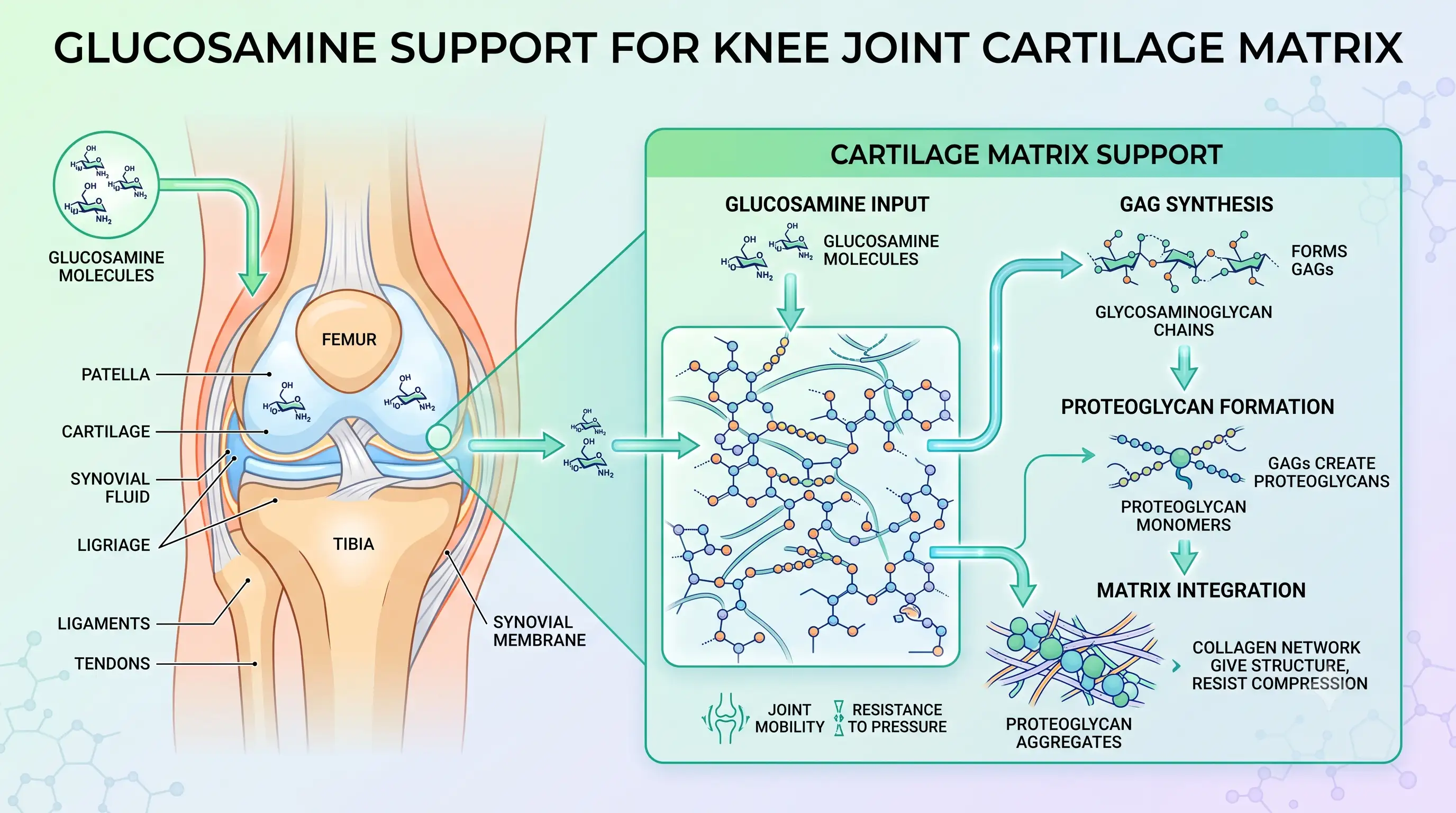
Glucosamine is an amino sugar produced naturally in the body and found in the fluid around joints. It serves as a precursor for glycosaminoglycans, which in turn form the proteoglycans that give cartilage its structure and its ability to resist compression[1]. It is also present in tendons, ligaments, and the synovial fluid that lubricates joints.
The reasoning behind supplementation is intuitive: cartilage is built partly from glucosamine, so supplying more of the raw material might support the tissue. Osteoarthritis involves the progressive breakdown of that cartilage along with changes to the underlying bone and joint lining, and it affects a large share of adults as they age — glucosamine is among the most commonly used supplements by people with the condition.
It is worth being careful with one common claim: the idea that the body's glucosamine production "declines with age" is frequently repeated but is not well established in the research. What is better documented is that the cartilage matrix itself changes with age and joint loading. The honest framing is that glucosamine supplies a building block, not that it corrects an age-related deficiency.
2. A Deep Dive Into Glucosamine's Studied Effects
Cartilage Building Blocks
Glucosamine participates in the synthesis of glycosaminoglycans and proteoglycans, the structural components of joint cartilage, and laboratory studies have examined effects on cartilage cell metabolism and inflammatory signalling. Whether oral supplementation delivers enough glucosamine to joint tissue to change cartilage composition in humans remains an open question — absorption is reasonable, but the amount reaching cartilage is modest.
Joint Pain and Function: What the Trials and Guidelines Say
Glucosamine has been studied extensively, and the results are genuinely inconsistent — reporting this accurately is more useful than picking a side. A 2014 analysis of 25 studies of glucosamine alone in knee osteoarthritis found a notable pattern: trials using the prescription drug formulation generally showed more favourable results than those using other products. The reviewers noted this could reflect genuine product differences, but also that most of those studies had a high risk of bias, were published more than two decades ago, and were funded by the manufacturer[1].
Major guideline bodies have drawn opposite conclusions from this literature. The 2019 American College of Rheumatology / Arthritis Foundation guideline strongly recommends against glucosamine for knee osteoarthritis, stating that the best data do not show important benefits, and the 2019 OARSI guideline likewise recommends against it. In contrast, the 2021 American Academy of Orthopaedic Surgeons guideline includes glucosamine among supplements that may help reduce pain and improve function in mild-to-moderate knee osteoarthritis while cautioning that the evidence is inconsistent, and the European ESCEO statement strongly recommends prescription crystalline glucosamine sulfate specifically while discouraging other formulations[1].
For osteoarthritis of the hip, a high-quality two-year trial found glucosamine no better than placebo for pain, function, or joint structure. For the temporomandibular joint, a review could not reach firm conclusions but noted that use for three months or longer was associated with reduced pain and improved mouth opening[1].
Joint Structure Over Time
Because glucosamine is a cartilage component, researchers have tested whether it slows the narrowing of joint space seen on X-ray. Two large two-year trials produced conflicting results — an Australian study found reduced joint space narrowing only in the group taking glucosamine and chondroitin together, while a US study found no difference between any group and placebo[1]. The question remains unresolved.
What the Evidence Does and Doesn't Show
| Use | Strength of evidence | Notes |
|---|---|---|
| Knee osteoarthritis pain | Inconsistent; guidelines conflict | Prescription-grade formulations show better results, possibly partly bias |
| Hip osteoarthritis | Not supported | High-quality trial found no benefit |
| Slowing joint space narrowing | Uncertain | Large trials conflict |
| Temporomandibular joint OA | Preliminary | Longer use associated with improvement in a review |
| Preventing osteoarthritis in healthy joints | Not established | Not what it has been studied for |
3. Shop Smart: How to Choose the Right Glucosamine
Step 1: Sulfate vs. Hydrochloride (HCl)
- Glucosamine Sulfate: The form used in the majority of trials that reported benefit, and the form referenced in the European guideline — specifically as stabilized, prescription-grade crystalline glucosamine sulfate. The sulfate component itself has been proposed to contribute, since sulfur is used in cartilage synthesis. If you are going to try glucosamine, this is the better-supported choice.
- Glucosamine Hydrochloride (HCl): Delivers more glucosamine per gram but lacks the sulfate component. Trials using HCl have generally been less positive, though it is not clear whether that reflects the molecule itself or differences in study design and quality.
- N-acetyl glucosamine: A different compound with a much smaller evidence base for joints; not interchangeable.
Note that the products studied most favourably in Europe are regulated as prescription medicines there, not as supplements — so an over-the-counter product is not automatically equivalent even when the ingredient name matches.
Step 2: Check the Source — Shellfish vs. Fermented
Most glucosamine is derived from chitin in the shells of shrimp, crab, and lobster. Shellfish allergy is generally to the flesh protein rather than the shell, and purified glucosamine is often tolerated, but this is not a risk worth taking on assumption: if you have a shellfish allergy, choose a fermented or "vegan" glucosamine produced from corn or other plant sources, and discuss it with your doctor.
Step 3: Verified Content and Dose Transparency
Independent analyses of joint supplements have repeatedly found products containing less than the labelled amount. Look for third-party verification (USP, NSF) or a published certificate of analysis, and check whether the label states glucosamine sulfate as a salt (for example "glucosamine sulfate potassium chloride"), since the elemental glucosamine content may be lower than the headline number implies.
4. Everyday Habits: What Actually Helps Joints
- Exercise is the first-line recommendation in every major osteoarthritis guideline. Low-impact activity — walking, cycling, swimming, water exercise — improves pain and function, and cartilage depends on movement for nutrient exchange since it has no blood supply of its own.
- Strengthen the muscles around the joint. Quadriceps and hip strength meaningfully change how load is distributed through the knee, and strengthening programmes have some of the best evidence available for knee osteoarthritis.
- Weight management reduces joint load mechanically and is a core guideline recommendation for knee and hip osteoarthritis.
- Dietary sources: Glucosamine is concentrated in animal cartilage and crustacean shells rather than in muscle meat. Bone broth simmered with joints and connective tissue and the gristle on chicken bones supply some, in variable and generally small amounts compared with supplements.
- Physical therapy and assistive approaches: Braces, appropriate footwear, and guided rehabilitation are often more effective than any supplement, and are worth discussing with a clinician.
5. The Perfect Match: Synergies and Incompatibilities
Nutrients rarely work in isolation. One of the interactions below is clinically important and appears in national health guidance.
✅ Commonly Used Combinations
- Chondroitin: The familiar pairing — glucosamine as a building block, chondroitin drawing water into the matrix. Report it accurately, though: a 2018 pooled analysis of 29 studies found pain significantly reduced by glucosamine or chondroitin taken separately, but not by the combination[1]. The combination is not harmful, but it is not clearly superior to either alone.
- MSM (Methylsulfonylmethane): An organic sulfur compound studied in small trials for joint pain, with modest reported effects. It is a reasonable addition, but claims that it dramatically amplifies glucosamine's effects are not supported by good evidence.
- Curcumin and Omega-3 Fatty Acids: Both studied for joint comfort through inflammation-related pathways, and often combined in joint formulas.
- Vitamin C and Collagen: Vitamin C is a required cofactor for collagen synthesis, giving this pairing a sound mechanistic rationale.
❌ Requiring Caution
- Warfarin and other anticoagulants: Glucosamine and chondroitin have been associated with an increased risk of bleeding in people taking warfarin[1]. This is the most important interaction on this page — do not combine without physician supervision and INR monitoring.
- Diabetes and blood glucose: Glucosamine is an amino sugar, and it may cause increases in blood glucose in some people[1]. Most studies in people with well-controlled diabetes have been reassuring, but monitoring is sensible if you take glucose-lowering medication, particularly at higher doses.
- Shellfish allergy: Choose a fermented, plant-derived product and confirm with your doctor.
- Pregnancy and breastfeeding: Little is known about safety; not recommended.
- Before surgery: Stop as advised by your surgical team, given the bleeding and glucose considerations.
6. Dosage, Timing, and Safety
Typical Ranges Used in Research
- Glucosamine sulfate: 1,500 mg per day, most often as a single daily dose in the trials of crystalline glucosamine sulfate, or split into three 500 mg doses in other studies.
- With chondroitin: Typically 1,500 mg glucosamine plus 1,200 mg chondroitin.
- Timing: With food, to reduce digestive upset. Consistency matters more than timing.
- Duration: This is not a painkiller and produces no acute effect. Trials generally run three to six months, so give it at least 8 to 12 weeks — and it is entirely reasonable to stop if nothing has changed by three months.
Safety Record
No major safety problems have been identified in large studies of glucosamine and chondroitin[1]. Reported side effects are generally mild — nausea, heartburn, abdominal discomfort, loose stools, headache — and less common when taken with food. This good tolerability is a genuine consideration when weighing a trial period.
7. Frequently Asked Questions
Q. Does glucosamine repair cartilage?
A. There is no reliable evidence that it does. Trials looking at joint space narrowing have conflicted. Consider it for possible symptom support rather than structural repair.
Q. Sulfate or HCl?
A. Sulfate is the better-supported choice, since most positive trials used it — particularly the stabilized crystalline form. HCl has a weaker record in trials.
Q. My doctor says it doesn't work. Is that right?
A. It is a defensible reading — two major rheumatology guidelines recommend against it. Other bodies disagree. Your doctor also knows your medications and history, which matters for the warfarin and blood sugar considerations.
Q. How long should I try it?
A. At least 8 to 12 weeks of consistent daily use. If there is no meaningful difference by three months, stopping is a reasonable decision rather than a failure.
Q. I'm allergic to shellfish. Can I take it?
A. Choose a fermented, plant-derived glucosamine and confirm with your doctor. Shellfish allergy is usually to the flesh protein rather than the shell, but this is not worth risking on assumption.
Q. Should I take it with chondroitin?
A. Either approach is defensible. Notably, the largest pooled analysis found benefit for each alone but not for the combination, so the popular pairing is not clearly the better option.
8. Conclusion and Precautions
Glucosamine is mechanistically sensible, extensively researched, well tolerated, and genuinely contested — major guideline bodies read the same evidence and reach opposite conclusions. Claims that it rebuilds cartilage or addresses the root cause of osteoarthritis are not supported. What can fairly be said is that some good trials found real symptom benefit, that the sulfate form has the stronger record, and that a two-to-three month trial is low-risk for someone with mild-to-moderate joint discomfort who is not on anticoagulants. It belongs alongside exercise, strengthening, and weight management — the measures every osteoarthritis guideline places first.
⚠️ Precautions: The FDA has not evaluated glucosamine for the treatment of any medical condition, and this article is not medical advice. Glucosamine has been associated with increased bleeding risk in people taking warfarin — consult your physician before combining. Because it is an amino sugar, monitor blood glucose if you have diabetes. Choose a fermented, plant-derived product if you have a shellfish allergy. Not recommended during pregnancy or breastfeeding. Consult a healthcare professional before starting supplementation, and seek medical assessment for new, severe, or swollen painful joints.
9. Sources and References
- NIH National Center for Complementary and Integrative Health (NCCIH) — Glucosamine and Chondroitin for Osteoarthritis: What You Need To Know
https://www.nccih.nih.gov/health/glucosamine-and-chondroitin-for-osteoarthritis-what-you-need-to-know - Arthritis Foundation — Supplement Guide: Glucosamine
https://www.arthritis.org - Mayo Clinic — Glucosamine: Uses and Risks
https://www.mayoclinic.org - Cleveland Clinic — Do Joint Supplements Actually Work?
https://my.clevelandclinic.org - Harvard Health Publishing — The truth about joint supplements
https://www.health.harvard.edu - NIH National Institute of Arthritis and Musculoskeletal and Skin Diseases (NIAMS) — Osteoarthritis
https://www.niams.nih.gov/health-topics/osteoarthritis
© 2026 Healing-Finder. All rights reserved.