The Complete Isoflavones Guide: Menopause Support, Phytoestrogens, and Synergies
1. What Isoflavones Are and How They Behave
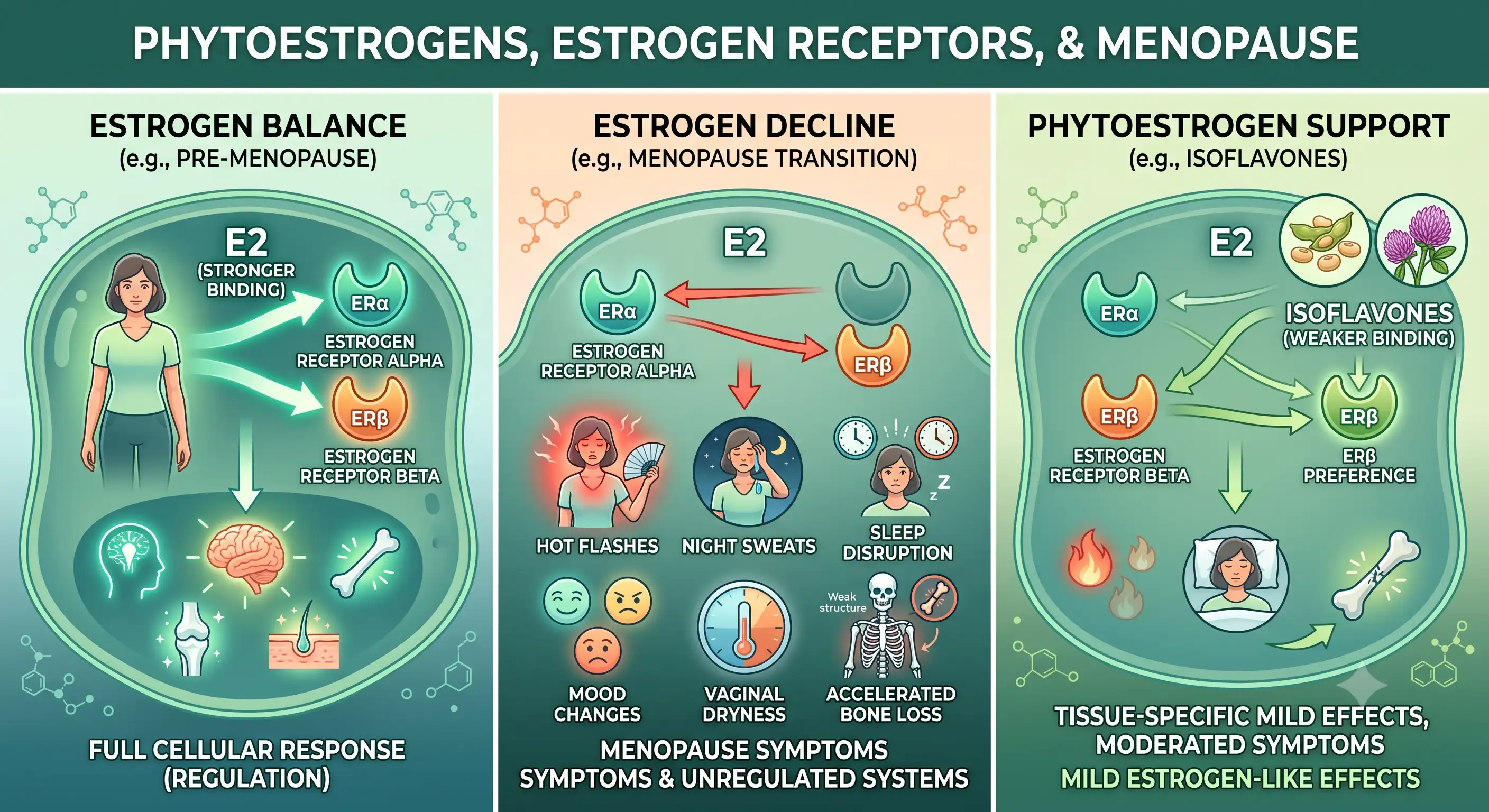
Isoflavones are a class of phytoestrogens — plant compounds whose molecular shape resembles human estrogen closely enough to interact with estrogen receptors. The main dietary sources are soy (genistein, daidzein, and glycitein) and red clover. During the menopause transition, ovarian estrogen production declines, which can bring hot flashes, night sweats, sleep disruption, mood changes, vaginal dryness, and accelerated bone loss[1].
Isoflavones bind estrogen receptors far more weakly than the body's own estradiol, and they show a relative preference for the ER-beta receptor subtype over ER-alpha. Because of this, they are often described as behaving somewhat like selective receptor modulators — producing mild estrogen-like effects in some tissues and little or none in others. This is genuinely different from Hormone Replacement Therapy (HRT), and should not be assumed to be equally effective or equally risk-free. Women considering either option should discuss it with their doctor.
The Equol Question — Why Results Differ So Much Between People
Certain gut bacteria convert daidzein into a metabolite called equol, which binds estrogen receptors more strongly than daidzein itself. Only a minority of people carry the bacteria needed to do this: roughly a quarter to a half of adults are "equol producers," with higher rates reported in populations with traditional soy-rich diets. Researchers have proposed that this partly explains why isoflavone trials produce such inconsistent results — non-producers may simply respond less. It is a plausible and actively studied hypothesis rather than a settled fact, and there is no routine clinical test for producer status.
2. A Deep Dive Into Isoflavones' Studied Effects
Hot Flashes and Night Sweats
This is the most studied use. A number of randomized trials and several meta-analyses have reported that daily isoflavone intake may modestly reduce the frequency and severity of vasomotor symptoms in peri- and post-menopausal women, typically after 8 to 12 weeks[2]. The reported effect is generally smaller and slower to appear than with hormone therapy.
It is important to report the other side accurately: professional menopause societies have reviewed this literature and, in recent non-hormonal treatment position statements, have concluded that the evidence for soy isoflavones and other phytoestrogens is not sufficient to recommend them for vasomotor symptoms[2]. Trials have been limited by small size, high placebo response rates in hot flash research, and large variation in the products used. Studies of S-equol specifically are an area of continuing interest. The reasonable summary is that some women report meaningful relief, the average measured effect is modest, and expert consensus has not endorsed it as a recommended therapy.
Bone Density
Estrogen restrains the activity of osteoclasts, the cells that break down bone, so its decline at menopause is associated with faster bone loss. Isoflavones have been studied for a possible mild estrogen-like effect on bone turnover, and some meta-analyses report small improvements in bone mineral density measures with longer-term use. Crucially, there is no evidence that isoflavones reduce fracture risk — the outcome that actually matters — and they are not a substitute for the calcium, vitamin D, weight-bearing exercise, and where indicated prescription treatment that make up established bone care.
Cardiometabolic Markers
Soy foods have been associated with modest reductions in LDL cholesterol, though much of that effect appears attributable to soy protein and the displacement of other foods rather than to isoflavones specifically. Studies of isolated isoflavones on blood pressure, vascular function, and blood lipids report small and inconsistent effects.
Breast Health — What the Evidence Actually Says
This is the question that worries people most, and the picture is more reassuring than the fears suggest — with one important distinction. Observational research, including studies in breast cancer survivors, has generally found that soy food intake is not associated with harm, and in several studies has been associated with neutral or somewhat favourable outcomes. Major cancer organisations accordingly do not advise avoiding soy foods. However, that evidence concerns soy as food; concentrated isoflavone supplements deliver much higher amounts in a different form, and the data on them are far thinner. Anyone with a history of estrogen-receptor-positive breast cancer, or taking tamoxifen or an aromatase inhibitor, should treat supplements as a decision for their oncologist rather than a self-directed choice.
What the Evidence Does and Doesn't Show
| Use | Strength of evidence | Notes |
|---|---|---|
| Hot flashes / night sweats | Mixed; not endorsed by menopause societies | Modest average effect; high placebo response in this field |
| Bone mineral density measures | Small effects reported | No fracture-reduction evidence |
| LDL cholesterol (soy foods) | Modest | Largely attributed to soy protein, not isoflavones alone |
| Soy foods and breast cancer safety | Reassuring observational data | Supplements are a separate question — ask your oncologist |
| Vaginal dryness, mood, cognition | Insufficient | Not supported by good evidence |
3. Shop Smart: How to Choose the Right Isoflavones
Step 1: Standardization to Genistein and Daidzein
Look for a product that states its total isoflavone content and the amounts of genistein and daidzein, the two most studied compounds. Labels that list only "soy extract" in milligrams tell you very little, because isoflavone content varies widely by extract.
Step 2: Aglycone vs. Glucoside Forms
Isoflavones occur in plants mostly bound to a sugar molecule (glucoside form) and must be freed to the "aglycone" form before absorption. Fermented soy foods such as natto, miso, and tempeh already contain a higher proportion of aglycones, and some supplements are standardized this way. Aglycone-rich preparations are generally reported to be absorbed more readily, though whether this translates into better symptom outcomes has not been clearly established.
Step 3: Source — Soy vs. Red Clover, and S-Equol
- Soy isoflavones: The most studied source, with the largest body of research behind them.
- Red clover: Contains a somewhat different isoflavone profile (including formononetin and biochanin A). Studied for menopause symptoms with similarly mixed results.
- S-equol supplements: Provide the active metabolite directly, bypassing the need for the right gut bacteria. A logical idea under active study; the evidence base is still limited.
Step 4: Non-GMO Preference and Third-Party Testing
Non-GMO sourcing is a values-based preference rather than a safety or efficacy issue — there is no evidence that GMO soy isoflavones behave differently. What does matter is verification: botanical extracts vary in quality, so look for independent testing (USP, NSF) or a published certificate of analysis. Avoid mega-dose products; more is not better here, and higher long-term intakes are where the endometrial questions in Section 6 arise.
4. Everyday Habits: The Menopause Transition
- Food first: Tofu, tempeh, natto, miso, edamame, and soy milk supply isoflavones within a whole food that also provides protein — and the reassuring safety data are strongest for soy in this form. A traditional Asian dietary pattern supplies roughly 25–50 mg of isoflavones daily.
- Give it time: Phytoestrogen effects, where they occur, build gradually. Trials generally measure outcomes at 8 to 12 weeks, so judge over months and stop if nothing changes.
- Support your gut microbiome: Because equol production depends on gut bacteria, a varied diet with plenty of fibre and fermented foods is sensible — though there is no reliable way to convert yourself into an equol producer.
- The measures with the strongest evidence: Regular exercise, keeping bedrooms cool, layered clothing, limiting alcohol and spicy triggers, weight management, and cognitive behavioural therapy for insomnia and hot flash bother all have real supporting evidence for the menopause transition. Supplements sit alongside these, not ahead of them.
- Protect bone actively: Adequate calcium and vitamin D, resistance and impact exercise, not smoking, and moderating alcohol do more for bone at menopause than any phytoestrogen.
5. The Perfect Match: Synergies and Incompatibilities
Nutrients rarely work in isolation. The cautions in this section are among the most important on this site, because isoflavones interact with hormone-related medication.
✅ Combinations That Make Sense Together
- Vitamin D and Calcium: The established foundation of bone care at menopause. Calcium supplies the building material and vitamin D enables its absorption; isoflavones are at most a modest addition to this, not the central element.
- Vitamin K2: Involved in activating bone matrix proteins. A reasonable adjunct with a sound rationale, though outcome evidence remains limited — and note K2 interacts with warfarin.
- Magnesium: Contributes to normal bone structure, muscle function, and sleep quality.
- Black Cohosh — with a caveat: Another botanical studied for menopause symptoms, sometimes combined with isoflavones. Evidence for black cohosh is itself mixed, and rare reports of liver injury have been associated with it, so this pairing is worth discussing with a clinician rather than assuming it is additive.
❌ Combinations Requiring Medical Advice
- Tamoxifen and aromatase inhibitors: These medications act on estrogen signalling, and isoflavones interact with the same receptors. Concentrated supplements should only be used with oncologist approval.
- Hormone Replacement Therapy: Combining a phytoestrogen with prescribed hormone therapy has unpredictable net effects. Discuss with your prescriber rather than layering them.
- Thyroid medication (levothyroxine): Soy can reduce levothyroxine absorption. Separate them by several hours, and let your doctor know, as dose adjustment and monitoring may be needed. In people with low iodine intake, high soy intake has also been associated with effects on thyroid function.
- Oral contraceptives and other hormone-related medication: Discuss with a pharmacist before adding concentrated isoflavones.
- Iron and mineral supplements: Soy contains phytates that can reduce mineral absorption. Spacing them apart is a simple precaution.
6. Dosage, Timing, and Safety
Typical Ranges Used in Research
- Total isoflavones: Studies commonly use 40–80 mg per day, sometimes up to about 100 mg, often split into two doses.
- Timing: With food, which may aid absorption and reduce stomach upset. Consistency matters more than timing.
- Duration: At least 8 to 12 weeks before judging. There is limited data on continuous high-dose use beyond a few years.
Tolerability
Isoflavones are generally well tolerated. The most commonly reported effects are digestive — bloating, gas, nausea — along with occasional breast tenderness. Soy allergy, while less common in adults than children, does exist and is a contraindication.
7. Frequently Asked Questions
Q. Is soy safe if I've had breast cancer?
A. Observational evidence on soy foods is reassuring and major cancer organisations do not advise avoiding them. Concentrated supplements are a different and less-studied matter, and that decision should be made with your oncologist.
Q. Are isoflavones as effective as HRT for hot flashes?
A. No. The measured effect in trials is considerably smaller and slower, and menopause societies have not found the evidence sufficient to recommend them. They are a gentle option some women try, not an equivalent.
Q. Why do some women say it worked and others notice nothing?
A. Individual variation is genuinely large, and differences in gut bacteria that produce equol are one leading explanation. Product differences and the strong placebo response seen in hot flash research also contribute.
Q. Do isoflavones cause hormonal problems in men?
A. Reviews of the available human data have not found that normal soy intake meaningfully affects testosterone or fertility in men. Very high supplemental doses are less studied.
Q. Soy foods or a supplement?
A. Food is the better-supported starting point — the safety evidence is strongest there and it comes with protein and other nutrients. A standardized supplement is an option if you want the doses used in trials, with the cautions above.
8. Conclusion and Precautions
Isoflavones are a well-characterised group of plant compounds with a genuine biological mechanism and a large but inconsistent research base. Some women report real relief from hot flashes; the average measured effect in trials is modest, and menopause societies have not endorsed them as a recommended treatment. Soy foods have reassuring long-term safety data and are a sensible dietary choice through the menopause transition; concentrated supplements can be a reasonable trial for some women, with realistic expectations and — where hormone-sensitive conditions or medications are involved — a conversation with a doctor first.
⚠️ Precautions: The FDA has not evaluated isoflavones for the treatment of any medical condition, and this article is not medical advice. Women with a history of estrogen-receptor-positive breast cancer or other hormone-sensitive conditions, and anyone taking tamoxifen, an aromatase inhibitor, hormone therapy, or thyroid medication, should discuss phytoestrogen supplements with their doctor before use. Not recommended during pregnancy or breastfeeding, or for children. Any postmenopausal vaginal bleeding requires prompt medical assessment.
9. Sources and References
- Mount Sinai Health System — Soy
https://www.mountsinai.org - The Menopause Society (formerly NAMS) — Nonhormone Therapy Position Statement and consumer resources
https://www.menopause.org - NIH National Center for Complementary and Integrative Health (NCCIH) — Soy
https://www.nccih.nih.gov/health/soy - Linus Pauling Institute, Oregon State University — Micronutrient Information Center: Soy Isoflavones
https://lpi.oregonstate.edu - American Cancer Society — Soy and cancer risk
https://www.cancer.org - American College of Obstetricians and Gynecologists (ACOG) — Menopause resources
https://www.acog.org
© 2026 Healing-Finder. All rights reserved.