The Complete Folic Acid Guide: DNA Synthesis, Prenatal Care, and Folate Forms
1. Folate, Folic Acid, and Why the Distinction Matters
Vitamin B9 exists in several related forms, and the terminology causes a lot of confusion:
- Folate: The naturally occurring forms found in foods such as leafy greens and legumes.
- Folic Acid: The stable synthetic form used in supplements and in fortified foods such as flour and cereals. It is the form used in the research and fortification programmes that demonstrated a reduction in neural tube defects.
- 5-MTHF (L-methylfolate): The biologically active form that circulates in blood; also available as a supplement ingredient.
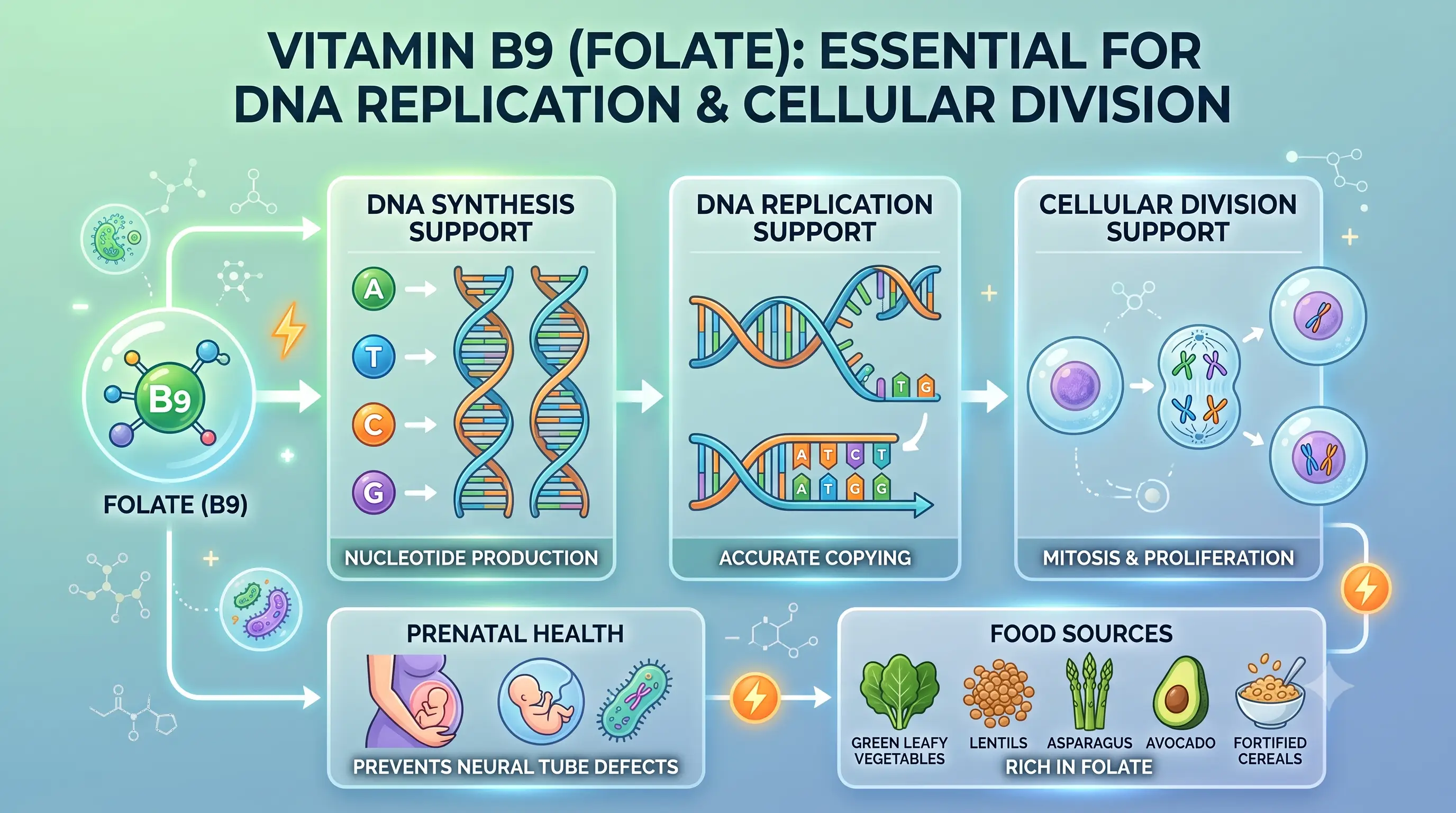
Whatever the starting form, B9 is required for one-carbon metabolism — the set of reactions that build DNA and RNA, support rapid cell division and tissue growth, and recycle the amino acid homocysteine[1]. Requirements rise sharply whenever cells are dividing quickly, which is why pregnancy is where folate matters most.
Daily Requirements
| Group | Recommended intake | Note |
|---|---|---|
| Adults generally | 400 mcg DFE per day | Usually achievable from a varied diet |
| All women who could become pregnant | 400 mcg folic acid daily, in addition to food folate | CDC recommendation; USPSTF gives 400–800 mcg a Grade A recommendation[2] |
| Pregnancy | 600 mcg DFE per day | Follow your obstetric provider's specific advice |
| Breastfeeding | 500 mcg DFE per day | — |
| Previous NTD-affected pregnancy | Higher dose (commonly 4,000 mcg) under medical supervision | Prescribed and monitored by a physician — not self-directed[2] |
| Upper limit (supplemental folic acid, adults) | 1,000 mcg per day | Applies to synthetic folic acid, not food folate |
"DFE" stands for Dietary Folate Equivalents, a unit that accounts for folic acid being more efficiently absorbed than food folate.
2. A Deep Dive Into Folate's Key Roles
Neural Tube Development
This is one of the best-established findings in all of nutrition. The neural tube — which becomes the brain and spinal cord — closes within roughly the first month of pregnancy, often before a woman knows she is pregnant. Randomized trials and national food fortification programmes have shown that adequate folic acid intake before and during early pregnancy reduces the occurrence of neural tube defects such as spina bifida and anencephaly[2]. The US Preventive Services Task Force gives supplementation a Grade A recommendation, its strongest category.
Two practical points follow. First, because the critical window is so early, the recommendation applies to all women who could become pregnant, not only those actively planning. Second, "reduces the risk" is the accurate phrasing — folic acid lowers the likelihood of these defects but cannot guarantee prevention, and other factors contribute.
Red Blood Cell Formation
Folate is required for the DNA synthesis that produces new red blood cells. Deficiency leads to megaloblastic anemia, in which cells are abnormally large and immature, causing fatigue, weakness, pallor, and shortness of breath. Because B12 deficiency causes an almost identical blood picture but requires different treatment, this is a diagnosis for a physician rather than something to infer from symptoms.
Homocysteine and Cardiovascular Markers
Folate, working with B6 and B12, converts homocysteine to methionine. Elevated homocysteine has been associated with cardiovascular risk, and supplementation reliably lowers it. It is worth being straightforward, though: large randomized trials testing whether lowering homocysteine with B vitamins reduces heart attacks and strokes have largely not shown the benefit that was hoped for. Folate supports normal homocysteine metabolism; it is not established as a cardiovascular treatment.
Other Areas
Folate status has been studied in relation to mood, cognition in older adults, and — in the specific case of L-methylfolate at prescription doses — as an adjunct in depression under medical supervision. Outside that clinical context, evidence for supplementation improving mood or cognition in people who are already replete is limited.
What the Evidence Does and Doesn't Show
| Use | Strength of evidence | Notes |
|---|---|---|
| Reducing neural tube defect risk | Well established (USPSTF Grade A) | Requires intake before conception |
| Treating folate-deficiency anemia | Well established | Medical diagnosis needed to distinguish from B12 deficiency |
| Lowering homocysteine | Well established | Biomarker change; outcome benefit not demonstrated |
| Preventing cardiovascular events | Not supported | Large trials were largely negative |
| Mood and cognition in replete adults | Insufficient | Prescription methylfolate in depression is a separate clinical context |
3. Shop Smart: How to Choose the Right Form
Step 1: Folic Acid vs. L-Methylfolate — an Honest Comparison
Methylated folate supplements are marketed heavily, often with the claim that a large share of the population "cannot process" folic acid. That framing overstates the case, and in the prenatal context it can be actively unhelpful. Here is the more accurate picture:
- Folic acid is well absorbed and converted by most people, and it is the form used in the trials and national fortification programmes that actually demonstrated fewer neural tube defects. Health authorities continue to describe it as safe and effective at recommended amounts, and note that supplementation at recommended levels does not delay the detection of vitamin B12 deficiency[2].
- MTHFR gene variants are common and can somewhat reduce the efficiency of converting folic acid to its active form. For most people this does not produce a clinically meaningful problem, and routine MTHFR testing is not recommended by major genetics and obstetric organisations for this purpose.
- L-Methylfolate (5-MTHF) is a perfectly good supplement form, bypasses the conversion step, and is a reasonable choice — particularly for people who prefer it or have been advised to use it. What it does not have is the same body of outcome evidence in pregnancy that folic acid has.
- Practical takeaway: For pregnancy planning, following your obstetric provider's guidance — which in most countries means folic acid at the recommended dose — is the evidence-aligned choice. Outside pregnancy, either form is fine.
Step 2: Prenatal Formulations
A prenatal supplement should provide at least 400 mcg of folate or folic acid, along with iodine, iron appropriate to your status, vitamin D, and B12. Check the actual amounts rather than trusting the front label, avoid products that mega-dose one nutrient, and confirm the choice with your obstetric provider — dosing may differ if you have a relevant medical history, take certain medications, or have had a previous affected pregnancy.
Step 3: Third-Party Testing
Prenatal supplements are one category where verification is worth insisting on. Look for USP or NSF certification, or a published certificate of analysis including heavy metals.
4. Everyday Habits: Getting Folate From Food
- Dark leafy greens: Spinach, romaine, and asparagus are rich sources — the name folate comes from folium, Latin for leaf.
- Legumes: Lentils, chickpeas, black beans, and edamame are among the densest food sources; a cooked cup of lentils supplies a large share of the daily requirement.
- Broccoli and Brussels sprouts: Reliable everyday contributors.
- Avocado, citrus, and beets: Useful additions with other nutrients alongside.
- Fortified grains: In countries with mandatory fortification, bread, flour, pasta, and cereals contribute a meaningful baseline — this is precisely the public health measure that reduced neural tube defects at a population level.
- Cook gently: Folate is water-soluble and heat-sensitive. Steaming or light sautéing preserves considerably more than prolonged boiling; using cooking liquid in soups recovers some of what leaches out.
- Limit alcohol: Alcohol interferes with folate absorption and metabolism, and this is one of the more common causes of low folate status in adults.
5. The Perfect Match: Synergies and Incompatibilities
Nutrients rarely work in isolation, and folate's relationship with vitamin B12 is the most clinically important pairing on this page.
✅ Combinations That Work Well Together
- Vitamin B12: B9 and B12 operate in the same metabolic cycle, and B12 is needed to regenerate the active form of folate. Taking them together — as in a balanced B-complex or prenatal — reduces the risk of the masking problem described below.
- Vitamin B6: Also part of homocysteine metabolism.
- Iron and Vitamin C: Relevant in pregnancy and in anemia workups, since iron and folate deficiencies often occur together and vitamin C aids iron absorption.
- Choline and iodine: Both important in pregnancy and frequently under-supplied; worth checking your prenatal covers them.
❌ Requiring Care
- High-dose folic acid without B12: At high supplemental doses, folic acid can correct the anemia of B12 deficiency while allowing the neurological damage to progress undetected. This is the reason for the 1,000 mcg upper limit on supplemental folic acid, and why older adults and people on metformin or long-term acid-reducing medication should have B12 status considered.
- Methotrexate: Works by blocking folate metabolism. Folate supplementation is often deliberately prescribed alongside it to reduce side effects — but the dose and timing must come from the prescribing physician, never self-adjusted.
- Anticonvulsants (phenytoin, carbamazepine, valproate): Interact with folate in both directions; changes require neurologist input, especially in pregnancy planning.
- Sulfasalazine and some other medications: Can impair folate absorption.
- Alcohol: Reduces absorption and increases loss.
6. Dosage, Timing, and Safety
Practical Approach
- General adult supplementation: 400 mcg daily is the standard amount and is what most multivitamins contain.
- Pregnancy planning: Begin at least one month before conception and continue through early pregnancy — the window that matters closes early.
- Timing: Any time of day, with or without food. Consistency is what counts.
- Upper limit: 1,000 mcg per day of supplemental folic acid for adults unless a physician has prescribed more for a specific reason.
Tolerability
Folate is water-soluble and generally very well tolerated at recommended amounts. Reported effects at high doses are uncommon and mild — nausea, bloating, sleep disturbance, or irritability.
7. Frequently Asked Questions
Q. I'm not planning a pregnancy. Do I still need 400 mcg?
A. Health authorities recommend it for all women who could become pregnant, precisely because roughly half of pregnancies are unplanned and the critical window closes before most people know they are pregnant.
Q. Should I get tested for MTHFR before choosing a prenatal?
A. Routine MTHFR testing is not recommended by major professional bodies for this purpose. If you have specific concerns, raise them with your doctor rather than ordering a direct-to-consumer test and self-interpreting it.
Q. Is methylfolate better than folic acid?
A. It is a good form, but "better" overstates it. Folic acid is what the pregnancy evidence was built on. Outside pregnancy either works; in pregnancy, follow your provider's advice.
Q. Can I get enough from food alone?
A. For general health, often yes. For pregnancy prevention of neural tube defects, guidelines specifically recommend a supplement or fortified foods in addition to dietary folate, because the required blood levels are difficult to reach reliably through diet.
Q. Is unmetabolized folic acid in the blood dangerous?
A. This has been studied and debated. Health authorities reviewing the evidence have concluded that at recommended amounts no health risks are confirmed, and that folic acid at these doses is safe and effective.
8. Conclusion and Precautions
Folate is a genuinely essential nutrient, and its role in reducing neural tube defect risk is one of the strongest and most consequential findings in nutritional science — strong enough that many countries fortify the food supply on the basis of it. For adults generally, a varied diet with leafy greens, legumes, and fortified grains usually covers requirements. For anyone who could become pregnant, a daily 400 mcg supplement started before conception is a simple, low-cost, well-evidenced step. Beyond that, more is not better, and the B12 relationship is worth respecting.
⚠️ Precautions: This article is not medical advice, and dietary supplements are not intended to diagnose, treat, cure, or prevent any disease. Do not exceed 1,000 mcg of supplemental folic acid per day without medical direction, as high doses can mask vitamin B12 deficiency. Always consult your obstetrician or midwife regarding exact prenatal dosages, particularly if you have had a previous affected pregnancy, take anticonvulsants or methotrexate, or have a malabsorption condition.
9. Sources and References
- National Institutes of Health (NIH), ODS — Folate Fact Sheet for Health Professionals
https://ods.od.nih.gov/factsheets/Folate-HealthProfessional/ - Centers for Disease Control and Prevention (CDC) — Folic Acid
https://www.cdc.gov/folic-acid/index.html - Mayo Clinic — Folate (folic acid)
https://www.mayoclinic.org - Harvard T.H. Chan School of Public Health, The Nutrition Source — Folate (Vitamin B9)
https://www.hsph.harvard.edu - American College of Obstetricians and Gynecologists (ACOG) — Nutrition During Pregnancy
https://www.acog.org - U.S. Preventive Services Task Force — Folic Acid Supplementation to Prevent Neural Tube Defects
https://www.uspreventiveservicestaskforce.org
© 2026 Healing-Finder. All rights reserved.