The Complete CoQ10 Guide: Cellular Energy, Heart Research, and Ubiquinol
1. What CoQ10 Does in the Body
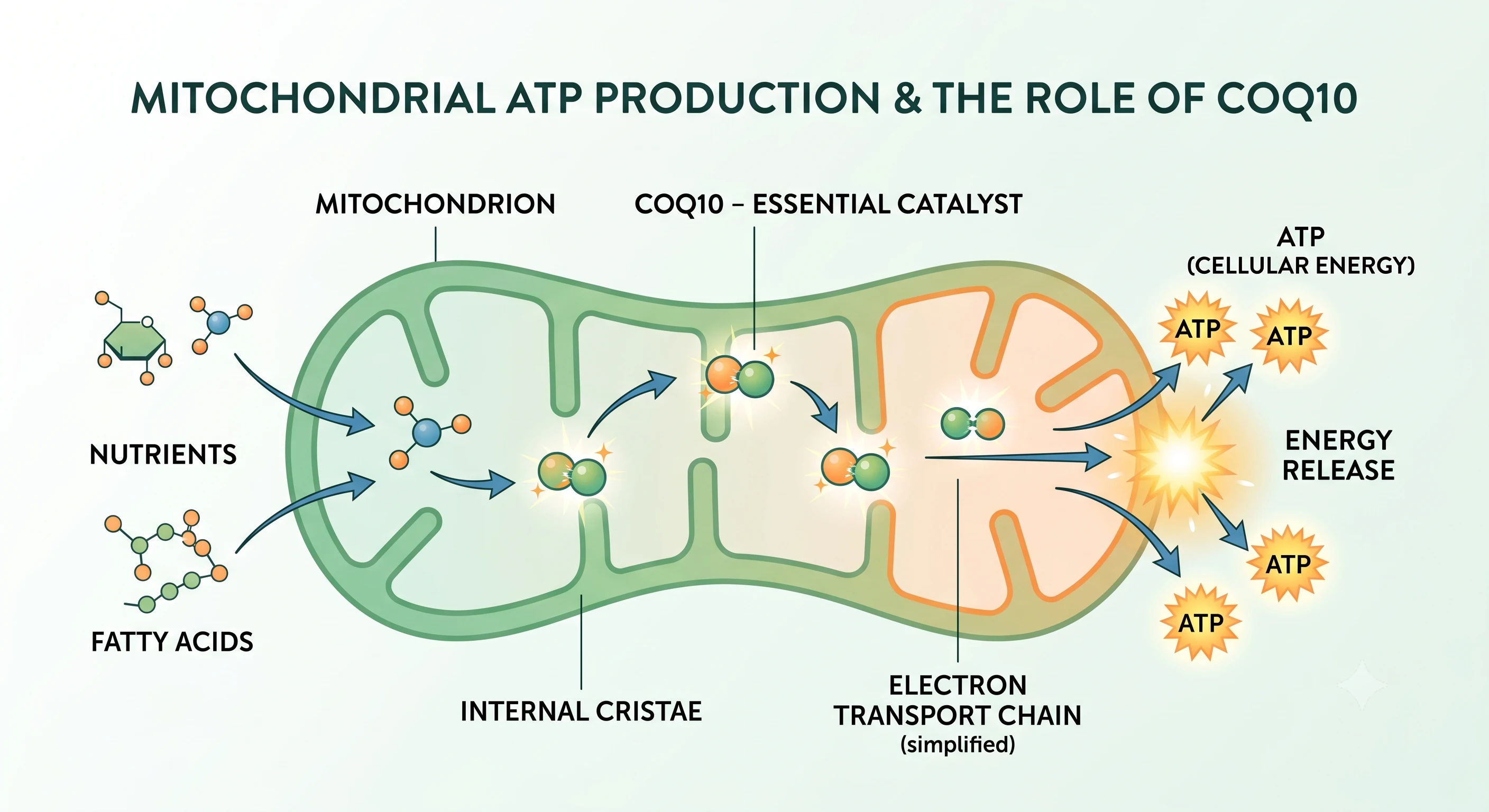
Inside nearly every cell are mitochondria, the structures that generate most of the body's usable energy. Coenzyme Q10 (CoQ10) is an essential component of that process: it shuttles electrons along the mitochondrial electron transport chain, the series of reactions that ultimately produces ATP[1]. It also functions as a fat-soluble antioxidant within cell membranes and lipoproteins.
The body makes its own CoQ10, and small amounts come from food — meat, fish, and nuts contain it, though generally not enough to raise blood levels much[3]. Tissue levels tend to decline with age, and they are highest in the organs with the greatest energy demand, including the heart.
Statins and CoQ10
Statin medications lower cholesterol by inhibiting an enzyme in a pathway that the body also uses to synthesise CoQ10, and statin use is consistently associated with reduced blood CoQ10 levels[3]. This is a well-documented biochemical observation. Whether that reduction is what causes the muscle aches some people experience on statins is a separate and still unsettled question — which matters, because the whole case for CoQ10 supplementation in statin users rests on it.
2. A Deep Dive Into CoQ10's Studied Effects
Heart Failure and Blood Pressure
The heart muscle is among the most energy-demanding tissues in the body and contains some of the highest natural concentrations of CoQ10. Clinical research suggests CoQ10 may improve symptoms in congestive heart failure when used alongside standard medical treatment, and findings on blood pressure are mixed — some trials report modest reductions, others do not[3][2]. Reviewers have consistently noted that many of the supporting trials were small and that larger studies are needed before firm conclusions can be drawn. Anyone with a cardiovascular condition should be guided by their cardiologist, not by supplementation.
Statin-Associated Muscle Symptoms
For some people taking statins, muscle aches and fatigue are a genuine and sometimes treatment-limiting problem. Several small trials have examined whether CoQ10 eases these symptoms, and some report improvement — but results across studies have been inconsistent, and there is not currently enough evidence to know whether it reliably helps[3]. Given the low risk and low cost, some physicians are willing to trial it; that decision is best made with the prescriber rather than independently.
Migraine
This is one of the better-supported uses. Some research suggests CoQ10 may reduce how often migraines occur or how long they last, with the important practical caveat that people typically need to take it for around three months before any benefit would be expected[3]. Some headache guidelines list it among options with possible preventive effect.
Where the Evidence Is Negative or Absent
It is worth stating the limits plainly. Trials of CoQ10 in Parkinson's disease, including at high doses, have not shown benefit for symptoms[3]. Research on exercise performance has not been conclusive. Claims that CoQ10 reverses ageing, boosts energy in healthy people, or improves fertility outcomes go well beyond what the evidence supports. Deficiency-related conditions — primary CoQ10 deficiency and certain mitochondrial disorders — are treated with CoQ10 medically, but these are rare inherited conditions managed by specialists.
What the Evidence Does and Doesn't Show
| Use | Strength of evidence | Notes |
|---|---|---|
| Migraine frequency/duration | Moderate | Requires ~3 months; among the better-supported uses |
| Heart failure symptoms (adjunct) | Promising but mixed | Alongside standard care only; larger trials needed |
| Blood pressure | Mixed, modest | Findings inconsistent |
| Statin-related muscle symptoms | Inconsistent | Not enough evidence for a firm conclusion |
| Parkinson's disease | Negative | High-dose trials did not show benefit |
| Energy in healthy people, anti-ageing | Not established | Common marketing claim |
3. Shop Smart: How to Choose the Right CoQ10
Step 1: Ubiquinone vs. Ubiquinol
- Ubiquinone: The oxidised form. Less expensive, chemically stable, and the form used in the large majority of published clinical trials — which is a genuine point in its favour.
- Ubiquinol: The reduced, active form. Some studies report higher blood levels for a given dose, and it is often preferred by older adults on the reasoning that conversion efficiency declines with age. It costs more and is less stable.
- The practical position: The body interconverts the two forms continuously, and both raise blood CoQ10. Ubiquinol may offer a bioavailability advantage; ubiquinone has the deeper research base. Either is a reasonable choice, and the difference is smaller than marketing suggests — dose and consistency matter more.
Step 2: Oil-Based Softgels
CoQ10 is strongly fat-soluble and absorbs poorly from dry powder. Softgels suspending CoQ10 in an oil base (olive, MCT, or rice bran oil) generally achieve better uptake, particularly when taken with a meal containing fat. Solubilised or "crystal-free" formulations are designed to improve this further.
Step 3: Dose Transparency and Testing
Check the stated milligram amount and form. Because CoQ10 is a relatively expensive raw material, independent verification (USP, NSF) is a useful safeguard against underdosed products.
4. Everyday Habits: Getting CoQ10 From Food
- Organ meats: Beef heart and liver are the densest natural sources.
- Fatty fish: Sardines, mackerel, salmon, and tuna provide useful amounts alongside omega-3 fatty acids.
- Nuts, seeds, and oils: Peanuts, pistachios, sesame seeds, and soybean and canola oil contribute modest amounts.
- Legumes and vegetables: Soybeans, lentils, spinach, and broccoli contain small quantities.
- Take it with fat: Whether from food or a supplement, dietary fat meaningfully improves absorption.
- Realistic expectation: Dietary intake typically supplies only a few milligrams a day, which is far below supplemental doses. Food is a good habit, not a route to research-level intakes.
5. The Perfect Match: Synergies and Incompatibilities
Nutrients rarely work in isolation. One interaction below is clinically important and should not be treated as a footnote.
✅ Combinations That Make Sense Together
- Omega-3 (Fish Oil): Because CoQ10 is fat-soluble, taking it with omega-3 oils provides a lipid vehicle that supports absorption. The two are commonly paired for cardiovascular support.
- L-Carnitine: L-Carnitine transports fatty acids into mitochondria, where CoQ10 participates in converting them to energy. The two are often combined for stamina and cardiac support, though evidence for the specific combination is limited.
- PQQ (Pyrroloquinoline quinone): CoQ10 supports the function of existing mitochondria; PQQ has been studied for its potential role in mitochondrial biogenesis. A popular pairing, but evidence for the combination is still emerging.
- Magnesium and riboflavin (B2): Both also studied in migraine prevention, and frequently combined with CoQ10 in that context.
❌ Requiring Caution
- Warfarin (and similar anticoagulants): CoQ10 is structurally similar to vitamin K and may make warfarin less effective, potentially raising clot risk[3]. Do not combine without discussing it with your physician, and expect INR monitoring if you do.
- Blood pressure medication: Possible additive lowering of blood pressure; monitor.
- Chemotherapy and radiotherapy: As with other antioxidants, do not add during cancer treatment without oncology approval.
- Insulin and diabetes medication: CoQ10 may affect blood glucose in some people; monitor if relevant.
- Before surgery: Stop as advised by your surgical team.
6. Dosage, Timing, and Safety
Typical Ranges Used in Research
- General supplementation: Commonly 100–200 mg per day.
- Migraine studies: Often around 100 mg three times daily, or 300 mg per day.
- Cardiovascular studies: Frequently 100–300 mg per day, in a clinical setting alongside standard care.
- Timing: With a meal containing fat. Splitting doses above 100 mg improves absorption. Because CoQ10 supports energy production, some people find late-evening doses disturb sleep or produce vivid dreams — morning or early afternoon is generally recommended.
- Duration: Give it at least 8 to 12 weeks, and around three months for migraine, before judging.
Tolerability
CoQ10 has a good safety record and causes few side effects when taken as directed. Reported effects are usually mild and include upper stomach discomfort, loss of appetite, nausea, diarrhoea, dizziness, sleep difficulty, tiredness, headache, rash, and irritability[3].
7. Frequently Asked Questions
Q. Should everyone on a statin take CoQ10?
A. Not automatically. Statins do lower CoQ10 levels, but whether supplementing relieves muscle symptoms remains unproven. If you have statin-related muscle aches, raise it with your prescriber — there may be better options, including dose or drug changes.
Q. Ubiquinol or ubiquinone?
A. Ubiquinol may absorb somewhat better and is often chosen by people over 40; ubiquinone is cheaper and has the larger trial base. Both work. If cost would stop you taking it consistently, ubiquinone is the better practical choice.
Q. Will it give me more energy?
A. In healthy, well-nourished people there is no good evidence that it increases energy or exercise performance. The "cellular energy" role is biochemical, not a stimulant effect.
Q. How long until I notice anything for migraine?
A. Around three months of consistent daily use is the usual expectation in the research. It is a preventive approach, not something to take during an attack.
Q. Can I take it at night?
A. You can, but some people report difficulty sleeping or unusually vivid dreams. Morning or early afternoon with food is the standard recommendation.
8. Conclusion and Precautions
CoQ10 is a genuinely essential molecule with a clear, well-understood role in cellular energy production, an excellent tolerability record, and a research base that is stronger in some areas than others — most encouraging for migraine prevention and as an adjunct in heart failure, inconsistent for statin muscle symptoms, and negative for Parkinson's disease. For adults over 40 or those taking a statin, it is a reasonable, low-risk supplement that may help support cellular energy production and everyday heart health as part of a broader routine. It is not a substitute for medication or care prescribed by a physician, and the warfarin interaction deserves real attention.
⚠️ Precautions: The FDA has not evaluated CoQ10 for the treatment of any medical condition, and this article is not medical advice. CoQ10 may reduce the effectiveness of warfarin — consult your physician before combining. Safety during pregnancy and breastfeeding has not been established. Because it supports energy production, taking it late in the evening may disturb sleep in some people; morning or early afternoon with a meal is generally recommended. Consult a healthcare professional before starting supplementation, especially if you take blood thinners, blood pressure or diabetes medication, or are undergoing cancer treatment.
9. Sources and References
- NIH National Center for Complementary and Integrative Health (NCCIH) — Coenzyme Q10
https://www.nccih.nih.gov/health/coenzyme-q10 - Wyman M, Leonard M, Morledge T — Coenzyme Q10: A therapy for hypertension and statin-induced myalgia? Cleveland Clinic Journal of Medicine. 2010;77(7):435-442
https://www.ccjm.org/content/77/7/435 - Mayo Clinic — Coenzyme Q10: Uses and Risks
https://www.mayoclinic.org/drugs-supplements-coenzyme-q10/art-20362602 - Cleveland Clinic Health Library — Coenzyme Q10 Supplement: Uses & Side Effects
https://my.clevelandclinic.org - Mount Sinai Health System — Coenzyme Q10
https://www.mountsinai.org/health-library/supplement/coenzyme-q10 - Linus Pauling Institute, Oregon State University — Micronutrient Information Center: Coenzyme Q10
https://lpi.oregonstate.edu
© 2026 Healing-Finder. All rights reserved.