The Complete Biotin Guide: Keratin Support, Hair and Nail Health, and Synergies
1. What Biotin Actually Does in the Body
Biotin, also known as Vitamin B7 or Vitamin H, is a water-soluble B-vitamin that acts as a co-enzyme for five carboxylase enzymes involved in breaking down dietary fats, carbohydrates, and proteins[1]. These enzymes handle fatty acid synthesis, the metabolism of branched-chain amino acids, and gluconeogenesis — which is why biotin is often described as a metabolic "helper molecule" rather than a source of energy in itself.
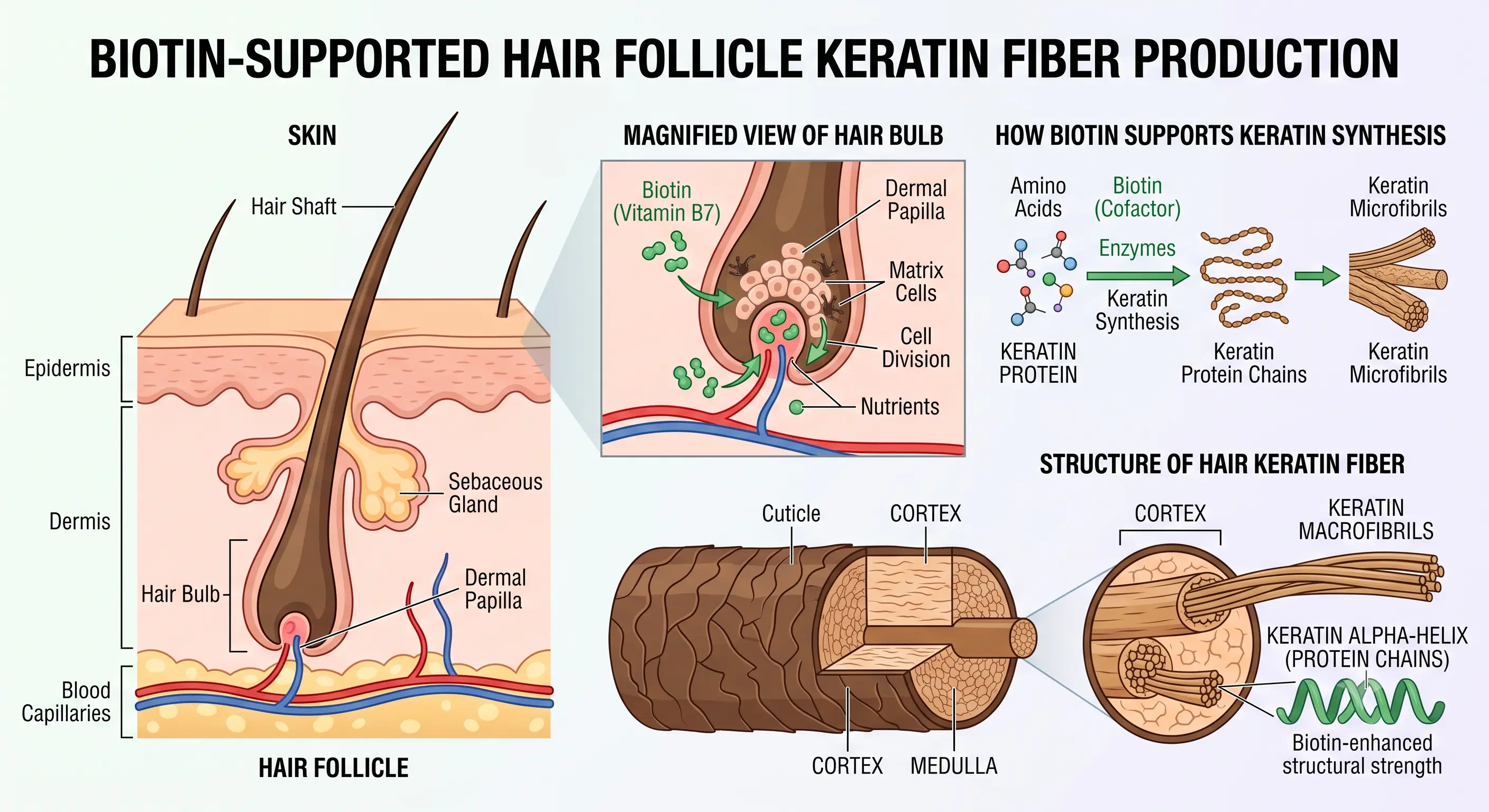
Biotin is also required for the production of keratin, the structural protein that makes up hair, skin, and nails. This is the biological basis for its popularity in beauty supplements. It is worth being precise here: biotin is necessary for normal keratin production, but that is not the same as saying extra biotin produces extra keratin in someone whose intake is already adequate.
How Much Do You Actually Need?
In the United States, the Adequate Intake (AI) for adults is 30 mcg per day (35 mcg for lactating women)[1]. Most people in developed countries meet this comfortably through a normal mixed diet, and gut bacteria may contribute a small additional amount. True biotin deficiency is uncommon in otherwise healthy adults.
Who Is More Likely to Run Low?
- People taking certain anticonvulsants (such as carbamazepine, phenytoin, phenobarbital) over long periods, which can accelerate biotin breakdown.
- People with chronic heavy alcohol use, which can reduce biotin absorption.
- People who regularly consume raw egg whites, which contain avidin — a protein that binds biotin and blocks its absorption.
- Pregnant and breastfeeding women, in whom marginal biotin status has been observed in some studies.
- People with biotinidase deficiency, a rare inherited condition that requires medical management, not self-directed supplementation.
Signs associated with genuine deficiency — such as thinning hair, a scaly red rash around the eyes, nose and mouth, and neurological symptoms — should be assessed by a physician rather than self-treated, since they overlap with many other conditions.
2. A Deep Dive Into Biotin's Key Benefits
Hair Growth and Reduced Shedding
Biotin supports the body's keratin infrastructure, and correcting a biotin deficiency may help reduce hair breakage and shedding in deficient individuals[2]. Case reports and small studies in people with an identified deficiency or an underlying condition affecting biotin status have described improvement after supplementation. Evidence that additional biotin improves hair health in people who are not deficient is limited, and dermatology organizations generally note that routine biotin supplementation is not an established treatment for common hair loss[5].
It is also worth understanding hair biology before judging any supplement: a hair follicle spends years in its growth phase and roughly three months in its resting and shedding phase. Any change in hair — for better or worse — typically takes three to six months to become visible, which is why short trials and "before and after" photos taken weeks apart are unreliable indicators.
Brittle Nail Support
Some small clinical studies, several of them older and uncontrolled, suggest that daily biotin supplementation over several months may help increase nail plate thickness and reduce splitting in people with brittle fingernail syndrome. Results vary between individuals, the studies were small, and biotin deficiency is uncommon in otherwise healthy people — so this should be seen as a promising but not firmly established use.
Metabolic and Nervous System Support
Because the biotin-dependent carboxylases sit at key points in fat and amino acid metabolism, adequate biotin status is part of normal energy metabolism. This does not mean biotin acts as a stimulant or "energy booster" — supplementing beyond what the enzymes require does not accelerate metabolism in a healthy person.
What the Evidence Does and Doesn't Show
| Use | Strength of evidence | Notes |
|---|---|---|
| Correcting diagnosed biotin deficiency | Well established | Standard nutritional practice under medical guidance |
| Brittle nails | Limited / preliminary | Small, mostly older studies; results vary |
| Hair health in deficient individuals | Limited | Mainly case reports and small series |
| Hair growth in non-deficient individuals | Insufficient | Not supported by robust controlled trials |
| Skin quality, weight loss, "energy" | Insufficient | Commonly marketed, not well supported |
Reading claims critically: Regulators in several countries have taken action against marketers for overstated hair and nail claims. If a product promises to regrow hair, reverse baldness, or deliver results "in weeks," treat that as a marketing signal rather than a scientific one.
3. Shop Smart: How to Choose the Right Biotin
Step 1: Understand the Dosage Gap
The daily requirement is around 30 mcg, while hair and nail supplements typically provide 1,000 mcg to 10,000 mcg — hundreds of times higher. These larger amounts reflect the doses used in the small studies on brittle nails, not an established requirement. Biotin is water-soluble and no Tolerable Upper Intake Level has been set, but "more is better" is not supported by evidence, and higher doses meaningfully increase the risk of laboratory test interference described in Section 6. Many people find a moderate dose (for example, the amount in a standard B-complex or a 1,000–5,000 mcg product) a reasonable starting point.
Step 2: Check the Form
The biologically active form is d-biotin, and this is what reputable supplements use. Some products list biotin as part of a broader hair-and-nail blend; in that case check that the other ingredients are disclosed with individual amounts rather than hidden inside a "proprietary blend."
Step 3: Look for Third-Party Verification
Dietary supplements are not approved by regulators for efficacy before sale, so manufacturing quality varies. Seals from independent testing organizations (such as USP, NSF, or Informed Choice) indicate that a product has been checked for identity, potency, and contaminants. This says nothing about whether the ingredient works — only that the label is accurate.
Step 4: Capsule Shell and Format
Check the capsule shell if this matters to you: gelatin capsules are animal-derived, while cellulose (HPMC) capsules are plant-based. Gummy formats are popular but often contain added sugars and sometimes deliver less consistent dosing.
4. Everyday Habits: Getting Biotin From Food
- Egg Yolks: One of the richest common sources of bioavailable biotin. Cook eggs thoroughly — raw egg whites contain avidin, which binds biotin and blocks absorption.
- Organ Meats: Beef liver is exceptionally high in biotin, along with B12, iron, and vitamin A.
- Nuts and Seeds: Almonds, walnuts, peanuts, and sunflower seeds provide steady daily amounts alongside healthy fats and vitamin E.
- Salmon and Tuna: Contribute biotin plus omega-3 fatty acids and protein.
- Legumes and Sweet Potato: Soybeans, lentils, and sweet potato are useful plant sources, particularly for vegetarian diets.
- Adequate overall protein: Keratin is built from amino acids. A diet chronically low in protein — including during aggressive dieting — is a common and often overlooked contributor to hair and nail fragility.
Because hair and nail quality reflect overall nutritional status, factors such as iron (ferritin), zinc, vitamin D, thyroid function, and total calorie intake often matter more than biotin specifically. Persistent hair loss deserves a proper medical work-up rather than a supplement trial.
5. The Perfect Match: Synergies and Incompatibilities
Nutrients rarely work in isolation. Sensible combinations can support absorption and complementary functions, while some pairings reduce absorption or simply waste money.
✅ Combinations That Make Sense Together
- Zinc and Selenium: Both minerals have established roles in skin and hair follicle biology, and deficiency in either is associated with hair changes. Adequate status matters more than high doses — excess zinc and selenium both carry their own risks.
- Collagen Peptides or general protein: Supply the amino acid building blocks that keratin synthesis depends on.
- Iron (only if indicated): Low ferritin is a well-recognized contributor to hair shedding, especially in menstruating women. Iron should be taken based on a blood test, not assumption, because excess iron is harmful.
- Other B vitamins: Biotin works alongside the rest of the B-complex in energy metabolism, so a balanced complex is often a reasonable alternative to a single high-dose product.
❌ Combinations to Separate or Avoid
- Raw Egg Whites: Avidin binds biotin tightly in the gut and makes it unavailable. Cooking denatures avidin, so cooked eggs are not a problem.
- High-dose Alpha-Lipoic Acid: Biotin and lipoic acid share the same intestinal transporter (SMVT), so very high lipoic acid intakes may theoretically compete with biotin absorption. Spacing them apart is a simple precaution.
- Long-term anticonvulsant therapy: Not a reason to avoid biotin, but a reason to discuss supplementation with the prescribing physician rather than self-adjusting.
- Chronic alcohol use: Impairs absorption of biotin and several other B vitamins; supplementation does not offset the underlying problem.
6. Dosage, Timing, and Safety
Typical Intake Ranges
- Adequate Intake: 30 mcg/day for adults, generally met by diet[1].
- Common supplement range: 1,000–10,000 mcg/day in hair and nail products. Higher amounts have not been shown to give better results.
- Timing: Biotin is water-soluble and can be taken with or without food; taking it with a meal may reduce mild stomach upset. Consistency matters more than timing.
Tolerability
Biotin is generally well tolerated, and no Tolerable Upper Intake Level has been established, largely because toxicity has not been documented. Occasional reports include mild digestive discomfort or skin breakouts, though these are not well characterized in controlled research.
Special Situations
- Pregnancy and breastfeeding: Biotin needs are covered by prenatal vitamins; discuss high-dose products with an obstetric provider.
- Upcoming surgery or cardiac testing: Mention biotin use, given the troponin interference issue.
- Existing thyroid diagnosis: Biotin does not change thyroid function, but it can change how your thyroid results appear. Inform your endocrinologist.
7. Frequently Asked Questions
Q. How long before I would notice anything?
A. Because of the hair growth cycle, any visible change generally takes three to six months, and there is no guarantee of a change at all — particularly if your biotin status was already adequate.
Q. Is 10,000 mcg better than 1,000 mcg?
A. There is no good evidence that it is. Higher doses do increase the likelihood of interfering with blood tests, so the higher amount carries a practical downside without a demonstrated benefit.
Q. Can I get my biotin level tested?
A. Direct biotin testing is uncommon and not routinely offered. Physicians usually assess deficiency based on clinical signs, diet, and risk factors. If you are experiencing hair loss, evaluating thyroid function, ferritin, and other causes is usually more informative.
Q. Will biotin help hair loss caused by genetics or hormones?
A. There is no evidence that it addresses androgenetic (pattern) hair loss. That condition has established medical treatments that a dermatologist can discuss with you.
Q. My urine turned a strange color after starting a B-complex. Is that biotin?
A. Bright yellow urine is typically caused by riboflavin (B2) in a B-complex, not biotin. It is harmless and simply reflects excess water-soluble vitamin being excreted.
8. Conclusion and Precautions
Biotin is an essential, well-characterized B-vitamin with a clear role in metabolism and keratin production. Supplementation has the strongest rationale for people whose intake or absorption is genuinely compromised; for people with an adequate diet, the evidence that extra biotin improves hair or nails is limited. It can be a reasonable, low-risk part of a broader routine — alongside adequate protein, iron and thyroid status, and realistic expectations — rather than a solution on its own.
⚠️ Precautions: The FDA has not evaluated biotin for the treatment of any medical condition, and this article is not medical advice. High-dose biotin can artificially skew certain laboratory blood test results (especially thyroid panels and cardiac troponin tests) — inform your doctor and laboratory if you take biotin before having blood work done. Consult a healthcare professional before starting long-term supplementation, particularly if you are pregnant or breastfeeding, take prescription medication, or are experiencing unexplained hair loss.
9. Sources and References
- National Institutes of Health (NIH), ODS — Biotin Fact Sheet
https://ods.od.nih.gov/factsheets/Biotin-HealthProfessional/ - Mayo Clinic — Biotin: Does it work for hair loss?
https://www.mayoclinic.org - Cleveland Clinic — Biotin for Hair and Nails
https://my.clevelandclinic.org - Harvard T.H. Chan School of Public Health — B-Vitamins
https://www.hsph.harvard.edu - American Academy of Dermatology (AAD) — Hair Loss Supplements
https://www.aad.org - U.S. Food and Drug Administration — Safety communications on biotin interference with laboratory tests
https://www.fda.gov - Linus Pauling Institute, Oregon State University — Micronutrient Information Center: Biotin
https://lpi.oregonstate.edu
© 2026 Healing-Finder. All rights reserved.