The Complete Red Yeast Rice Guide: Cholesterol, Monacolin K, and Synergies
1. What Red Yeast Rice Is — and Why It Is Not an Ordinary Supplement
Red Yeast Rice (RYR) is a traditional Chinese culinary and medicinal product made by fermenting rice with the mould Monascus purpureus. It has been used for centuries as a food colouring, in rice wine, and in traditional medicine[1].
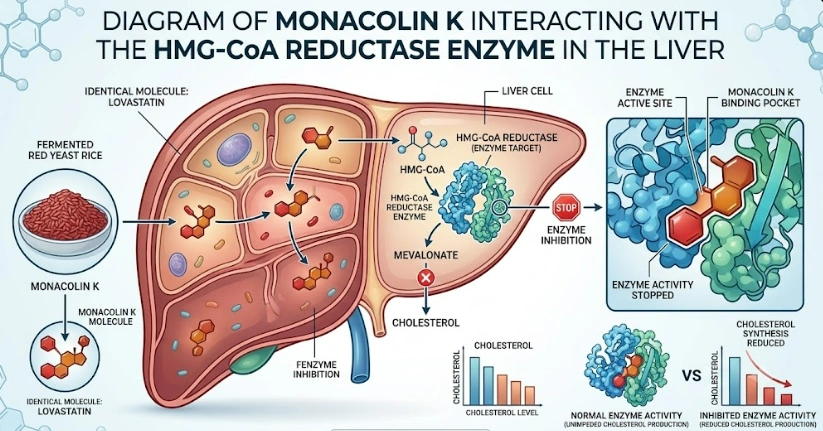
During fermentation it produces monacolin K, a compound that is chemically identical to lovastatin — the active ingredient in a prescription statin medication. It works the same way, by inhibiting HMG-CoA reductase, the liver enzyme that drives cholesterol synthesis. This single fact defines everything about how red yeast rice should be understood.
What follows is educational information, not a recommendation. Red yeast rice is not a product to start, stop, dose, or combine on your own. If you are considering it, that conversation belongs with a physician who can check your lipid panel, your other medications, and your liver function — the same way they would with any statin.
2. A Deep Dive Into RYR's Studied Effects
LDL Cholesterol
Multiple clinical trials and meta-analyses report that red yeast rice preparations reduce total and LDL cholesterol, with the size of the reduction depending directly on how much monacolin K the product actually contains. This is unsurprising — it is the expected effect of a statin. Reported average LDL reductions in trials of products containing meaningful monacolin K have often fallen in a range broadly comparable to a low-dose statin.
The important framing: this is not evidence that a "natural" alternative works: it is evidence that a statin works when it happens to be delivered inside a fermented rice product with variable, unlabelled potency and no pharmaceutical quality control. That distinction matters for safety.
Other Lipid Measures
Some studies report modest reductions in triglycerides and small increases in HDL cholesterol. Effects are generally smaller and less consistent than the LDL effect, and individual responses vary.
Cardiovascular Outcomes
One large Chinese secondary-prevention trial using a specific RYR preparation reported reduced recurrent cardiac events. That study has been influential but has not been replicated in Western populations with standard products, and its findings should not be generalised to over-the-counter RYR supplements of unknown potency.
What the Evidence Does and Doesn't Show
| Point | Status | Notes |
|---|---|---|
| Lowers LDL cholesterol | Well established | Because it contains a statin |
| Predictable dosing | Not established | Monacolin content varies enormously between products |
| Safer than a prescription statin | Not supported | Same mechanism, same class of risks, less oversight |
| Cardiovascular event reduction | Limited | One trial, specific preparation, not generalisable |
| Suitable for self-management | No | Requires physician supervision and monitoring |
3. Regulatory Status: Three Jurisdictions, Three Answers
Red yeast rice is the clearest example in this whole category of a substance where the regulatory answer depends entirely on where you are standing. The molecule is identical everywhere; the legal conclusions are not. Understanding why is genuinely useful, because it explains how the same product can be a licensed functional food ingredient in one country and an unapproved drug in another.
| Jurisdiction | Status | Practical effect |
|---|---|---|
| Korea | Recognised functional food ingredient on the notified (고시형) list | Permitted claim: helps improve blood cholesterol. Functional component monacolin K, daily intake 4–8 mg[8] |
| United States | Treated as an unapproved drug when it contains meaningful monacolin K | Products may not lawfully be sold as supplements at effective doses; enforcement action has followed[2] |
| European Union | Permitted in food supplements only below a strict monacolin threshold | Limited to under 3 mg of monacolins per daily portion, with mandatory warnings[3] |
Korea: A Notified Functional Ingredient With a Defined Dose
In Korea, red yeast rice appears on the Ministry of Food and Drug Safety's list of recognised functional ingredients, in the blood cholesterol improvement functional category, alongside ingredients such as soy protein and garlic. The designated functional component is monacolin K, with a daily intake of 4–8 mg[8].
Two things follow from this, and they matter equally. First, a Korean product carrying this claim is a legitimately regulated functional food with a specified dose — not an unregulated powder of unknown potency, which addresses part of the variability problem described in Section 4. Second, the recognised claim is improvement of blood cholesterol as a functional food outcome. It is not an authorisation to treat hyperlipidemia, and it does not change the fact that monacolin K is chemically identical to lovastatin, with the same class of risks and interactions.
The 2021 Re-evaluation
In December 2021 the MFDS carried out a re-evaluation of nine functional ingredients whose original approvals were more than ten years old or where safety information warranted a fresh look. Red yeast rice and red yeast rice (rice-based) were both included, alongside spirulina, propolis extract, gamma-linolenic acid-containing oils, psyllium husk fibre, polydextrose, chlorophyll-containing plants, and Coleus forskohlii extract. Following the review, MFDS announced it would revise the precautions for consumption and daily intake entries in the standards — and specifically recommended that sensitive age groups refrain from consumption[9].
That is an unusual and significant step for an ingredient that remains on the approved list. It should be read as the regulator saying: this works through a pharmacological mechanism, so treat it with more care than an ordinary functional food.
For a reader, the practical takeaway is the same in all three jurisdictions: if the product contains enough monacolin K to do anything, it is acting as a statin. That is a reason to involve a physician, check your other medications, and have your lipids and liver function monitored — regardless of which regulatory label the box carries.
Reporting Adverse Effects
If you experience a suspected adverse effect from a health functional food in Korea, it can be reported through the MFDS reporting system. Post-market surveillance is how issues like the ones behind the 2021 re-evaluation come to light, and reports from consumers form a meaningful part of it.
4. Shop Smart: Quality and Contamination Issues
Step 1: Citrinin Contamination
Poorly controlled fermentation can produce citrinin, a mycotoxin associated with kidney damage. Independent testing has found citrinin in a meaningful proportion of marketed RYR products. Only consider products explicitly tested and certified citrinin-free, with documentation available.
Step 2: The Potency Problem
This is the core practical issue outside Korea, where no dose is specified. Independent analyses of commercial RYR products have repeatedly found monacolin K content varying by orders of magnitude between brands — from essentially none to amounts comparable to a pharmaceutical dose — and some products do not disclose the content at all, partly because disclosing it invites regulatory action. The result is that two bottles labelled identically may deliver completely different drug exposures. There is no way for a consumer to resolve this from the label.
Step 3: Third-Party Verification
Look for independent testing (USP, NSF, or a published certificate of analysis) covering both monacolin content and citrinin. Even so, verification does not turn RYR into a controlled medication — it only reduces one source of uncertainty.
5. Everyday Habits: The Foundation That Comes First
- Diet: Reducing saturated fat, adding soluble fibre (oats, psyllium, legumes), plant sterols, nuts, and oily fish all have measurable effects on lipid profiles.
- Physical activity: Regular aerobic exercise improves triglycerides and HDL and supports overall cardiovascular risk.
- Body weight and alcohol: Both meaningfully affect triglycerides.
- Know your actual risk: LDL is one input into cardiovascular risk, alongside blood pressure, smoking, diabetes, age, and family history. A physician can calculate your overall risk, which determines whether any lipid-lowering treatment is warranted at all.
- If you do take RYR: evening dosing is conventional, since hepatic cholesterol synthesis peaks at night — but this is a detail, not the important part.
6. The Perfect Match: Synergies and Incompatibilities
The interactions in this section are the most consequential on this website. Treat them as you would statin interactions, because that is what they are.
✅ Reasonable Combinations
- Coenzyme Q10: Statins reduce the body's CoQ10 synthesis, and CoQ10 is commonly taken alongside RYR for that reason. Being accurate: trials of CoQ10 for statin-related muscle symptoms have produced inconsistent results, so this is a reasonable and low-risk addition rather than a proven requirement.
- Plant sterols and stanols: Reduce cholesterol absorption in the gut — a genuinely complementary mechanism, and one with an authorized health claim behind it in several jurisdictions.
- Soluble fibre (psyllium, oat beta-glucan): Well-established modest LDL reduction through a different route.
❌ Do Not Combine
- Prescription statins: Never take RYR alongside atorvastatin, rosuvastatin, simvastatin, or any other statin. You would be doubling a statin dose without knowing by how much, raising the risk of muscle injury (including rhabdomyolysis) and liver damage.
- Grapefruit and grapefruit juice: Inhibits the enzyme that clears monacolin K, raising blood levels unpredictably.
- Fibrates (gemfibrozil) and niacin at high doses: Increase myopathy risk when combined with statins.
- Certain antibiotics and antifungals (erythromycin, clarithromycin, itraconazole), some HIV medications, cyclosporine, and amiodarone: All inhibit statin metabolism and raise toxicity risk.
- Other liver-stressing supplements or heavy alcohol use: Compound the hepatic risk.
- Anticoagulants: Discuss with your physician; monitoring may be needed.
7. Dosage, Monitoring, and Safety
Dosing
Trials have typically used RYR preparations delivering roughly 3–10 mg of monacolin K daily. In the European Union, food supplements are limited to below 3 mg of monacolin per daily portion, with warnings required. Because product content varies so widely, "how many capsules" is not a question that can be answered generically — which is itself the point.
Side Effects Mirror Those of Statins
- Muscle symptoms: aching, tenderness, weakness, or cramping. Severe cases (rhabdomyolysis) can damage the kidneys and are a medical emergency.
- Liver effects: raised liver enzymes; rarely, clinically significant liver injury.
- Digestive upset, headache, dizziness.
- Blood glucose: statins have been associated with small increases in the risk of developing type 2 diabetes.
If you do take it under medical supervision: have liver enzymes and lipids monitored as your doctor directs, and stop and contact them promptly if you develop unexplained muscle pain, tenderness or weakness, dark or tea-coloured urine, yellowing of the skin or eyes, unusual fatigue, or reduced urine output. Tell every clinician who treats you — including surgeons, dentists, and pharmacists — that you take it, since many will not think to ask about a "supplement" that acts as a statin.
8. Frequently Asked Questions
Q. Is red yeast rice a safer, natural alternative to statins?
A. No. It contains a statin. The differences are that the dose is unknown, the manufacturing is less controlled, and no clinician is monitoring you — which makes it less safe, not more.
Q. I had muscle pain on a prescription statin. Will RYR avoid that?
A. There is no good reason to expect so, since the mechanism is the same. Statin intolerance is worth discussing with your doctor — often a different statin, a lower dose, alternate-day dosing, or a non-statin medication solves it.
Q. How do I know how much monacolin K I'm getting?
A. Usually you cannot, which is the central problem. Some products state it, many do not, and independent testing has found large discrepancies from label claims.
Q. Does the red yeast rice in food pose the same risk?
A. Culinary amounts used as a colouring or in traditional dishes deliver far less monacolin than concentrated supplements, and are not the concern here.
Q. Should I take CoQ10 with it?
A. Many people do, on the reasoning that statins lower CoQ10. It is low-risk, though the evidence that it prevents muscle symptoms is inconsistent. It does not make RYR itself safer.
9. Conclusion and Precautions
Red yeast rice is the clearest example on this site of a "supplement" that is pharmacologically a drug. Its cholesterol-lowering effect is real and well documented — precisely because it contains a statin. That same fact means it carries statin-class risks, unpredictable potency, potential citrinin contamination, and a long list of serious drug interactions, all without the dose control and monitoring that come with a prescription. Regulators have reached different conclusions about how to classify it — a recognised functional ingredient in Korea with a defined 4–8 mg monacolin K intake, an unapproved drug in the United States, capped below pharmacological levels in the EU — but all three positions point the same way in practice. It should never be started, stopped, dosed, or combined with anything without a physician's involvement, and for most people a prescribed statin at a known dose is the more sensible option.
⚠️ Precautions: The FDA considers RYR products containing meaningful amounts of monacolin K to be unapproved drugs, and potency varies widely and unpredictably between brands. This article is not medical advice. Do not use if pregnant, planning pregnancy, or breastfeeding, if you take a prescription statin, or if you have liver or kidney disease. Avoid grapefruit and check all medications with a pharmacist. Can cause muscle pain (myopathy), liver stress, and rarely rhabdomyolysis. Always consult a physician before use, have liver enzymes monitored during long-term use, and seek prompt medical attention for unexplained muscle pain, dark urine, or jaundice.
10. Sources and References
- NIH National Center for Complementary and Integrative Health (NCCIH) — Red Yeast Rice
https://www.nccih.nih.gov/health/red-yeast-rice - U.S. Food and Drug Administration — Red yeast rice and unapproved drug claims
https://www.fda.gov - European Food Safety Authority (EFSA) — Scientific opinion on monacolins from red yeast rice
https://www.efsa.europa.eu - Mayo Clinic — Red yeast rice: Uses and risks
https://www.mayoclinic.org - Cleveland Clinic — Red Yeast Rice and Cholesterol
https://my.clevelandclinic.org - NIH LiverTox — Clinical and Research Information on Drug-Induced Liver Injury
https://www.ncbi.nlm.nih.gov/books/NBK547852/ - American Heart Association — Cholesterol management
https://www.heart.org - Ministry of Food and Drug Safety (MFDS, 식품의약품안전처) — Health Functional Food standards and recognised functional ingredients: red yeast rice (blood cholesterol improvement; monacolin K 4–8 mg/day)
https://www.mfds.go.kr - Ministry of Food and Drug Safety (MFDS) — Re-evaluation of nine health functional food ingredients, including red yeast rice (2021)
https://www.mfds.go.kr
© 2026 Healing-Finder. All rights reserved.