The Complete Plant Sterols Guide: Cholesterol Absorption, Stanols, and Synergies
1. What Plant Sterols Are and How They Work
Plant sterols (phytosterols) and their saturated counterparts, plant stanols, are compounds found naturally in vegetable oils, nuts, seeds, legumes, and whole grains. Structurally they closely resemble cholesterol — which is precisely the point[1].
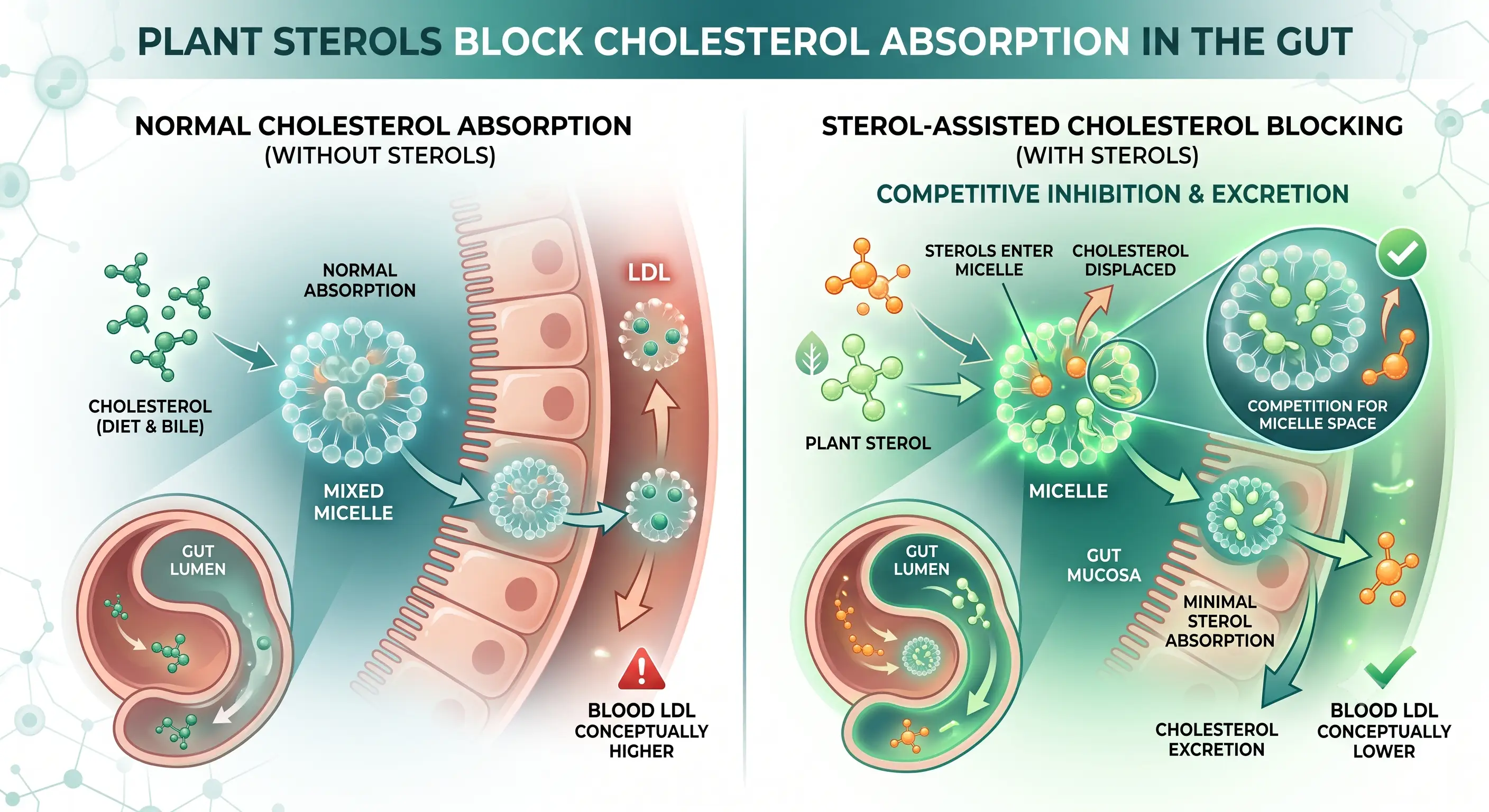
The mechanism is unusually clean and easy to describe. Cholesterol is absorbed from the small intestine only after being packaged into mixed micelles, and the space in those micelles is limited. Plant sterols compete for that space. Because they look enough like cholesterol to take the slot but are themselves absorbed very poorly — under 5% for sterols and around 0.5% for stanols — they displace cholesterol, which then passes through and is excreted rather than absorbed.
Two consequences follow. First, this affects both dietary cholesterol and the far larger quantity of cholesterol the body secretes into the gut in bile — which is why the effect does not depend on eating a high-cholesterol diet. Second, because plant sterols act entirely in the intestine and barely enter the bloodstream, they work through a completely different route from statins, which inhibit cholesterol synthesis in the liver.
2. A Deep Dive Into What Plant Sterols Do
LDL Cholesterol Reduction — Well Established
This is among the better-substantiated effects of any food ingredient. Dozens of randomized controlled trials and multiple meta-analyses have found a consistent, dose-dependent reduction in LDL cholesterol of roughly 8–10% at intakes near 2 g per day, typically achieved within two to three weeks of regular consumption. Total cholesterol falls correspondingly. HDL cholesterol and triglycerides are essentially unchanged, so the effect is specific to LDL.
The strength of this evidence is reflected in regulation: authorities in several jurisdictions permit specific health claims linking plant sterols and stanols with cholesterol reduction, and in the United States an authorized health claim connects them, as part of a diet low in saturated fat and cholesterol, with reduced risk of coronary heart disease[2]. Health claims of this kind are granted only after a formal evidence review, which is a meaningfully higher bar than the marketing claims attached to most supplements.
What Has Not Been Shown
Being straightforward about the limit: plant sterols reliably lower LDL, but no randomized trial has demonstrated that they reduce heart attacks, strokes, or cardiovascular deaths. Such a trial would need to be very large and very long, and it has not been done. The reasoning that lowering LDL should reduce events is well supported from statin research, but for plant sterols specifically the outcome evidence does not exist. This page therefore describes an effect on a risk marker, not a demonstrated reduction in disease.
Combination With Statin Therapy
Because plant sterols block absorption while statins inhibit synthesis, the two act on complementary steps. Studies have found that adding plant sterols to ongoing statin therapy produces a further LDL reduction — in some studies comparable to what would be gained by doubling the statin dose. This is a genuinely useful observation, but it is a conversation to have with the physician managing your lipids, not a reason to adjust medication yourself.
A Note on Sitosterolemia
There is a rare inherited condition, sitosterolemia, in which plant sterols are absorbed in large amounts rather than excreted, accumulating in blood and tissue and causing premature atherosclerosis. People with this diagnosis must avoid plant sterols. Its existence has also prompted ongoing scientific discussion about whether modestly raised plant sterol levels matter in the general population — a question that remains unresolved but has not changed regulatory positions.
What the Evidence Does and Doesn't Show
| Use | Strength of evidence | Notes |
|---|---|---|
| Lowering LDL cholesterol | Well established | ~8–10% at about 2 g/day; basis of authorized health claims |
| Added effect alongside statins | Moderate | Complementary mechanism; discuss with your physician |
| Reducing heart attacks or strokes | Not demonstrated | No outcome trials exist |
| HDL or triglycerides | No meaningful effect | Effect is LDL-specific |
| Use in sitosterolemia | Contraindicated | Rare inherited condition |
3. Shop Smart: How to Choose the Right Product
Step 1: Sterols or Stanols?
Both work, and head-to-head comparisons have generally found similar LDL reductions at equivalent doses. Stanols are absorbed even less than sterols, which is sometimes presented as a safety advantage — a reasonable argument, though not one backed by demonstrated differences in outcomes. Choose on the basis of format, cost, and what you will actually take consistently.
Step 2: Fortified Foods vs. Capsules
- Fortified foods (spreads, yoghurt drinks, milk, some cereals): the format used in most trials, and generally delivered in a fat-containing matrix that suits absorption dynamics. The trade-off is that they add calories and cost, and you have to keep buying the specific product.
- Capsules and tablets: more convenient and often cheaper per gram. Evidence suggests they work when taken with meals, though the trial base is smaller than for fortified foods.
Whichever you choose, check the actual sterol or stanol content per serving — many products supply well under 1 g, meaning you would need several servings daily to reach the studied dose. This is the single most common reason people see no effect.
Step 3: Split Doses Across Meals
Plant sterols work by competing with cholesterol inside the intestine, so they need to be present when food is being digested. Taking the full 2 g once daily on an empty stomach is close to pointless. Splitting the dose across two or three meals is more effective than a single dose, and taking it with the largest meals is more effective still.
Step 4: Third-Party Testing
Look for USP or NSF verification or a published certificate of analysis confirming sterol content. Products sold in Korea as health functional foods carry a regulated functional claim and specified daily intake, which is a useful additional check — see Section 4.
4. Regulatory Status and How to Read the Claim
Plant sterol preparations are recognised as functional food ingredients in the blood cholesterol improvement category in Korea, and comparable claims are permitted in the United States, the European Union, and elsewhere following formal evidence reviews[2][5].
The wording of these claims is worth reading carefully, because it is precise rather than promotional. Approved claims describe helping to improve or maintain blood cholesterol levels, and where a disease-risk claim is permitted it is conditioned on the product being consumed as part of a diet low in saturated fat and cholesterol. None of them authorises a statement that the product treats high cholesterol or prevents heart disease.
5. Everyday Habits: Food Sources and Routine
- Natural food sources: vegetable oils (especially corn, rapeseed, and sesame), nuts and seeds, legumes, avocados, and whole grains. A typical mixed diet supplies 200–400 mg daily; vegetarian diets tend toward the higher end.
- Timing: with meals, split across the day. This is not optional for effectiveness — it is how the mechanism works.
- Give it three weeks, then measure: the LDL effect is essentially complete within two to three weeks of consistent intake. Because you cannot feel cholesterol, a before-and-after lipid panel arranged with your doctor is the only way to know whether it worked for you.
- What it stacks with in the diet: soluble fibre from oats and psyllium, soy protein, and nuts each lower LDL through different routes. The combined dietary approach produces considerably more than plant sterols alone.
- The things that matter more: reducing saturated fat, stopping smoking, regular aerobic activity, and weight management affect cardiovascular risk through multiple pathways, not just LDL. Plant sterols are a useful addition to that, not a replacement for it.
6. The Perfect Match: Synergies and Incompatibilities
Nutrients rarely work in isolation, and plant sterols pair unusually well because their mechanism is so specific.
✅ Combinations That Work Well Together
- Soluble Dietary Fibre (psyllium, oat beta-glucan): Fibre binds bile acids and reduces their reabsorption, prompting the liver to draw on circulating cholesterol. Different route, additive effect, and both carry authorized health claims — arguably the best-evidenced combination in this whole category.
- Omega-3 Fatty Acids: Complementary rather than overlapping — omega-3's established lipid effect is on triglycerides, while plant sterols act on LDL.
- Soy protein and nuts: Both have modest independent LDL-lowering effects and combine well within a dietary pattern.
- Statin therapy (with your physician's knowledge): Absorption blockade plus synthesis inhibition is genuinely complementary, and adding plant sterols to statin therapy has produced further LDL reduction in studies.
❌ Requiring Care
- Fat-soluble vitamins and carotenoids: The most relevant practical caution. Because plant sterols interfere with micelle-dependent absorption, they modestly reduce uptake of beta-carotene and, to a lesser extent, vitamin E and other carotenoids. Eating plenty of vegetables and fruit — particularly a carotenoid-rich serving daily — offsets this, and it is the standard advice attached to these products.
- Ezetimibe: This medication also blocks intestinal cholesterol absorption, by a related route. Combining it with plant sterols should be discussed with your physician rather than assumed additive.
- Sitosterolemia: An absolute contraindication.
- Children, pregnancy, and breastfeeding: Fortified products are generally not recommended for young children or during pregnancy and breastfeeding, since cholesterol is needed for growth and development and the reduction offers no benefit in these groups.
7. Dosage, Timing, and Safety
Practical Approach
- Effective dose: about 2 g of plant sterols or stanols daily. Around 1.5–2.4 g is the range where the benefit plateaus.
- Little added benefit above 3 g/day, and higher intakes increase the carotenoid absorption issue without improving LDL further.
- Timing: with meals, split into two or three servings.
- Duration: the effect is present only while you are taking it. LDL returns toward baseline within weeks of stopping — this is an ongoing dietary measure, not a course of treatment.
Tolerability
Plant sterols have a good safety record and have been consumed in fortified foods at scale for over two decades. Reported side effects are uncommon and generally mild — occasional digestive upset or changes in stool consistency.
Most importantly: high cholesterol is a medical matter. Whether you need lipid-lowering treatment depends on your overall cardiovascular risk — blood pressure, smoking, diabetes, age, and family history — not on the LDL number alone. Do not use plant sterols as a reason to decline or discontinue prescribed therapy, and do not assume a normal-looking result means no action is needed. Discuss your lipid panel with a physician, and tell them what you are taking.
8. Frequently Asked Questions
Q. How much does it actually lower cholesterol?
A. Around 8–10% reduction in LDL at about 2 g per day, reached within two to three weeks. That is a real and reproducible effect, though smaller than what a statin achieves.
Q. Can I take it instead of a statin?
A. No. The LDL reduction is much smaller, and unlike statins there is no trial evidence that plant sterols reduce heart attacks or strokes. Whether you need a statin is a clinical decision based on your overall risk.
Q. Can I take it with a statin?
A. The mechanisms are complementary and studies show additional LDL reduction. Tell the physician managing your lipids, so your treatment and monitoring account for it.
Q. Why do I need to take it with meals?
A. It works by competing with cholesterol for space in intestinal micelles during digestion. Taken away from food, there is nothing to compete with.
Q. Can I just eat more vegetable oil and nuts?
A. A normal diet supplies only 200–400 mg daily against an effective dose near 2 g. Food sources are healthy but will not reach the studied intake on their own.
Q. Will it lower my triglycerides too?
A. No — the effect is specific to LDL. For triglycerides, omega-3, alcohol reduction, and weight management are the relevant levers.
9. Conclusion and Precautions
Plant sterols and stanols are one of the more solidly grounded options in this category: a simple and well-understood mechanism, a clear dose-response relationship, consistent randomized trial evidence for an 8–10% LDL reduction at around 2 g daily, and formal regulatory review behind their claims. They may help support healthy blood cholesterol levels as part of a diet low in saturated fat, particularly alongside soluble fibre. The honest limits are equally clear — no trial has shown that they reduce cardiovascular events, the effect lasts only while you take them, and they are a complement to medical management of cholesterol rather than an alternative to it.
⚠️ Precautions: The FDA has not evaluated plant sterol supplements for the treatment of any medical condition, and this article is not medical advice. Do not use if you have sitosterolemia. Fortified products are not recommended for young children or during pregnancy and breastfeeding. Plant sterols modestly reduce absorption of beta-carotene and other fat-soluble antioxidants — maintain a good intake of fruit and vegetables. High cholesterol requires medical assessment of your overall cardiovascular risk; consult a healthcare professional before use, particularly if you take lipid-lowering medication such as a statin or ezetimibe, and do not stop prescribed therapy.
10. Sources and References
- National Institutes of Health (NIH), ODS — Dietary supplements and cardiovascular health
https://ods.od.nih.gov - U.S. Food and Drug Administration — Authorized Health Claims: plant sterol/stanol esters and coronary heart disease
https://www.fda.gov - American Heart Association — Cholesterol management and dietary approaches
https://www.heart.org - Mayo Clinic — Phytosterols and cholesterol
https://www.mayoclinic.org - Ministry of Food and Drug Safety (MFDS, 식품의약품안전처) — Health Functional Food standards: blood cholesterol improvement functional ingredients
https://www.mfds.go.kr - Harvard T.H. Chan School of Public Health, The Nutrition Source — Cholesterol and dietary fats
https://www.hsph.harvard.edu - Cleveland Clinic — Plant sterols and stanols
https://my.clevelandclinic.org
© 2026 Healing-Finder. All rights reserved.