The Complete Cranberry Extract Guide: Urinary Tract Health, PACs, and Synergies
1. What Cranberry Extract Is and the Mechanism Behind It
Cranberry Extract is among the most widely studied botanicals for urinary system health. Urinary tract infections most often begin when bacteria — predominantly E. coli from the gut — enter the urethra and attach to the lining of the bladder, where they can multiply[1].
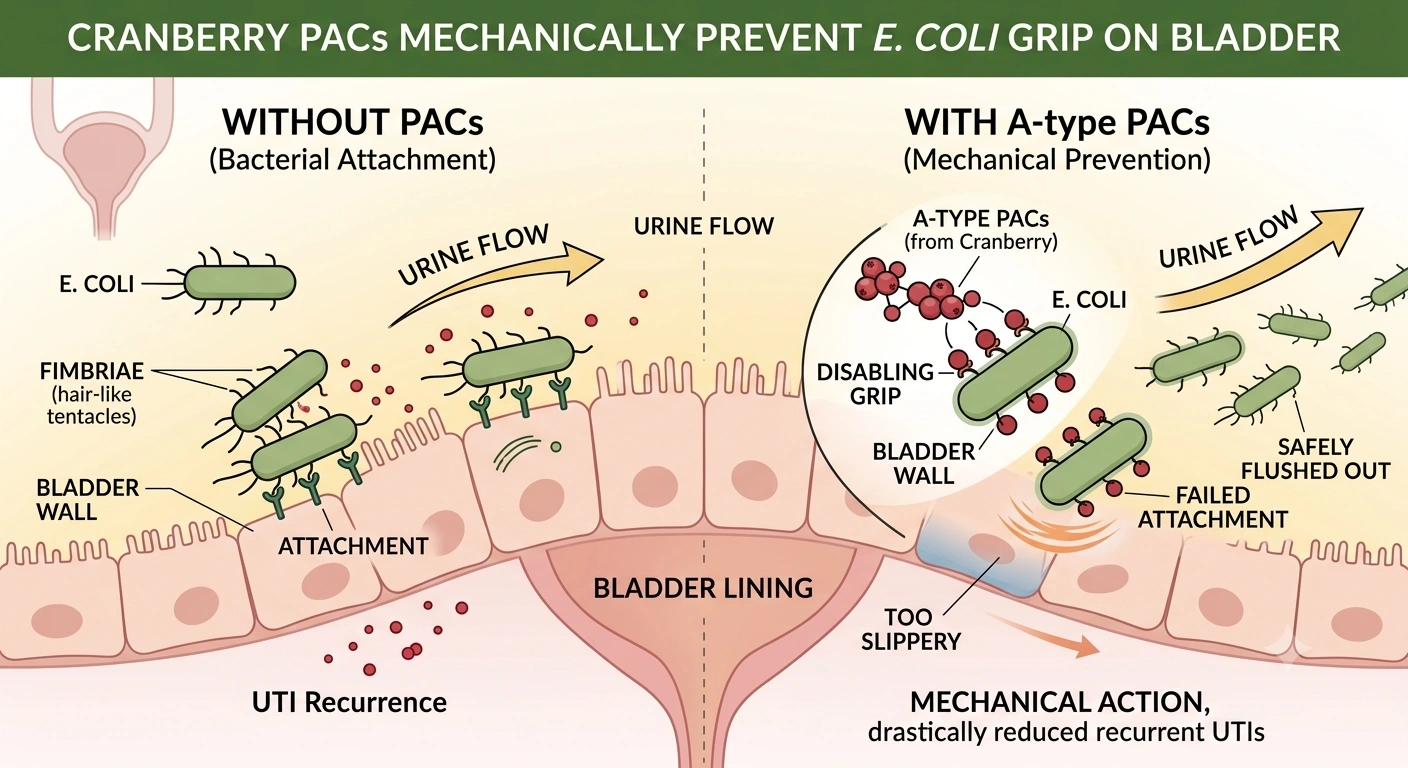
Unlike an antibiotic, cranberry does not kill bacteria. The proposed mechanism is mechanical interference with attachment: cranberry's A-type proanthocyanidins appear to bind to the fimbriae — the hair-like adhesion structures on E. coli — reducing their ability to grip the urinary lining, so that more bacteria are carried out during urination. An older idea, that cranberry works by acidifying urine, has largely been set aside; the adhesion mechanism is the one supported by current research.
2. A Deep Dive Into Cranberry's Studied Effects
Bacterial Adhesion and Recurrence
The active constituents are A-type proanthocyanidins (PACs), a class of polyphenol found in cranberry in an unusual structural configuration. Laboratory studies show they interfere with E. coli adhesion, and this is the most consistently described mechanism in the literature[2].
The clinical picture has genuinely improved over the past decade, and it is worth reporting accurately in both directions. Earlier systematic reviews concluded that cranberry products showed little benefit for preventing recurrent UTIs. More recent and larger evidence syntheses — with more trials and better standardisation of PAC content — have reported that cranberry products can reduce the risk of repeat symptomatic UTIs in certain groups, most notably women with recurrent infections and children. At the same time, national health bodies still describe the overall evidence as limited and inconsistent, and trials in older adults in residential care and in people using catheters have generally not shown benefit[1]. The honest summary is that cranberry appears to help some populations and not others, and product standardisation is a large part of why studies disagree.
Urine Odour and Comfort
Cranberry preparations are sometimes used with the aim of reducing urinary odour in the context of incontinence care. This use is based largely on practical experience rather than controlled trials, so it is best described as a common practice rather than a demonstrated effect.
Antioxidant and Cardiometabolic Research
Cranberry is rich in polyphenols, and studies have examined effects on blood vessel function, blood lipids, and inflammatory markers, with modest and preliminary results. Cranberry has also been investigated in relation to H. pylori adhesion in the stomach. These are research directions, not established uses, and do not support claims about kidney protection or general detoxification.
What the Evidence Does and Doesn't Show
| Use | Strength of evidence | Notes |
|---|---|---|
| Reducing recurrent UTIs in women with a history of them | Moderate but debated | Recent syntheses more favourable; standardisation matters |
| Reducing recurrent UTIs in children | Preliminary / moderate | Use only under paediatric guidance |
| Prevention in older adults in care settings or with catheters | Generally not supported | Trials have not shown benefit |
| Treating an active UTI | Not supported — do not use for this | Requires medical assessment |
| Kidney protection, detox, urinary odour | Insufficient | Marketing claims outrun the data |
3. Shop Smart: How to Choose the Right Cranberry Extract
Step 1: PAC Content Is the Number That Matters
Many of the trials reporting benefit used a daily dose in the region of 36 mg of A-type PACs, and this figure has become a common industry reference point. It is a reasonable benchmark rather than a precise threshold — the evidence does not establish an exact minimum effective dose.
Crucially, the label should state the PAC content, ideally measured by a recognised method such as BL-DMAC, rather than only the total milligrams of cranberry powder or a "concentrate ratio" such as 50:1. Independent analyses have repeatedly found wide variation in actual PAC content between products carrying similar label claims, and this inconsistency is one of the main reasons clinical trials have produced conflicting results.
Step 2: Whole Fruit vs. Juice Powder
Extracts using the whole cranberry — juice, skin, flesh, and seeds — capture a broader range of phytochemicals, and the skin is where much of the PAC content sits. Juice-only powders may contain considerably fewer PACs for the same weight.
Step 3: Skip the Sugary Juice
Commercial cranberry juice cocktail is heavily sweetened and diluted, and would require large volumes to approach studied PAC doses while delivering substantial sugar. Unsweetened pure cranberry juice is a reasonable food choice, but a standardised extract is the more practical route to the researched amounts.
Step 4: Third-Party Testing
Given the PAC labelling problem, verification (USP, NSF) or a published certificate of analysis stating the PAC assay method is genuinely useful here rather than a formality.
4. Everyday Habits: The Basics That Do Most of the Work
- Fluid intake: Drinking enough water increases urine volume and frequency, which physically flushes bacteria from the bladder. A randomised trial in women with recurrent UTIs found that increasing daily water intake reduced recurrences — making hydration one of the better-supported preventive measures available. Aim for pale-coloured urine; exact volumes depend on body size, climate, and activity, and people with kidney or heart conditions should follow their physician's fluid guidance.
- Don't hold urine for long periods, and empty the bladder after sexual activity.
- Wipe front to back, and avoid douches and irritating feminine hygiene products.
- Discuss recurrent infections with a clinician. Options such as vaginal estrogen after menopause, methenamine, or preventive antibiotic strategies have stronger evidence than any supplement, and recurrent UTIs sometimes signal something that needs investigation.
- Moderate added sugar as part of a generally sensible diet — though the popular idea that dietary sugar directly "feeds" bacteria in urine is an oversimplification.
5. The Perfect Match: Synergies and Incompatibilities
Nutrients rarely work in isolation. One interaction here is clinically important.
✅ Commonly Combined
- D-Mannose: A frequently paired option. D-Mannose is a simple sugar thought to act as a decoy that E. coli binds to instead of the bladder wall, so it works through a complementary anti-adhesion route. Evidence is limited and mostly from small studies, and no combination offers guaranteed protection against UTIs.
- Probiotics (Lactobacillus strains): Studied for supporting a healthy vaginal and urinary microbiome, which is relevant because vaginal flora influence UTI risk. Evidence is mixed and strain-specific.
- Vitamin C: Often included in urinary formulas. Its role here is not well established, and very high doses can increase oxalate excretion — see the kidney stone note below.
❌ Requiring Caution
- Warfarin: Cranberry has been reported to interact with warfarin, with case reports of raised INR and bleeding. The evidence is not entirely consistent, but the potential consequence is serious enough that concentrated cranberry products should only be used with physician awareness and INR monitoring.
- History of kidney stones: Cranberry contains oxalate, and high intakes may increase urinary oxalate. People prone to calcium oxalate stones should check with their physician.
- Aspirin sensitivity or allergy: Cranberry contains salicylates; avoid high doses if you are sensitive to aspirin.
- Certain medications cleared by the kidneys or metabolised by CYP enzymes: Interactions have been suggested but are not well characterised. If you take multiple prescriptions, ask a pharmacist.
- Diabetes: Choose an unsweetened extract rather than juice products, and account for carbohydrate content.
6. Dosage, Timing, and Safety
Typical Ranges Used in Research
- Standardised extract: Commonly around 36 mg of A-type PACs daily, sometimes split into two doses.
- Unsweetened juice: Trials have used roughly 240–300 ml daily, which supplies considerable volume and sugar compared with an extract.
- Timing: Consistency matters more than timing; some prefer an evening dose since urine sits in the bladder longer overnight.
- Duration: Prevention studies typically run 6 to 12 months. This is a long-term preventive approach, not something to take reactively.
Tolerability
Cranberry is generally well tolerated. Reported effects are mostly digestive — stomach upset or loose stools, more likely with large juice volumes or high extract doses.
7. Frequently Asked Questions
Q. Can cranberry cure a UTI I already have?
A. No. The mechanism is about preventing bacteria from attaching, not clearing an established infection. An active UTI needs medical assessment, and delaying treatment risks a kidney infection.
Q. Juice or capsules?
A. A standardised extract stating its PAC content is the more practical way to reach the studied doses. Sweetened cranberry cocktail is mostly sugar; unsweetened juice is a reasonable food but requires large volumes.
Q. Why do studies disagree so much?
A. Largely because "cranberry" has meant very different things across trials — juice, powder, and extracts with wildly varying PAC content, in different populations. That is also why checking the PAC number on the label matters.
Q. How long should I take it?
A. Prevention trials generally ran 6 to 12 months. If you are considering long-term use for recurrent infections, that is worth planning with a clinician who can also discuss better-evidenced options.
Q. Is it safe in pregnancy?
A. Cranberry as a food is generally considered fine, but concentrated supplements have limited safety data in pregnancy — and UTIs during pregnancy specifically require prompt medical treatment. Ask your obstetric provider.
8. Conclusion and Precautions
Cranberry extract has a well-characterised mechanism, a good safety record, and research that has grown more favourable for one specific use — reducing repeat infections in women with a history of recurrent UTIs — while remaining unsupportive for others, such as prevention in catheter users or care-home residents. Standardised to a meaningful PAC content, it is a reasonable non-antibiotic option that some people use as part of a broader routine to support urinary tract health, alongside the hydration and hygiene measures that carry at least as much weight. What it is not, under any framing, is a treatment for an infection you already have.
⚠️ Precautions: The FDA has not evaluated cranberry extract for the treatment or prevention of any medical condition, and this article is not medical advice. Cranberry is not a substitute for antibiotics. If you have an active UTI — particularly with fever, back or side pain, or blood in the urine — seek medical care promptly to reduce the risk of a kidney infection. Consult a healthcare professional before using concentrated cranberry products if you take warfarin, have a history of kidney stones, are aspirin-sensitive, are pregnant or breastfeeding, or are considering use in a child.
9. Sources and References
- NIH National Center for Complementary and Integrative Health (NCCIH) — Cranberry
https://www.nccih.nih.gov/health/cranberry - Mayo Clinic — Urinary tract infection (UTI): Prevention
https://www.mayoclinic.org - Cleveland Clinic — Do Cranberries Help With UTIs?
https://my.clevelandclinic.org - American Urological Association (AUA) — Recurrent Uncomplicated UTI Guideline
https://www.auanet.org - Harvard Health Publishing — Cranberry juice and UTIs
https://www.health.harvard.edu - Cochrane Library — Cranberries for preventing urinary tract infections (systematic review)
https://www.cochranelibrary.com
© 2026 Healing-Finder. All rights reserved.