The Complete Creatine Guide: Muscle Strength, ATP Production, and Synergies
1. What Creatine Is and How It Works
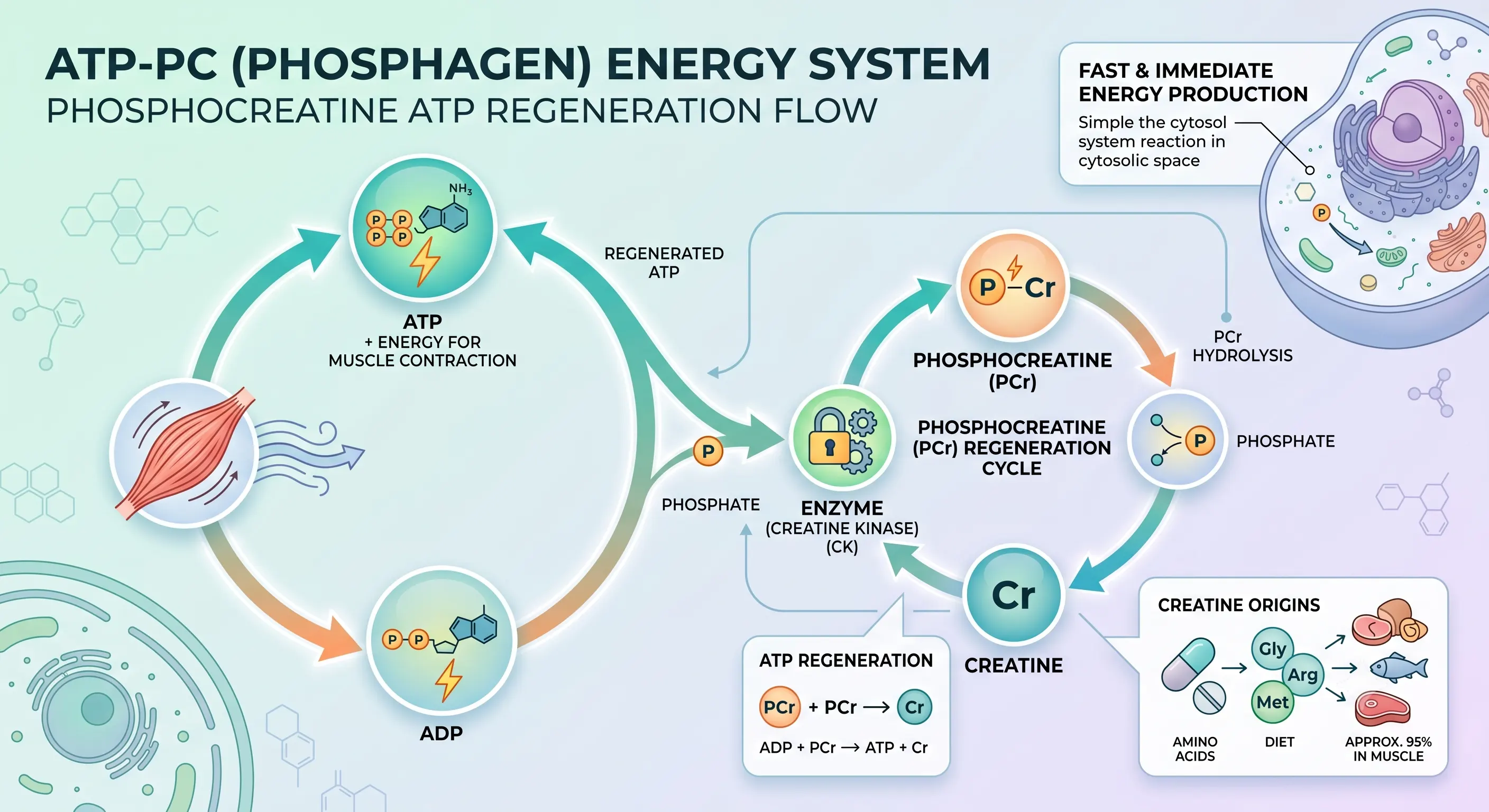
Creatine is a compound the body produces from the amino acids glycine, arginine, and methionine, and also obtains from meat and fish. Roughly 95% of the body's creatine is stored in skeletal muscle, mostly as phosphocreatine[1]. It is one of the most extensively researched supplements in sports nutrition, with hundreds of published human trials.
The mechanism is straightforward. Muscle contraction runs on ATP, and during maximal effort the available ATP is depleted within seconds. Phosphocreatine donates a phosphate group to rapidly regenerate ATP, extending how long you can sustain high-intensity output. Supplementation raises muscle phosphocreatine stores — typically by around 20% in people starting from a lower baseline — which is why the practical effect shows up in the last few reps of a set or the final metres of a sprint rather than in endurance events.
2. A Deep Dive Into Creatine's Key Benefits
Strength and Power Output
By increasing muscle phosphocreatine, creatine supports repeated high-intensity efforts. Across the literature, supplementation alongside heavy resistance training has been associated with greater gains in maximal strength, power output, and sprint performance than training alone[4]. Effects diminish as exercise duration lengthens, so the benefit is concentrated in short, intense efforts rather than endurance work.
Muscle Mass and Cell Volumisation
Creatine draws water into muscle cells. Part of the early increase in scale weight and muscle fullness reflects this intracellular water rather than new tissue. Researchers have also proposed that cell swelling itself acts as an anabolic signal and that creatine influences satellite cell activity and myogenic signalling; alongside the simpler explanation that it allows more training volume, this is why longer-term studies show genuine increases in lean mass with training[2].
Recovery and Training Tolerance
Some studies report reduced markers of muscle damage and improved glycogen replenishment with creatine, which may support tolerance of higher training loads. Findings are less consistent than for strength.
Cognition and Brain Creatine
The brain also uses phosphocreatine, and creatine supplementation has been shown to raise brain creatine levels modestly. Studies suggest possible cognitive benefits under conditions of metabolic stress — sleep deprivation in particular — and in vegetarians, whose baseline levels are lower. In well-rested omnivores the effects appear small or absent. This is a legitimately interesting research area, not an established use.
Older Adults and Muscle Preservation
Creatine combined with resistance training has been studied in older adults for muscle mass and functional strength, with generally positive results. It is one of the more promising applications outside athletic performance, and should be combined with training rather than used alone.
What the Evidence Does and Doesn't Show
| Use | Strength of evidence | Notes |
|---|---|---|
| Strength and power with resistance training | Well established | The most consistently supported effect |
| Lean mass gains with training | Well established | Part water, part genuine tissue over time |
| Muscle preservation in older adults (with training) | Promising | Training is required |
| Cognition under sleep deprivation / in vegetarians | Preliminary | Small effects; not established in rested omnivores |
| Endurance performance | Limited | Effects diminish as effort lengthens |
| Fat loss on its own | Not supported | Creatine does not burn fat |
3. Shop Smart: How to Choose the Right Creatine
Step 1: Creatine Monohydrate
Creatine Monohydrate is the form used in the overwhelming majority of published research and remains the most cost-effective option. Alternatives marketed as superior — ethyl ester, hydrochloride (HCl), buffered forms, liquid creatine — have not been shown in comparative studies to outperform monohydrate, and generally cost more. Sports nutrition position statements continue to identify monohydrate as the reference form[1]. Creapure is a well-known branded monohydrate with published purity specifications; it is a reasonable choice rather than a requirement.
Step 2: Micronised Powder
Micronised monohydrate has been milled to a smaller particle size, which improves how it disperses in water and can reduce the gritty texture and occasional stomach discomfort associated with coarser powders. It is the same compound, simply easier to take.
Step 3: Third-Party Testing — Essential for Competitive Athletes
Creatine itself is permitted in sport, but contamination of sports supplements with banned substances is a documented risk. If you compete under anti-doping rules, use a product batch-tested under a programme such as Informed Sport or NSF Certified for Sport. For everyone else, USP or NSF verification is a sensible baseline.
Step 4: Skip the Proprietary Blends
Plain monohydrate at 3–5 g is inexpensive. Multi-ingredient "creatine matrix" products often contain less actual creatine than the label implies, at several times the price.
4. Everyday Habits: The Saturation Approach
- Daily consistency, not timing: Creatine works by saturating muscle stores over time, so what matters is taking 3–5 g every day, including rest days. Whether you take it before or after training makes little practical difference; post-workout with a meal is a reasonable default.
- Loading is optional: A loading phase (around 20 g daily split into four doses for 5–7 days) saturates stores faster, reaching full levels in about a week. Taking 3–5 g daily without loading reaches the same saturation in roughly three to four weeks and is less likely to cause digestive upset or a sudden weight jump. Neither approach produces a better end result.
- Hydration: Because creatine draws water into muscle, maintaining good fluid intake is sensible — particularly when training in heat. The older claim that creatine causes dehydration or cramping has not been supported by controlled research; if anything, studies have found no increase in cramp incidence.
- Dietary sources: Red meat and fish supply roughly 1–2 g of creatine per pound of raw weight, and cooking degrades some of it. Reaching supplemental amounts through food alone means eating a large volume of meat, which is why vegetarians and vegans typically have lower baseline stores and often see the clearest response.
- Mix it simply: Water or juice is fine. Creatine degrades slowly in liquid, so drink it rather than leaving it mixed for hours.
5. The Perfect Match: Synergies and Incompatibilities
Nutrients rarely work in isolation, though creatine is notably self-sufficient compared with most supplements.
✅ Combinations That Work Well Together
- Carbohydrate and protein: Taking creatine with a meal containing carbohydrate and protein raises insulin, which supports creatine transport into muscle. The effect on final saturation is modest, so this is a convenience optimisation rather than a requirement.
- Beta-Alanine: A complementary pairing across effort durations — creatine supports very short maximal efforts, while beta-alanine buffers acidity in the roughly 60–240 second range. The two address different limiting factors.
- Resistance training: Not a supplement, but the essential partner. Creatine without progressive training produces little of what people are hoping for.
- Adequate total protein: Around 1.6–2.2 g per kg of body weight daily for those training for muscle; creatine does not compensate for insufficient protein.
❌ Points to Watch
- Very high-dose caffeine: An older study suggested caffeine might blunt creatine's ergogenic effect, and the idea has been widely repeated. Later research has not consistently confirmed it, and a normal pre-workout coffee is not a problem. Very high stimulant intakes are worth moderating for other reasons — sleep and cardiovascular load — rather than because of creatine.
- Nephrotoxic medication or reduced kidney function: Creatine appears safe for healthy kidneys, but anyone with existing kidney disease, or taking medication that stresses the kidneys (including long-term NSAIDs at high doses), should consult a physician first.
- Diuretics: Combining with diuretics may affect fluid balance; discuss with your doctor.
- Blood test note: Creatine supplementation can slightly raise serum creatinine — a marker used to estimate kidney function — without indicating kidney damage. Tell your doctor you take creatine before kidney function testing, so the result is interpreted correctly.
6. Dosage, Timing, and Safety
Practical Protocol
- Maintenance: 3–5 g daily, every day. Larger individuals may use slightly more.
- Optional loading: ~20 g daily in four split doses for 5–7 days, then maintenance.
- Timing: Any time of day, ideally with food. Consistency is the only variable that clearly matters.
- Cycling: Not necessary. There is no evidence that continuous use downregulates the body's response in a way that requires breaks.
Tolerability and Common Effects
- Temporary weight increase of roughly 1–2 kg in the first weeks, largely intracellular water. This is expected and not fat gain, but it is worth knowing if you compete in a weight category.
- Digestive upset occasionally, most often with large single doses during loading. Splitting doses or using micronised powder usually resolves it.
- Bloating is usually reported during loading rather than on a maintenance dose.
7. Frequently Asked Questions
Q. Do I need to load?
A. No. Loading just gets you to saturation in about a week instead of three to four. The final result is the same, and skipping it reduces digestive side effects.
Q. Is creatine bad for the kidneys?
A. In healthy people, long-term studies at standard doses have not shown kidney harm. If you have existing kidney disease, that is a different situation and warrants medical advice before starting.
Q. Will it make me look bloated or puffy?
A. The water is drawn into muscle cells rather than under the skin, so the usual visible effect is fuller-looking muscle. Some people notice mild bloating during a loading phase; a steady 3–5 g dose avoids this.
Q. Does creatine cause hair loss?
A. There is no good evidence that it does. The concern originates from one small study that has not been replicated and did not measure hair loss.
Q. Is it useful without lifting weights?
A. Much less so. Creatine's value comes from enabling harder training; on its own, the main effect is water retention in muscle. The exception is areas like brain creatine, where research is still preliminary.
Q. Should women take creatine?
A. The mechanism is the same regardless of sex, and studies in women report benefits for strength and lean mass with training. Dosing guidance does not differ meaningfully.
8. Conclusion and Precautions
Creatine monohydrate has the deepest research base of any supplement in this category, a simple and well-understood mechanism, decades of safety data in healthy adults, and a very low cost. Taken consistently at 3–5 g daily alongside resistance training, it is a well-supported option for supporting muscle strength, power, and lean mass — and increasingly of interest for older adults maintaining muscle function. It is a genuine training aid rather than a shortcut: the training still does the work, individual response varies, and it is not a fat-loss product.
⚠️ Precautions: The FDA has not evaluated creatine for the treatment of any medical condition, and this article is not medical advice. Expect a temporary weight increase of roughly 1–2 kg from intracellular water retention. Creatine can modestly raise serum creatinine on blood tests without indicating kidney damage — tell your doctor you take it. Individuals with kidney or liver disease should consult a physician before starting, and creatine is not recommended during pregnancy or breastfeeding, or for children and adolescents without professional guidance. Competitive athletes should choose batch-tested products.
9. Sources and References
- International Society of Sports Nutrition (ISSN) — Position Stand: Creatine Supplementation and Exercise
https://www.sportsnutritionsociety.org - Cooper R, Naclerio F, Allgrove J, Jimenez A — Creatine supplementation with specific view to exercise/sports performance: an update. J Int Soc Sports Nutr. 2012;9:33 (PubMed)
https://pubmed.ncbi.nlm.nih.gov/22817979/ - Mayo Clinic — Creatine: Benefits and Safety
https://www.mayoclinic.org - NIH Office of Dietary Supplements — Dietary Supplements for Exercise and Athletic Performance
https://ods.od.nih.gov/factsheets/ExerciseAndAthleticPerformance-HealthProfessional/ - Cleveland Clinic — Creatine Supplements
https://my.clevelandclinic.org - Harvard Health Publishing — Sports Supplements
https://www.health.harvard.edu
© 2026 Healing-Finder. All rights reserved.